
磁共振成像辅助放射治疗计划的剂量学效应:高危靶区的剂量优化及放射生物学剂量分析评估
Dosimetric Effects of Magnetic Resonance Imaging-assisted Radiotherapy Planning: Dose Optimization for Target Volumes at High Risk and Analytic Radiobiological Dose Evaluation.
作者信息
Park Ji-Yeon, Suh Tae Suk, Lee Jeong-Woo, Ahn Kook-Jin, Park Hae-Jin, Choe Bo-Young, Hong Semie
机构信息
Department of Radiation Oncology, University of Florida, FL, USA.
Department of Biomedical Engineering, College of Medicine, The Catholic University of Korea, Seoul, Korea. ; Research Institute of Biomedical Engineering, College of Medicine, The Catholic University of Korea, Seoul, Korea.
出版信息
J Korean Med Sci. 2015 Oct;30(10):1522-30. doi: 10.3346/jkms.2015.30.10.1522. Epub 2015 Sep 12.
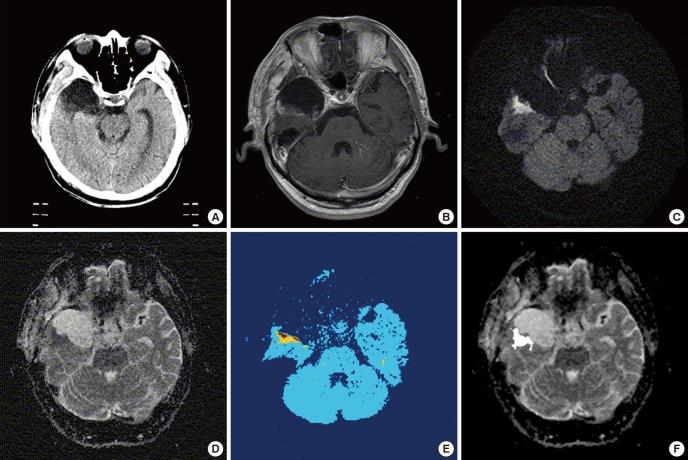
Based on the assumption that apparent diffusion coefficients (ADCs) define high-risk clinical target volume (aCTVHR) in high-grade glioma in a cellularity-dependent manner, the dosimetric effects of aCTVHR-targeted dose optimization were evaluated in two intensity-modulated radiation therapy (IMRT) plans. Diffusion-weighted magnetic resonance (MR) images and ADC maps were analyzed qualitatively and quantitatively to determine aCTVHR in a high-grade glioma with high cellularity. After confirming tumor malignancy using the average and minimum ADCs and ADC ratios, the aCTVHR with double- or triple-restricted water diffusion was defined on computed tomography images through image registration. Doses to the aCTVHR and CTV defined on T1-weighted MR images were optimized using a simultaneous integrated boost technique. The dosimetric benefits for CTVs and organs at risk (OARs) were compared using dose volume histograms and various biophysical indices in an ADC map-based IMRT (IMRTADC) plan and a conventional IMRT (IMRTconv) plan. The IMRTADC plan improved dose conformity up to 15 times, compared to the IMRTconv plan. It reduced the equivalent uniform doses in the visual system and brain stem by more than 10% and 16%, respectively. The ADC-based target differentiation and dose optimization may facilitate conformal dose distribution to the aCTVHR and OAR sparing in an IMRT plan.
基于表观扩散系数(ADC)以细胞密度依赖方式定义高级别胶质瘤的高风险临床靶区(aCTVHR)这一假设,在两个调强放射治疗(IMRT)计划中评估了以aCTVHR为靶区的剂量优化的剂量学效果。对扩散加权磁共振(MR)图像和ADC图进行定性和定量分析,以确定细胞密度高的高级别胶质瘤中的aCTVHR。在使用平均和最小ADC以及ADC比值确认肿瘤恶性程度后,通过图像配准在计算机断层扫描图像上定义具有双重或三重受限水扩散的aCTVHR。使用同步整合加量技术优化在T1加权MR图像上定义的aCTVHR和临床靶区(CTV)的剂量。在基于ADC图的IMRT(IMRTADC)计划和传统IMRT(IMRTconv)计划中,使用剂量体积直方图和各种生物物理指标比较CTV和危及器官(OAR)的剂量学益处。与IMRTconv计划相比,IMRTADC计划将剂量适形性提高了15倍。它分别将视觉系统和脑干中的等效均匀剂量降低了10%以上和16%以上。基于ADC的靶区分化和剂量优化可能有助于在IMRT计划中实现向aCTVHR的适形剂量分布和OAR保护。



 Zotero 插件