D'Souza Monisha, Kulkarni Vaman, Bhaskaran Unnikrishnan, Ahmed Humam, Naimish Hegde, Prakash Anjali, S Tabreez, Dahiya Bhanu, Thapar Rekha, Mithra Prasanna, Kumar Nithin, Holla Ramesh, Bb Darshan, Kumar Avinash
Department of Community Medicine, Kasturba Medical College, Manipal University , Mangalore, India.
J Public Health Res. 2015 Jul 30;4(2):450. doi: 10.4081/jphr.2015.450. eCollection 2015 Jul 16.
The burden of diabetes mellitus (DM) is on the rise especially in developing countries like India. Due to its chronic nature DM tends to cause many debilitating complications and diabetic peripheral neuropathy (DPN) is one of them. The aim of this study is to determine the prevalence of DPN among patients attending a tertiary care hospital and to identify the determinants associated with it.
A cross sectional study was conducted in Government Wenlock Hospital, Mangalore (India), during January-February 2014. A total of 208 patients with >5 year duration of DM were asked to respond to the patient history version of Michigan Neuropathy Screening Instrument (MNSI) and examinations were conducted after obtaining consent from them. The statistical analysis was done in terms of descriptive statistics and association between variables was tested using logistic regression test.
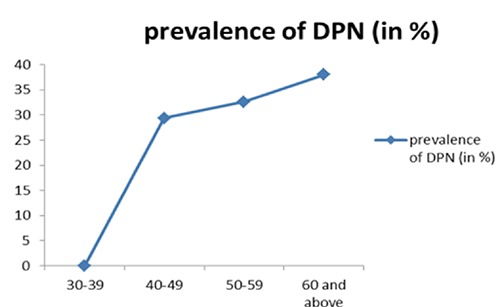
The prevalence of DPN using the MNSI history version and MNSI examination were found to be 18.3% and 32.2% respectively. The major determinants associated with DPN were found to be male gender (OR: 2.7, CI: 1.4-5.1, P=0.001), smoking (OR: 5.8, CI: 1.9-17.3, P=0.001) and age >40 years (OR: 2.7, CI: 1.2-5.8, P=0.011).
The burden of undetected DPN was found to be higher among diabetics, with an especially higher prevalence among males, smokers and those with long standing diabetes mellitus. Interventions in the form of early detection through routine screening, smoking cessation and regular follow up examinations would go a long way in reducing the burden of disability among diabetics and improve their quality of life significantly. Significance for public healthThe findings of the current research hold importance since diabetes is one of the leading causes of morbidity and mortality across the world. Due to its chronic nature and effects of hyperglycaemia, diabetes tends to be associated with many comorbidities, like peripheral neuropathy, nephropathy, retinopathy etc. The presence of diabetic peripheral neuropathy leads to a reduced quality of life among diabetic patients due to the trauma and consequent gangrenes andamputation. The concept of secondary prevention can be applied to the prevention of diabetic peripheral neuropathy using easy to apply screening tools and thus help in early diagnosis and treatment to reduce the burden of this debilitating illness.
糖尿病(DM)的负担正在上升,尤其是在印度等发展中国家。由于其慢性性质,糖尿病往往会导致许多使人衰弱的并发症,糖尿病周围神经病变(DPN)就是其中之一。本研究的目的是确定在一家三级护理医院就诊的患者中DPN的患病率,并确定与之相关的决定因素。
2014年1月至2月期间,在印度芒格洛尔的政府温洛克医院进行了一项横断面研究。共有208名糖尿病病程超过5年的患者被要求对密歇根神经病变筛查工具(MNSI)的患者病史版本做出回应,并在获得他们的同意后进行检查。统计分析采用描述性统计方法进行,变量之间的关联采用逻辑回归检验。
使用MNSI病史版本和MNSI检查得出的DPN患病率分别为18.3%和32.2%。发现与DPN相关的主要决定因素为男性(比值比:2.7,可信区间:1.4 - 5.1,P = 0.001)、吸烟(比值比:5.8,可信区间:1.9 - 17.3,P = 0.001)和年龄>40岁(比值比:2.7,可信区间:1.2 - 5.8,P = 0.011)。
未被发现的DPN在糖尿病患者中的负担较高,在男性、吸烟者和糖尿病病程较长者中患病率尤其高。通过常规筛查进行早期检测、戒烟和定期随访检查等干预措施,对于减轻糖尿病患者的残疾负担和显著提高他们的生活质量大有帮助。对公共卫生的意义本研究结果具有重要意义,因为糖尿病是全球发病和死亡的主要原因之一。由于其慢性性质和高血糖的影响,糖尿病往往与许多合并症相关,如周围神经病变、肾病、视网膜病变等。糖尿病周围神经病变的存在会导致糖尿病患者生活质量下降,因为会出现创伤以及随之而来的坏疽和截肢。二级预防的概念可以应用于使用易于应用的筛查工具预防糖尿病周围神经病变,从而有助于早期诊断和治疗,以减轻这种使人衰弱疾病的负担。