Nagaoka Natsuko, Jonas Jost B, Morohoshi Kei, Moriyama Muka, Shimada Noriaki, Yoshida Takeshi, Ohno-Matsui Kyoko
Department of Ophthalmology and Visual Science, Tokyo Medical and Dental University, 1-5-45 Yushima, Bunkyo-ku, Tokyo, 113-8519, Japan.
Department of Ophthalmology, Medical Faculty Mannheim of the Ruprecht-Karls University of Heidelberg, Mannheim, 68167, Germany.
PLoS One. 2015 Oct 1;10(10):e0138825. doi: 10.1371/journal.pone.0138825. eCollection 2015.
To assess the prevalence of glaucoma in patients with high myopia defined as myopic refractive error of >-8 diopters or axial length ≥26.5 mm.
The hospital-based observational study included 172 patients (336 eyes) with a mean age of 61.9±12.3 years and mean axial length of 30.1±2.3 mm (range: 24.7-39.1mm). Glaucomatous-type optic discs were defined by glaucomatous optic disc appearance. Glaucoma was defined by glaucomatous optic disc appearance and glaucomatous Goldmann visual field defects not corresponding with myopic macular changes.
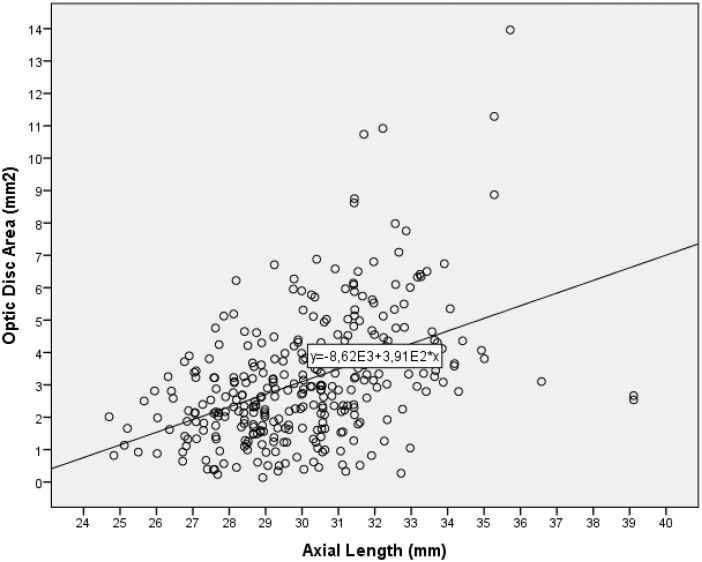
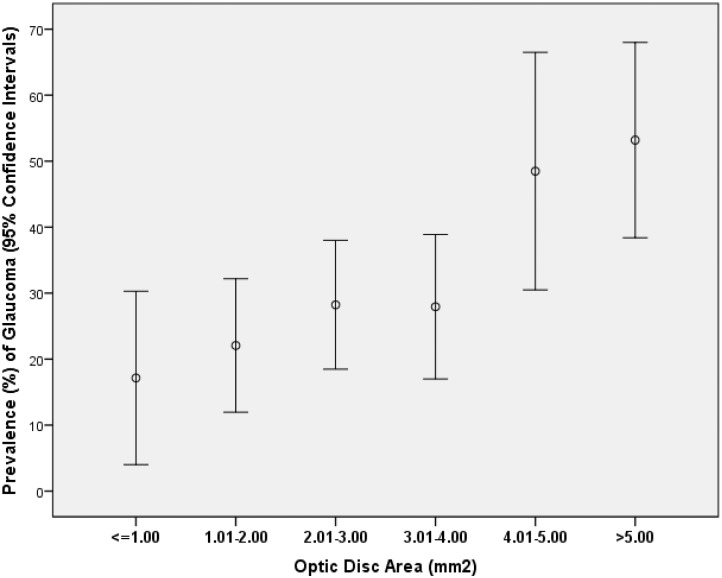
Larger disc area (mean: 3.18±1.94 mm2) was associated with longer axial length (P<0.001; standardized correlation coefficient: 0.45). Glaucoma was detected in 94 (28%; 95% Confidence intervals: 23%, 33%) eyes. In multivariate analysis, glaucoma prevalence was 3.2 times higher (P<0.001) in megalodiscs (>3.79 mm2) than in normal-sized discs or small discs (<1.51 mm2) after adjusting for older age. Axial length was not significantly (P = 0.38) associated with glaucoma prevalence in that model. Glaucoma prevalence increased by a factor of 1.39 for each increase in optic disc area by one mm2. Again, axial length was not significantly (P = 0.38) associated with glaucoma prevalence when added to this multivariate model.
Within highly myopic individuals, glaucoma prevalence increased with larger optic disc size beyond a disc area of 3.8 mm2. Highly myopic megalodiscs as compared to normal sized discs or small discs had a 3.2 times higher risk for glaucomatous optic nerve neuropathy. The increased glaucoma prevalence in axial high myopia was primarily associated with axial myopia associated disc enlargement and not with axial elongation itself.
评估高度近视患者(定义为近视屈光不正>-8 屈光度或眼轴长度≥26.5 毫米)青光眼的患病率。
这项基于医院的观察性研究纳入了 172 例患者(336 只眼),平均年龄为 61.9±12.3 岁,平均眼轴长度为 30.1±2.3 毫米(范围:24.7 - 39.1 毫米)。青光眼性视盘由青光眼性视盘外观定义。青光眼由青光眼性视盘外观和与近视性黄斑病变不相符的青光眼性戈德曼视野缺损定义。
较大的视盘面积(平均:3.18±1.94 平方毫米)与较长的眼轴长度相关(P<0.001;标准化相关系数:0.45)。在 94 只眼(28%;95%置信区间:23%,33%)中检测到青光眼。在多变量分析中,在调整年龄较大因素后,大视盘(>3.79 平方毫米)的青光眼患病率比正常大小视盘或小视盘(<1.51 平方毫米)高 3.2 倍(P<0.001)。在该模型中,眼轴长度与青光眼患病率无显著相关性(P = 0.38)。视盘面积每增加 1 平方毫米,青光眼患病率增加 1.39 倍。同样,当将眼轴长度添加到该多变量模型中时,其与青光眼患病率无显著相关性(P = 0.38)。
在高度近视个体中,当视盘面积超过 3.8 平方毫米时,青光眼患病率随视盘尺寸增大而增加。与正常大小视盘或小视盘相比,高度近视大视盘发生青光眼性视神经病变的风险高 3.2 倍。轴性高度近视中青光眼患病率增加主要与轴性近视相关的视盘扩大有关,而非与眼轴延长本身有关。