Romero María del Mar, Sabater David, Fernández-López José Antonio, Remesar Xavier, Alemany Marià
Department of Nutrition and Food Science, Faculty of Biology, University of Barcelona, Av.Diagonal 643, 08028, Barcelona, Spain; Institute of Biomedicine, University of Barcelona, Barcelona, Spain; CIBER Obesity and Nutrition, Barcelona, Spain.
Department of Nutrition and Food Science, Faculty of Biology, University of Barcelona, Av.Diagonal 643, 08028, Barcelona, Spain.
PLoS One. 2015 Oct 1;10(10):e0139502. doi: 10.1371/journal.pone.0139502. eCollection 2015.
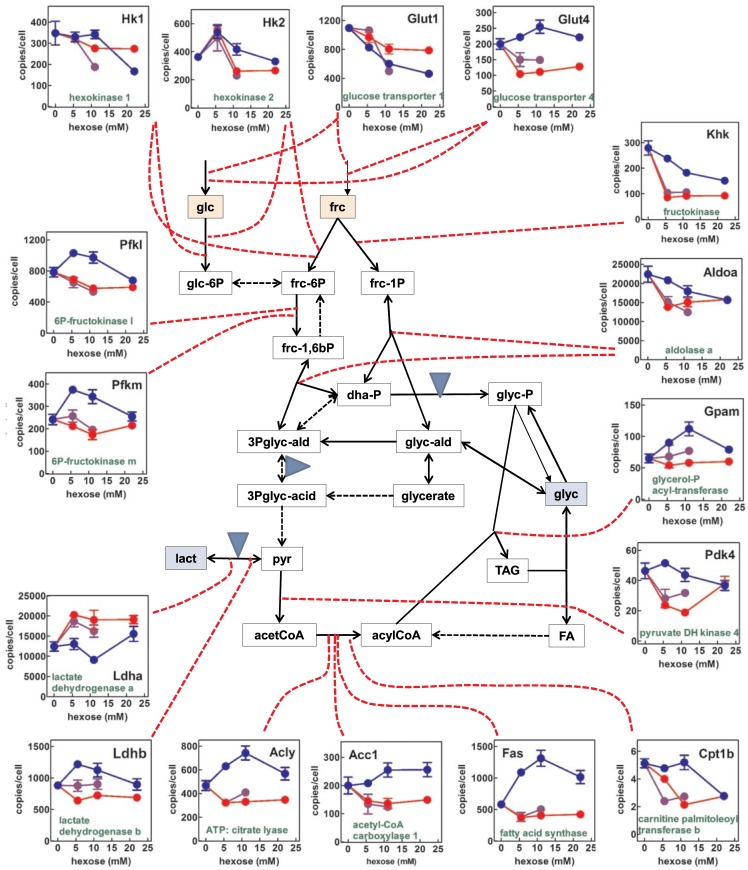
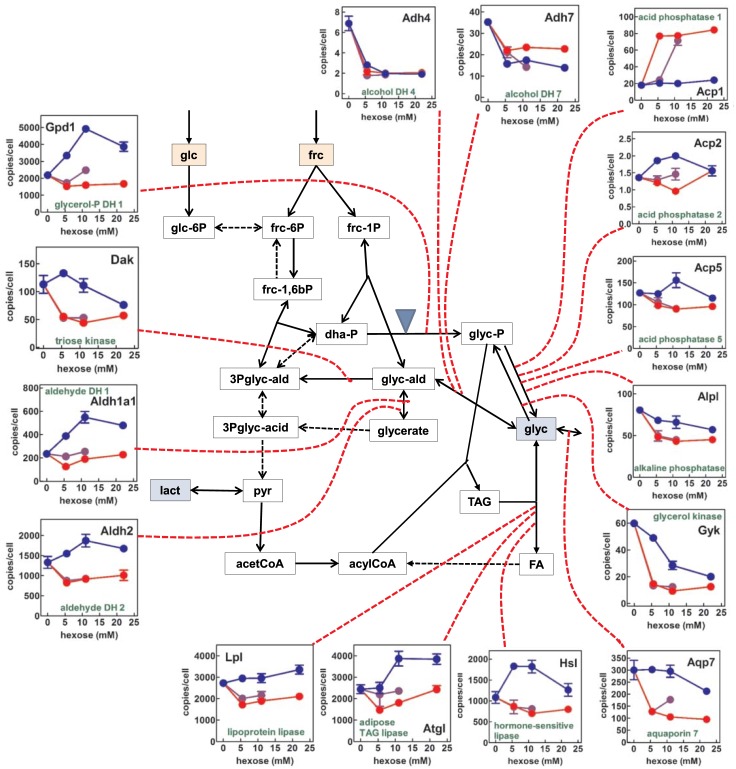
Cultured adipocytes (3T3-L1) produce large amounts of 3C fragments; largely lactate, depending on medium glucose levels. Increased glycolysis has been observed also in vivo in different sites of rat white adipose tissue. We investigated whether fructose can substitute glucose as source of lactate, and, especially whether the glycerol released to the medium was of lipolytic or glycolytic origin. Fructose conversion to lactate and glycerol was lower than that of glucose. The fast exhaustion of medium glucose was unrelated to significant changes in lipid storage. Fructose inhibited to a higher degree than glucose the expression of lipogenic enzymes. When both hexoses were present, the effects of fructose on gene expression prevailed over those of glucose. Adipocytes expressed fructokinase, but not aldolase b. Substantive release of glycerol accompanied lactate when fructose was the substrate. The mass of cell triacylglycerol (and its lack of change) could not justify the comparatively higher amount of glycerol released. Consequently, most of this glycerol should be derived from the glycolytic pathway, since its lipolytic origin could not be (quantitatively) sustained. Proportionally (with respect to lactate plus glycerol), more glycerol was produced from fructose than from glucose, which suggests that part of fructose was catabolized by the alternate (hepatic) fructose pathway. Earlier described adipose glycerophophatase activity may help explain the glycolytic origin of most of the glycerol. However, no gene is known for this enzyme in mammals, which suggests that this function may be carried out by one of the known phosphatases in the tissue. Break up of glycerol-3P to yield glycerol, may be a limiting factor for the synthesis of triacylglycerols through control of glycerol-3P availability. A phosphatase pathway such as that described may have a potential regulatory function, and explain the production of glycerol by adipocytes in the absence of lipolytic stimulation.
培养的脂肪细胞(3T3-L1)会产生大量的3C片段;主要是乳酸,这取决于培养基中的葡萄糖水平。在大鼠白色脂肪组织的不同部位,体内也观察到糖酵解增加。我们研究了果糖是否可以替代葡萄糖作为乳酸的来源,特别是释放到培养基中的甘油是来自脂解还是糖酵解。果糖转化为乳酸和甘油的效率低于葡萄糖。培养基中葡萄糖的快速耗尽与脂质储存的显著变化无关。果糖比葡萄糖更能抑制脂肪生成酶的表达。当两种己糖都存在时,果糖对基因表达的影响超过葡萄糖。脂肪细胞表达果糖激酶,但不表达醛缩酶b。当果糖作为底物时,甘油会伴随着乳酸大量释放。细胞三酰甘油的质量(及其不变性)无法解释释放出的相对较多的甘油量。因此,大部分甘油应该来自糖酵解途径,因为其脂解来源无法(定量地)维持。按比例(相对于乳酸加甘油),果糖产生的甘油比葡萄糖多,这表明部分果糖是通过替代(肝脏)果糖途径分解代谢的。先前描述的脂肪甘油磷酸酶活性可能有助于解释大部分甘油的糖酵解来源。然而,在哺乳动物中还没有已知的该酶基因,这表明该功能可能由组织中已知的磷酸酶之一来执行。甘油-3磷酸分解产生甘油,可能是通过控制甘油-3磷酸的可用性来限制三酰甘油合成的一个因素。这样描述的磷酸酶途径可能具有潜在的调节功能,并解释了在没有脂解刺激的情况下脂肪细胞产生甘油的现象。