WHO Collaborating Centre for Infectious Disease Epidemiology and Control, School of Public Health, Li Ka Shing Faculty of Medicine, The University of Hong Kong, Hong Kong Special Administrative Region, China.
Laboratory of Data Discovery for Health Limited, Hong Kong Science and Technology Park, New Territories, Hong Kong.
Nat Commun. 2022 Mar 23;13(1):1557. doi: 10.1038/s41467-022-29310-8.
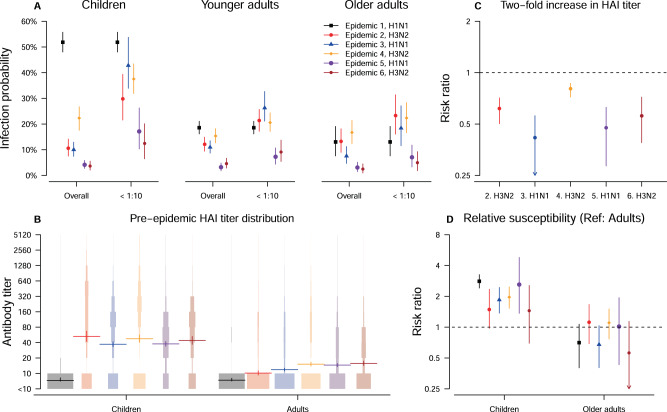
For >70 years, a 4-fold or greater rise in antibody titer has been used to confirm influenza virus infections in paired sera, despite recognition that this heuristic can lack sensitivity. Here we analyze with a novel Bayesian model a large cohort of 2353 individuals followed for up to 5 years in Hong Kong to characterize influenza antibody dynamics and develop an algorithm to improve the identification of influenza virus infections. After infection, we estimate that hemagglutination-inhibiting (HAI) titers were boosted by 16-fold on average and subsequently decrease by 14% per year. In six epidemics, the infection risks for adults were 3%-19% while the infection risks for children were 1.6-4.4 times higher than that of younger adults. Every two-fold increase in pre-epidemic HAI titer was associated with 19%-58% protection against infection. Our inferential framework clarifies the contributions of age and pre-epidemic HAI titers to characterize individual infection risk.
70 多年来,人们一直使用抗体滴度增加 4 倍或以上来确认配对血清中的流感病毒感染,尽管已经认识到这种启发式方法可能缺乏敏感性。在这里,我们使用一种新的贝叶斯模型分析了一个由 2353 人组成的大队列,这些人在香港被跟踪了长达 5 年,以描述流感抗体的动态,并开发一种算法来提高流感病毒感染的识别能力。感染后,我们估计血凝抑制(HAI)滴度平均增加了 16 倍,随后每年下降 14%。在六次流行中,成年人的感染风险为 3%-19%,而儿童的感染风险比年轻成年人高 1.6-4.4 倍。流行前 HAI 滴度每增加两倍,与感染的保护率为 19%-58%相关。我们的推理框架阐明了年龄和流行前 HAI 滴度对个体感染风险的贡献。