Saw Swee Hock School of Public Health, National University of Singapore and National University Health System, Singapore; Institute of Infectious Diseases and Epidemiology, Tan Tock Seng Hospital, Singapore.
Influenza Other Respir Viruses. 2013 Nov;7(6):1380-9. doi: 10.1111/irv.12129. Epub 2013 Jul 5.
Previous influenza pandemics had second and on occasion third waves in many countries that were at times more severe than the initial pandemic waves.
This study aims to determine the seroepidemiology of successive waves of H1N1pdm09 infections in Singapore and the overall risks of infection.
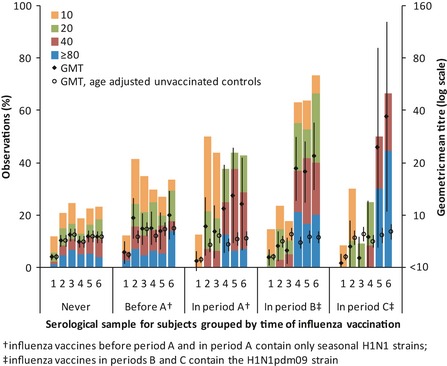
We performed a cohort study amongst 838 adults, with blood samples provided upon recruitment and at 5 points from 2009 to 2011 and tested by haemagglutination inhibition (HI) with A/California/7/2009 (H1N1pdm09). Surveys on key demographic and clinical information were conducted at regular intervals, and associations between seroconversion and these variables were investigated.
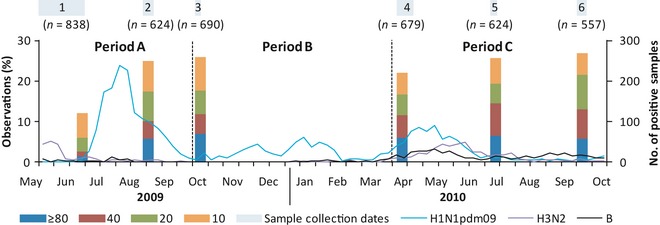
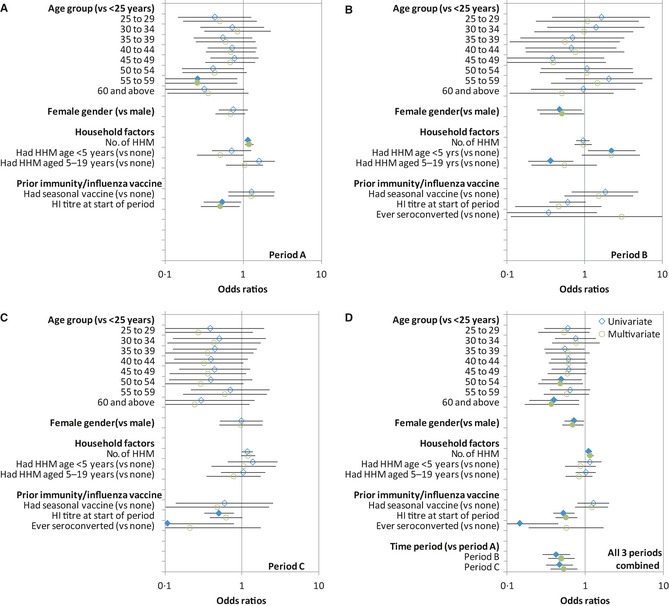
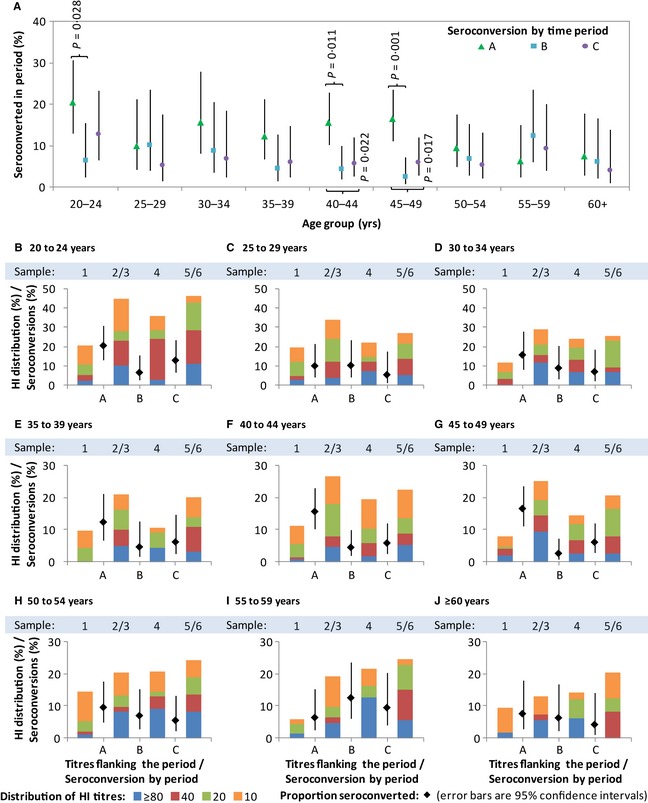
After the initial wave from June to September 2009, second and third waves occurred from November 2009 to February 2010 and April to June 2010, respectively. Seroconversion was 13·5% during the first wave and decreased to 6·2% and 6·8% in subsequent waves. Across the three waves, the elderly and those with higher starting HI titres were at lower risk of seroconversion, while those with larger households were at greater risk. Those with higher starting HI titres were also less likely to have an acute respiratory infection.
The second and third waves in Singapore had lower serological attack rates than the first wave. The elderly and those with higher HI titres had lower risk, while those in larger households had higher risk of seroconversion.
以往的流感大流行在许多国家都出现了第二波甚至第三波疫情,有时比最初的大流行波更为严重。
本研究旨在确定新加坡 H1N1pdm09 感染连续波的血清流行病学和总体感染风险。
我们对 838 名成年人进行了队列研究,在招募时和 2009 年至 2011 年的 5 个时间点提供了血液样本,并通过血凝抑制(HI)试验用 A/California/7/2009(H1N1pdm09)进行了检测。定期进行了有关关键人口统计学和临床信息的调查,并研究了血清转化率与这些变量之间的关联。
在 2009 年 6 月至 9 月的初始波之后,第二波和第三波分别发生在 2009 年 11 月至 2010 年 2 月和 2010 年 4 月至 6 月。第一波的血清转化率为 13.5%,随后分别降至 6.2%和 6.8%。在这三波中,老年人和起始 HI 滴度较高的人血清转化率较低,而家庭较大的人风险较高。起始 HI 滴度较高的人也不太可能患有急性呼吸道感染。
新加坡的第二波和第三波的血清发病率低于第一波。老年人和 HI 滴度较高的人风险较低,而家庭较大的人血清转化率较高。