Habibi Ehsanollah, Soury Shiva
Department of Occupational Health, School of Health, Isfahan University of Medical Sciences, Isfahan, Iran.
J Educ Health Promot. 2015 Aug 6;4:65. doi: 10.4103/2277-9531.162386. eCollection 2015.
Prevalence of work-related musculoskeletal disorders (WMSDs) is high among computer users. The study investigates the effect of three ergonomic interventions on the incidence of musculoskeletal disorders among the staff of Isfahan Province Gas Company, including training, sport, and installation of software.
The study was performed in the summer of 2013 on 75 (52 men, 23 women) Isfahan Province Gas Company employees in three phases (phase 1: Evaluation of present situation, phase 2: Performing interventions, and phase 3: Re-evaluation). Participants were divided into three groups (training, exercise, and software). The Nordic Musculoskeletal Questionnaire (NMQ) and rapid upper limb assessment (RULA) were used. Data collected were analyzed using SPSS software and McNemar test, t-test, and Chi-square test.
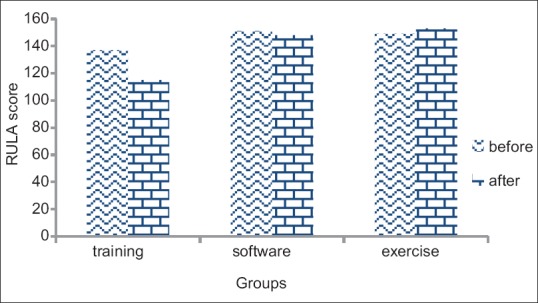
Based on the evaluations, there was a decrease in musculoskeletal symptoms among the trained group participants after they received the training. McNemar test showed that the lower rate of pain in low back, neck, knee, and wrist was significant (P < 0.05). The results obtained from the RULA method for evaluation of posture showed an average 25 points decrease in the right side of the body and 20 points decrease in the left side of the body in the group subjected to training. Based on t-test, the decrease was significant.
The study demonstrated that majority of the participants accepted interventions, which indicates that most of the people were unsatisfied with the work settings and seeking improvement at the workplace. Overall, the findings show that training, chair adjustment, and arrangement in workplace could decrease musculoskeletal disorders.
在计算机用户中,与工作相关的肌肉骨骼疾病(WMSDs)的患病率很高。本研究调查了三种人体工程学干预措施对伊斯法罕省天然气公司员工肌肉骨骼疾病发病率的影响,包括培训、运动和软件安装。
该研究于2013年夏季对75名(52名男性,23名女性)伊斯法罕省天然气公司员工分三个阶段进行(第一阶段:现状评估,第二阶段:实施干预措施,第三阶段:重新评估)。参与者被分为三组(培训组、运动组和软件组)。使用了北欧肌肉骨骼问卷(NMQ)和快速上肢评估(RULA)。收集的数据使用SPSS软件以及McNemar检验、t检验和卡方检验进行分析。
根据评估,接受培训后的培训组参与者肌肉骨骼症状有所减轻。McNemar检验表明,下背部、颈部、膝盖和手腕疼痛发生率降低具有显著性(P<0.05)。通过RULA方法评估姿势得到的结果显示,接受培训的组中,身体右侧平均下降25分,身体左侧平均下降20分。基于t检验,下降具有显著性。
该研究表明,大多数参与者接受了干预措施,这表明大多数人对工作环境不满意并寻求工作场所改善。总体而言,研究结果表明培训、椅子调整和工作场所布置可减少肌肉骨骼疾病。