Beaudart Charlotte, Biver Emmanuel, Reginster Jean-Yves, Rizzoli René, Rolland Yves, Bautmans Ivan, Petermans Jean, Gillain Sophie, Buckinx Fanny, Van Beveren Julien, Jacquemain Marc, Italiano Patrick, Dardenne Nadia, Bruyere Olivier
Public Health, Epidemiology and Health Economics, University of Liège, Liège 4000, Belgium.
Division of Bone Diseases, Faculty of Medicine, Geneva University Hospitals, Geneva, Switzerland.
Age Ageing. 2015 Nov;44(6):960-6. doi: 10.1093/ageing/afv133. Epub 2015 Oct 3.
The impact of sarcopenia on quality of life is currently assessed by generic tools. However, these tools may not detect subtle effects of this specific condition on quality of life.
The aim of this study was to develop a sarcopenia-specific quality of life questionnaire (SarQoL, Sarcopenia Quality of Life) designed for community-dwelling elderly subjects aged 65 years and older.
Participants were recruited in an outpatient clinic in Liège, Belgium.
Sarcopenic subjects aged 65 years or older.
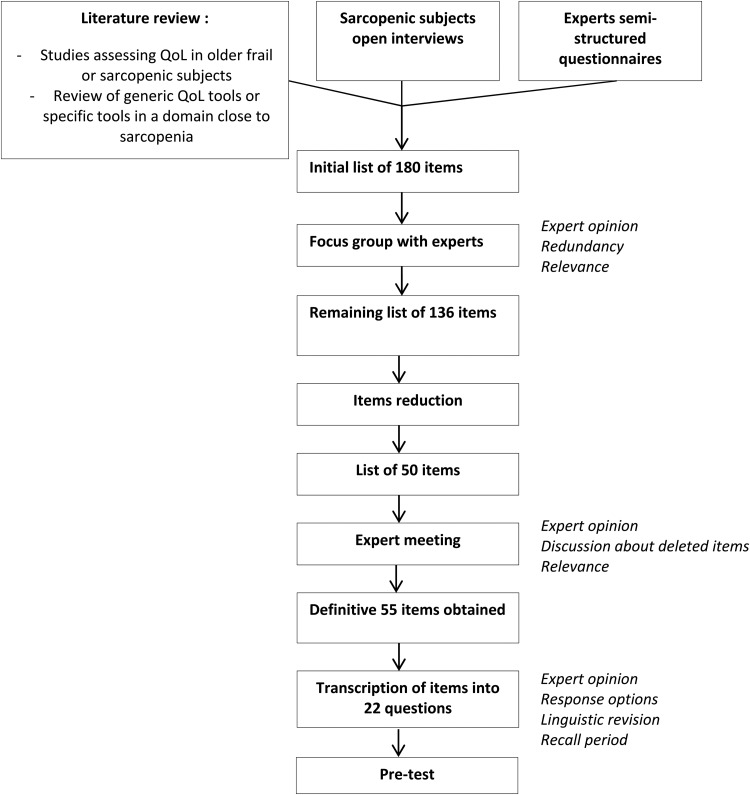
The study was articulated in the following four stages: (i) Item generation-based on literature review, sarcopenic subjects' opinion, experts' opinion, focus groups; (ii) Item reduction-based on sarcopenic subjects' and experts' preferences; (iii) Questionnaire generation-developed during an expert meeting; (iv) Pretest of the questionnaire-based on sarcopenic subjects' opinion.
The final version of the questionnaire consists of 55 items translated into 22 questions rated on a 4-point Likert scale. These items are organised into seven domains of dysfunction: Physical and mental health, Locomotion, Body composition, Functionality, Activities of daily living, Leisure activities and Fears. In view of the pretest, the SarQoL is easy to complete, independently, in ∼10 min.
The first version of the SarQoL, a specific quality of life questionnaire for sarcopenic subjects, has been developed and has been shown to be comprehensible by the target population. Investigations are now required to test the psychometric properties (internal consistency, test-retest reliability, divergent and convergent validity, discriminant validity, floor and ceiling effects) of this questionnaire.
目前,肌肉减少症对生活质量的影响是通过通用工具进行评估的。然而,这些工具可能无法检测到这种特定状况对生活质量的细微影响。
本研究的目的是开发一种专门针对肌肉减少症的生活质量问卷(SarQoL,肌肉减少症生活质量问卷),用于65岁及以上的社区居住老年受试者。
参与者在比利时列日的一家门诊诊所招募。
65岁及以上的肌肉减少症患者。
该研究分为以下四个阶段:(i)项目生成——基于文献综述、肌肉减少症患者的意见、专家意见、焦点小组;(ii)项目缩减——基于肌肉减少症患者和专家的偏好;(iii)问卷生成——在一次专家会议期间开发;(iv)问卷预测试——基于肌肉减少症患者的意见。
问卷的最终版本由55个项目组成,这些项目被翻译成22个问题,采用4点李克特量表进行评分。这些项目被组织成七个功能障碍领域:身心健康、运动、身体成分、功能、日常生活活动、休闲活动和恐惧。鉴于预测试,SarQoL易于独立完成,大约需要10分钟。
SarQoL的第一个版本,即一种针对肌肉减少症患者的特定生活质量问卷,已经开发出来,并且已被证明目标人群能够理解。现在需要进行调查,以测试该问卷的心理测量特性(内部一致性、重测信度、区分效度和聚合效度、判别效度、地板效应和天花板效应)。