Massey Veronica L, Beier Juliane I, Ritzenthaler Jeffrey D, Roman Jesse, Arteel Gavin E
Departments of Pharmacology and Toxicology and the University of Louisville Alcohol Research Center, University of Louisville Health Sciences Center, Louisville, KY 40292, USA.
Department of Medicine University of Louisville Health Sciences Center, Louisville, KY 40292, USA.
Biomolecules. 2015 Sep 30;5(4):2477-503. doi: 10.3390/biom5042477.
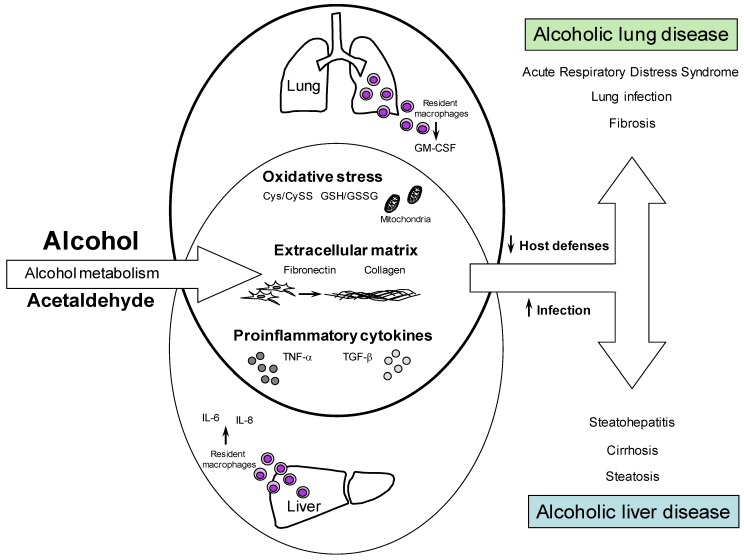
Both Alcoholic Liver Disease (ALD) and alcohol-related susceptibility to acute lung injury are estimated to account for the highest morbidity and mortality related to chronic alcohol abuse and, thus, represent a focus of intense investigation. In general, alcohol-induced derangements to both organs are considered to be independent and are often evaluated separately. However, the liver and lung share many general responses to damage, and specific responses to alcohol exposure. For example, both organs possess resident macrophages that play key roles in mediating the immune/inflammatory response. Additionally, alcohol-induced damage to both organs appears to involve oxidative stress that favors tissue injury. Another mechanism that appears to be shared between the organs is that inflammatory injury to both organs is enhanced by alcohol exposure. Lastly, altered extracellular matrix (ECM) deposition appears to be a key step in disease progression in both organs. Indeed, recent studies suggest that early subtle changes in the ECM may predispose the target organ to an inflammatory insult. The purpose of this chapter is to review the parallel mechanisms of liver and lung injury in response to alcohol consumption. This chapter will also explore the potential that these mechanisms are interdependent, as part of a gut-liver-lung axis.
酒精性肝病(ALD)以及与酒精相关的急性肺损伤易感性据估计是慢性酒精滥用相关发病率和死亡率最高的原因,因此,是深入研究的重点。一般来说,酒精对这两个器官造成的紊乱被认为是独立的,并且常常分开评估。然而,肝脏和肺对损伤有许多共同的反应,以及对酒精暴露的特定反应。例如,这两个器官都有驻留巨噬细胞,它们在介导免疫/炎症反应中起关键作用。此外,酒精对这两个器官的损伤似乎都涉及有利于组织损伤的氧化应激。这两个器官之间似乎还共有的另一种机制是,酒精暴露会增强对这两个器官的炎症损伤。最后,细胞外基质(ECM)沉积改变似乎是这两个器官疾病进展的关键步骤。事实上,最近的研究表明,ECM的早期细微变化可能使靶器官易受炎症损伤。本章的目的是综述肝脏和肺对酒精摄入的平行损伤机制。本章还将探讨这些机制作为肠-肝-肺轴的一部分相互依存的可能性。