Parker Daniel M, Carrara Verena I, Pukrittayakamee Sasithon, McGready Rose, Nosten François H
Shoklo Malaria Research Unit, Mahidol-Oxford Tropical Medicine Research Unit, Faculty of Tropical Medicine, Mahidol University, Mae Sot, Tak, Thailand.
Faculty of Tropical Medicine, Mahidol University, Bangkok, Thailand.
Malar J. 2015 Oct 5;14:388. doi: 10.1186/s12936-015-0921-y.
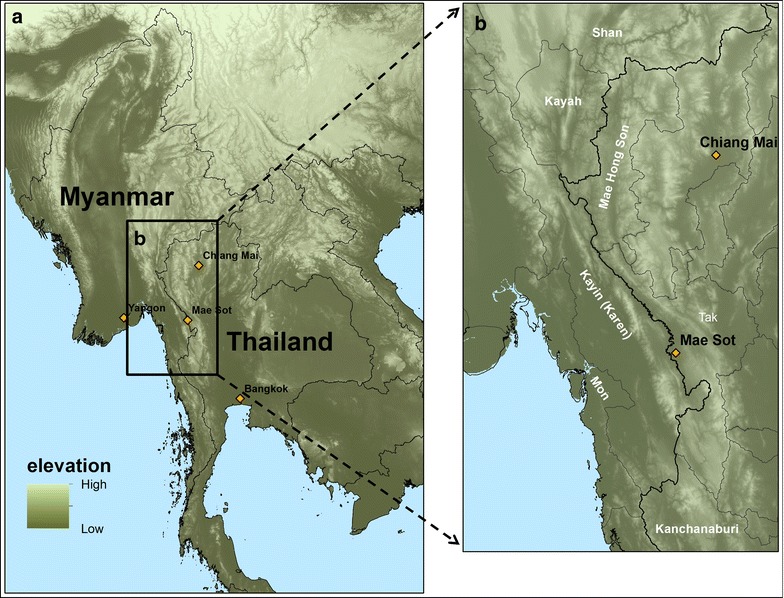
Malaria in Southeast Asia frequently clusters along international borders. For example, while most of Thailand is malaria free, the border region shared with Myanmar continues to have endemic malaria. This spatial pattern is the result of complex interactions between landscape, humans, mosquito vectors, and malaria parasites. An understanding of these complex ecological and socio-cultural interactions is important for designing and implementing malaria elimination efforts in the region. This article offers an ecological perspective on the malaria situation along the Thailand-Myanmar border.
This border region is long (2000 km), mountainous, and the environment ranges from thick forests to growing urban settlements and wet-rice fields. It is also a biologically diverse region. All five species of malaria known to naturally infect humans are present. At least three mosquito vector species complexes, with widely varying behavioural characteristics, exist in the area. The region is also a hub for ethnic diversity, being home to over ten different ethnolinguistic groups, several of which have been engaged in conflict with the Myanmar government now for over half a century. Given the biological and ethnic diversity, as well as the complex socio-political context, malaria control and elimination in the region is challenging.
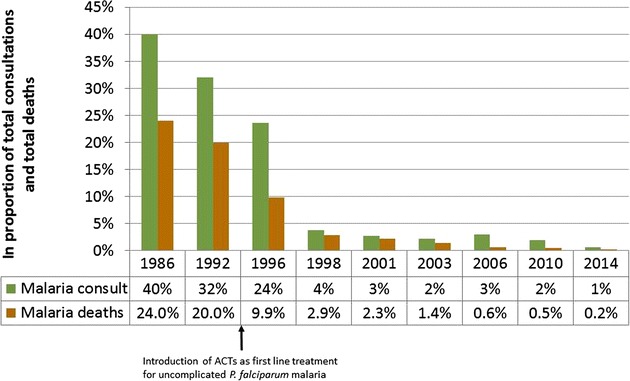
Despite these complexities, multipronged approaches including collaborations with multiple local organizations, quick access to diagnosis and treatment, prevention of mosquito bites, radical cure of parasites, and mass drug administration appear to be drastically decreasing Plasmodium falciparum infections. Such approaches remain crucial as the region moves toward elimination of P. falciparum and potentially Plasmodium vivax.
东南亚的疟疾常常聚集在国际边境沿线。例如,虽然泰国大部分地区无疟疾,但与缅甸接壤的边境地区仍有疟疾流行。这种空间格局是景观、人类、蚊虫媒介和疟原虫之间复杂相互作用的结果。了解这些复杂的生态和社会文化相互作用对于设计和实施该地区的疟疾消除工作至关重要。本文从生态学角度审视了泰国-缅甸边境的疟疾情况。
该边境地区漫长(2000公里),多山,环境从茂密森林到不断发展的城市定居点和水田不等。它也是一个生物多样性丰富的地区。已知自然感染人类的五种疟疾都存在。该地区至少存在三种蚊虫媒介物种复合体,其行为特征差异很大。该地区也是民族多样性的中心,有十多个不同的民族语言群体,其中一些群体与缅甸政府的冲突已持续了半个多世纪。鉴于生物和民族多样性以及复杂的社会政治背景,该地区的疟疾控制和消除工作具有挑战性。
尽管存在这些复杂性,但包括与多个当地组织合作、快速获得诊断和治疗、预防蚊虫叮咬、彻底治愈寄生虫以及大规模药物给药在内的多管齐下方法似乎正在大幅减少恶性疟原虫感染。随着该地区朝着消除恶性疟原虫以及可能消除间日疟原虫的方向发展,这些方法仍然至关重要。