Wilson Anne L, Chen-Hussey Vanessa, Logan James G, Lindsay Steve W
School of Biological and Biomedical Sciences, Durham University, South Road, Durham DH1 3LE, UK.
Malar J. 2014 Nov 21;13:446. doi: 10.1186/1475-2875-13-446.
Recommended vector control tools against malaria, such as long-lasting insecticidal nets (LLINs) and indoor residual spraying (IRS), mainly target mosquitoes that rest and feed on human hosts indoors. However, in some malaria-endemic areas, such as Southeast Asia and South America, malaria vectors primarily bite outdoors meaning that LLINs and IRS may be less effective. In these situations the use of topical insect repellents may reduce outdoor biting and morbidity from malaria. A systematic review and meta-analysis was conducted to assess the efficacy of topical insect repellents against malaria.
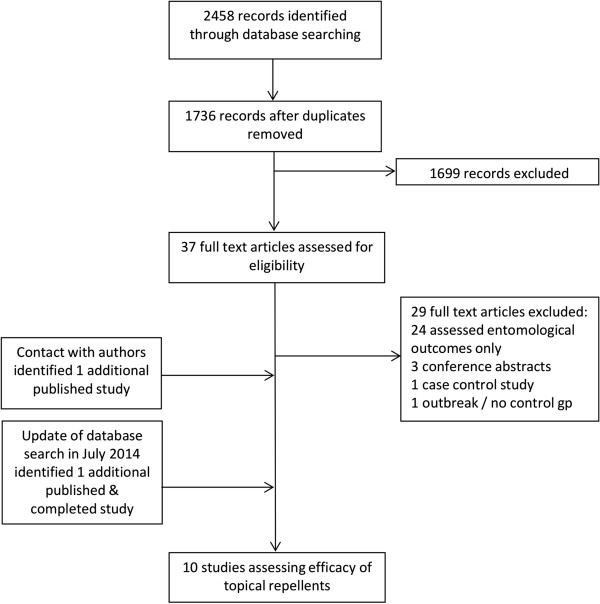
Studies were identified using database searches (MEDLINE, EMBASE, Web of Science and clinical trials registers), as well as reference list searches and contact with researchers. Randomized and non-randomized controlled trials were included that assessed the effect of topical repellents (all active ingredients and concentrations) on Plasmodium falciparum or Plasmodium vivax malaria or infection in malaria-endemic populations. Meta-analysis of clinical data was conducted in order to generate summary risk ratios.
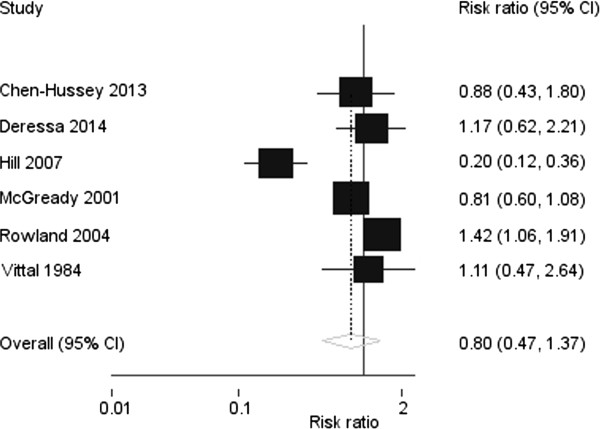
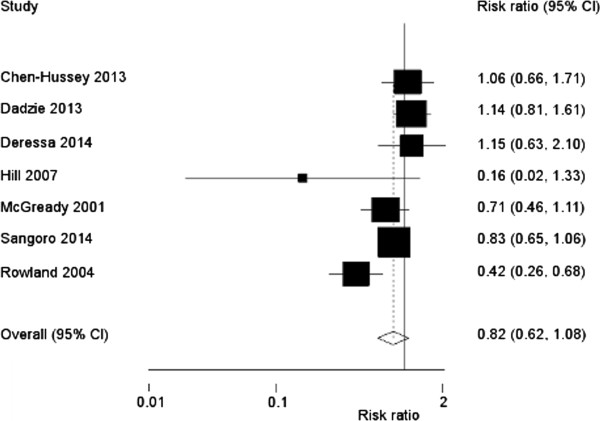
Ten trials met the inclusion criteria. Studies varied in terms of repellent active ingredient and formulation, co-interventions, study population, compliance, and follow-up period. Topical repellents showed an 18% protective efficacy against P. falciparum malaria, although this was not significant (95% CI: -8%, 38%). Similarly, the average protective efficacy of topical repellents against P. vivax malaria did not reach significance (protective efficacy: 20%, 95% CI: -37%, 53%). Exclusion of non-randomized trials from the meta-analysis did not alter the findings.
Although topical repellents can provide individual protection against mosquitoes, the results of this meta-analysis indicate that topical repellents are unlikely to provide effective protection against malaria. However, there was substantial heterogeneity between studies included and the relatively small number of studies meant that this heterogeneity could not be fully explored in the analysis. Further well-designed trials of topical repellents at appropriate doses and alternative modes of repellent delivery, such as spatial repellents and long-lasting insecticide-treated clothing, are required.
针对疟疾推荐的病媒控制工具,如长效驱虫蚊帐(LLINs)和室内滞留喷洒(IRS),主要针对在室内停歇并叮咬人类宿主的蚊子。然而,在一些疟疾流行地区,如东南亚和南美洲,疟疾媒介主要在户外叮咬,这意味着长效驱虫蚊帐和室内滞留喷洒可能效果较差。在这些情况下,使用局部用驱虫剂可能会减少户外叮咬以及疟疾发病率。开展了一项系统评价和荟萃分析,以评估局部用驱虫剂预防疟疾的疗效。
通过数据库检索(MEDLINE、EMBASE、科学引文索引和临床试验注册库)以及参考文献检索并与研究人员联系来识别研究。纳入评估局部用驱虫剂(所有活性成分和浓度)对恶性疟原虫或间日疟原虫疟疾或疟疾流行地区人群感染影响的随机和非随机对照试验。对临床数据进行荟萃分析以生成汇总风险比。
10项试验符合纳入标准。研究在驱虫剂活性成分和配方、联合干预措施、研究人群、依从性和随访期方面存在差异。局部用驱虫剂对恶性疟原虫疟疾显示出18%的保护效力,尽管这并不显著(95%置信区间:-8%,38%)。同样,局部用驱虫剂对间日疟原虫疟疾的平均保护效力也未达到显著水平(保护效力:20%,95%置信区间:-37%,53%)。从荟萃分析中排除非随机试验并未改变研究结果。
尽管局部用驱虫剂可为个体提供防蚊保护,但该荟萃分析结果表明,局部用驱虫剂不太可能对疟疾提供有效保护。然而,纳入的研究之间存在很大异质性,且研究数量相对较少,这意味着在分析中无法充分探究这种异质性。需要进一步开展设计良好的试验,采用适当剂量的局部用驱虫剂以及驱虫剂的替代递送方式,如空间驱避剂和长效杀虫剂处理过的衣物。