Soofi Sajid Bashir, Ariff Shabina, Khan Ubaidullah, Turab Ali, Khan Gul Nawaz, Habib Atif, Sadiq Kamran, Suhag Zamir, Bhatti Zaid, Ahmed Imran, Bhal Rajiv, Bhutta Zulfiqar Ahmed
Department of Pediatrics & Center of Excellence in Women and Child Health, Aga Khan University, Karachi, Pakistan.
Department of Pediatrics, King Edward Medical University, Lahore, Pakistan.
BMC Pediatr. 2015 Oct 5;15:144. doi: 10.1186/s12887-015-0450-4.
Globally, clinical certification of the cause of neonatal death is not commonly available in developing countries. Under such circumstances it is imperative to use available WHO verbal autopsy tool to ascertain causes of death for strategic health planning in countries where resources are limited and the burden of neonatal death is high. The study explores the diagnostic accuracy of WHO revised verbal autopsy tool for ascertaining the causes of neonatal deaths against reference standard diagnosis obtained from standardized clinical and supportive hospital data.
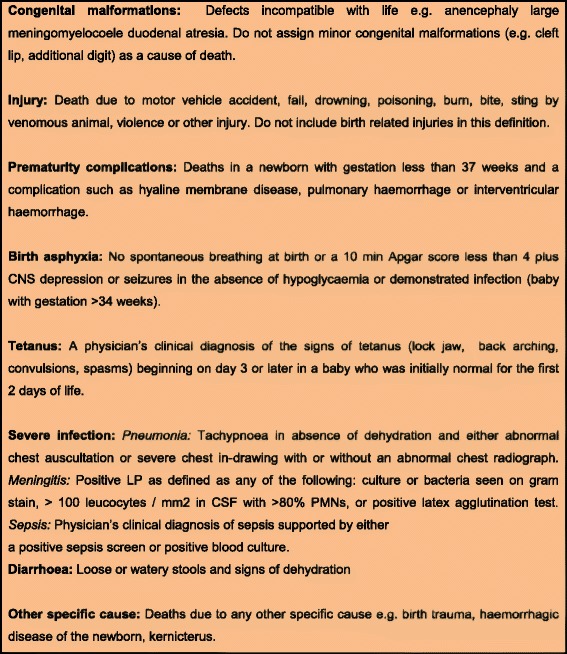
All neonatal deaths were recruited between August 2006 -February 2008 from two tertiary teaching hospitals in Province Sindh, Pakistan. The reference standard cause of death was established by two senior pediatricians within 2 days of occurrence of death using the International Cause of Death coding system. For verbal autopsy, trained female community health worker interviewed mother or care taker of the deceased within 2-6 weeks of death using a modified WHO verbal autopsy tool. Cause of death was assigned by 2 trained pediatricians. The performance was assessed in terms of sensitivity and specificity.
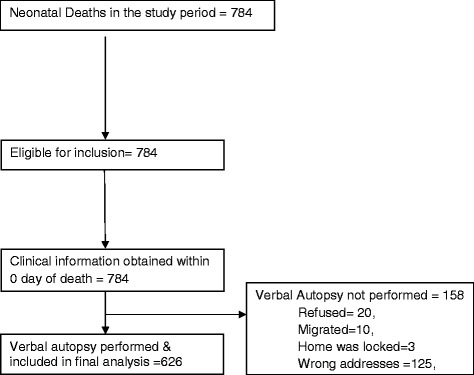
Out of 626 neonatal deaths, cause-specific mortality fractions for neonatal deaths were almost similar in both verbal autopsy and reference standard diagnosis. Sensitivity of verbal autopsy was more than 93% for diagnosing prematurity and 83.5% for birth asphyxia. However the verbal autopsy didn't have acceptable accuracy for diagnosing the congenital malformation 57%. The specificity for all five major causes of neonatal deaths was greater than 90%.
The WHO revised verbal autopsy tool had reasonable validity in determining causes of neonatal deaths. The tool can be used in resource limited community-based settings where neonatal mortality rate is high and death certificates from hospitals are not available.
在全球范围内,发展中国家通常无法获得新生儿死亡原因的临床认证。在这种情况下,对于资源有限且新生儿死亡负担较高的国家,必须使用世界卫生组织现有的死因推断工具来确定死亡原因,以进行战略卫生规划。本研究探讨了世界卫生组织修订的死因推断工具针对从标准化临床和辅助医院数据获得的参考标准诊断来确定新生儿死亡原因的诊断准确性。
2006年8月至2008年2月期间,从巴基斯坦信德省的两家三级教学医院招募了所有新生儿死亡病例。由两名资深儿科医生在死亡发生后2天内使用国际死亡原因编码系统确定参考标准死亡原因。对于死因推断,经过培训的女性社区卫生工作者在死亡后2至6周内使用经修改的世界卫生组织死因推断工具对死者的母亲或照顾者进行访谈。由两名经过培训的儿科医生确定死亡原因。从敏感性和特异性方面评估该工具的性能。
在626例新生儿死亡病例中,死因推断和参考标准诊断中新生儿死亡的病因特异性死亡率几乎相似。死因推断对于诊断早产的敏感性超过93%,对于诊断出生窒息的敏感性为83.5%。然而,死因推断对于诊断先天性畸形的准确性不可接受,为57%。所有五种主要新生儿死亡原因的特异性均大于90%。
世界卫生组织修订的死因推断工具在确定新生儿死亡原因方面具有合理的有效性。该工具可用于新生儿死亡率高且无法获得医院死亡证明的资源有限的社区环境。