Sidonskaya Ekaterina, Schweighofer Alois, Shubchynskyy Volodymyr, Kammerhofer Nina, Hofmann Julia, Wieczorek Krzysztof, Meskiene Irute
Division of Plant Protection, Department of Crop Sciences, University of Natural Resources and Life Sciences, Konrad-Lorenz-Straße 24, A-3430 Tulln on the Danube, Austria.
Max F. Perutz Laboratories of the University and Medical University of Vienna, Dr Bohr-Gasse 9, A-1030 Vienna, Austria Institute of Biotechnology, University of Vilnius, Graiciuno 8, LT-02242 Vilnius, Lithuania.
J Exp Bot. 2016 Jan;67(1):107-18. doi: 10.1093/jxb/erv440. Epub 2015 Oct 5.
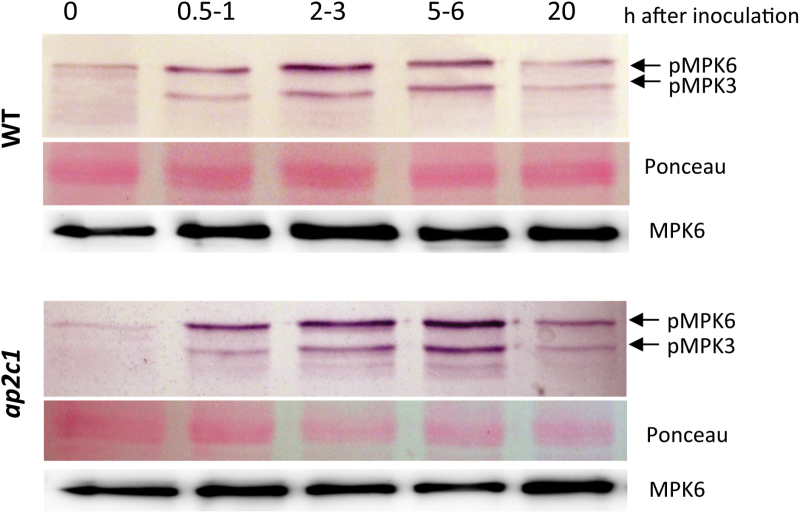
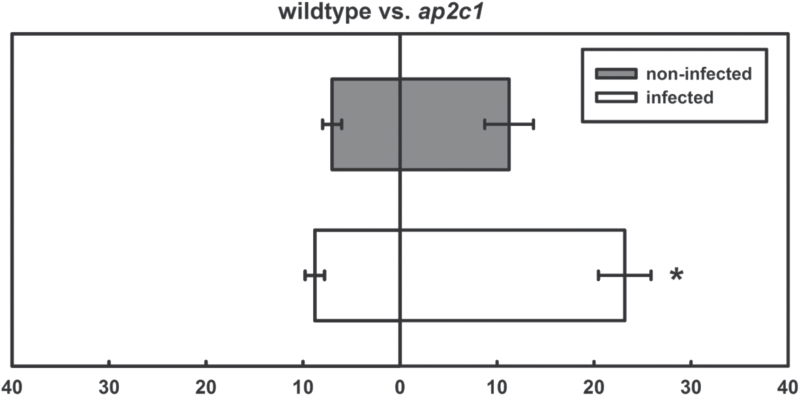
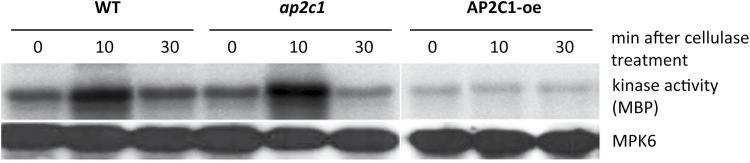
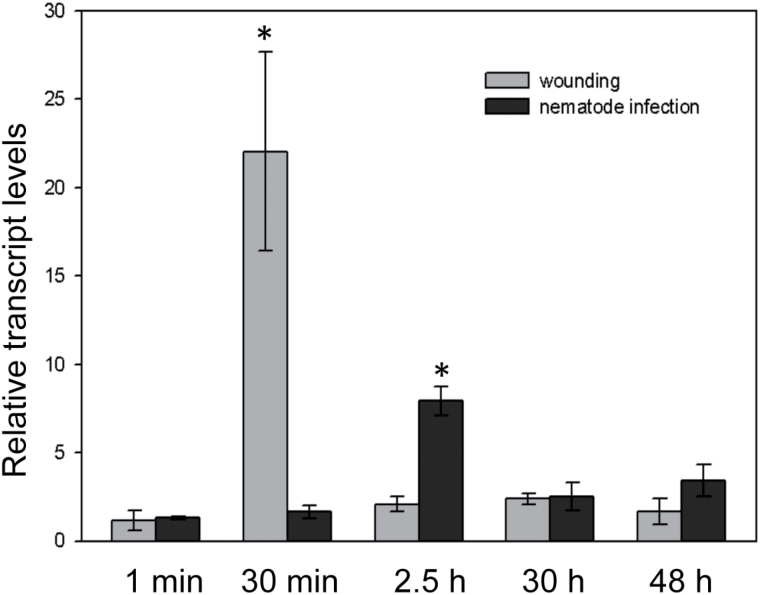
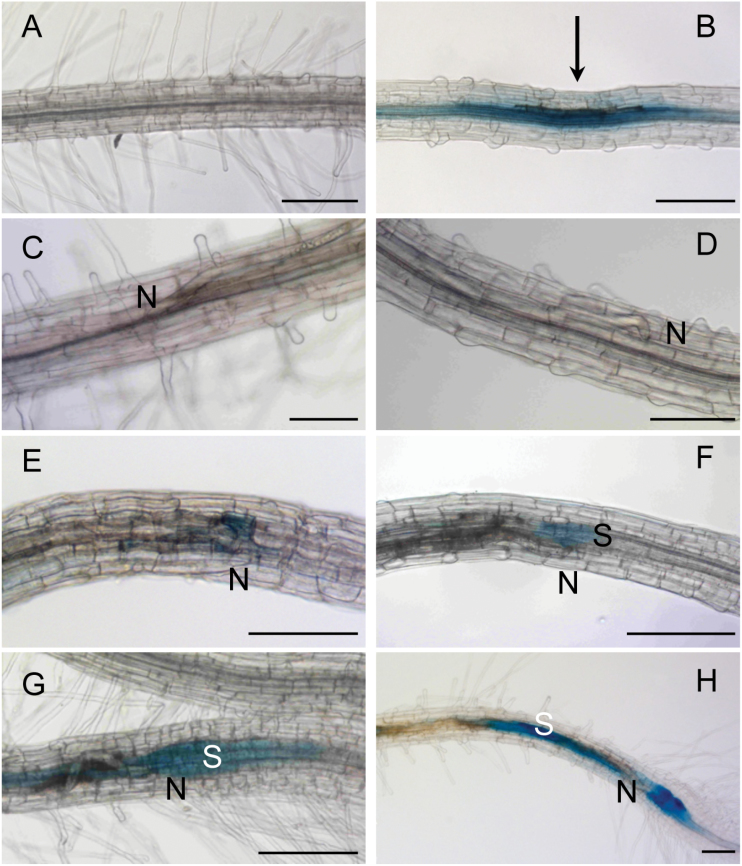
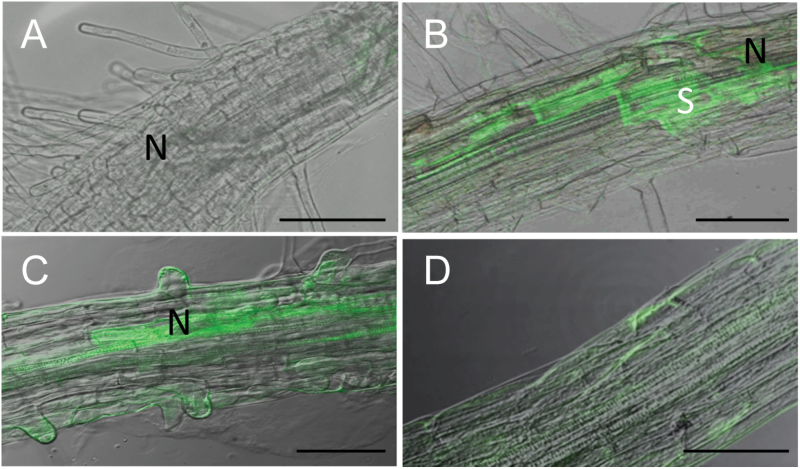
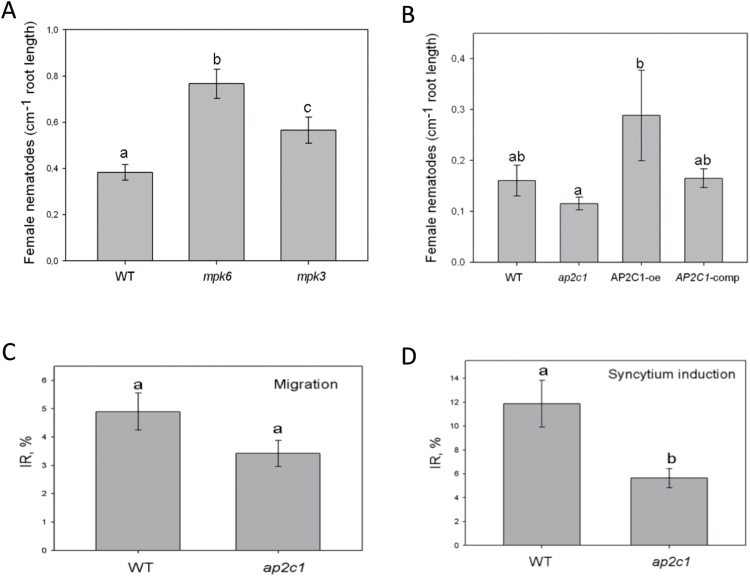
Plant-parasitic cyst nematodes infect plants and form highly sophisticated feeding sites in roots. It is not known which plant cell signalling mechanisms trigger plant defence during the early stages of nematode parasitism. Mitogen-activated protein kinases (MAPKs) are central components of protein phosphorylation cascades transducing extracellular signals to plant defence responses. MAPK phosphatases control kinase activities and the signalling outcome. The involvement and the role of MPK3 and MPK6, as well as the MAPK phosphatase AP2C1, is demonstrated during parasitism of the beet cyst nematode Heterodera schachtii in Arabidopsis. Our data reveal notable activation patterns of plant MAPKs and the induction of AP2C1 suggesting the attenuation of defence signalling in plant cells during early nematode infection. It is demonstrated that the ap2c1 mutant that is lacking AP2C1 is more attractive but less susceptible to nematodes compared with the AP2C1-overexpressing line. This implies that the function of AP2C1 is a negative regulator of nematode-induced defence. By contrast, the enhanced susceptibility of mpk3 and mpk6 plants indicates a positive role of stress-activated MAPKs in plant immunity against nematodes. Evidence is provided that phosphatase AP2C1, as well as AP2C1-targeted MPK3 and MPK6, are important regulators of plant-nematode interaction, where the co-ordinated action of these signalling components ensures the timely activation of plant defence.
植物寄生性胞囊线虫会感染植物并在根中形成高度复杂的取食位点。目前尚不清楚在 nematode 寄生的早期阶段,哪些植物细胞信号传导机制会触发植物防御。丝裂原活化蛋白激酶(MAPKs)是将细胞外信号转导至植物防御反应的蛋白质磷酸化级联反应的核心组成部分。MAPK 磷酸酶控制激酶活性和信号传导结果。在拟南芥中甜菜胞囊线虫 Heterodera schachtii 的寄生过程中,证明了 MPK3 和 MPK6 以及 MAPK 磷酸酶 AP2C1 的参与和作用。我们的数据揭示了植物 MAPKs 的显著激活模式以及 AP2C1 的诱导,这表明在 nematode 感染早期植物细胞中的防御信号传导减弱。结果表明,与 AP2C1 过表达系相比,缺乏 AP2C1 的 ap2c1 突变体对 nematodes 更具吸引力,但敏感性较低。这意味着 AP2C1 的功能是 nematode 诱导防御的负调节因子。相比之下,mpk3 和 mpk6 植物易感性增强表明应激激活的 MAPKs 在植物对线虫的免疫中起积极作用。有证据表明,磷酸酶 AP2C1 以及 AP2C1 靶向的 MPK3 和 MPK6 是植物与线虫相互作用的重要调节因子,这些信号成分的协同作用确保了植物防御的及时激活。