Lu Fengzhong, Li Wanchen, Peng Yalin, Cao Yang, Qu Jingtao, Sun Fuai, Yang Qingqing, Lu Yanli, Zhang Xuehai, Zheng Lanjie, Fu Fengling, Yu Haoqiang
Key Laboratory of Biology and Genetic Improvement of Maize in Southwest Region, Ministry of Agriculture, Maize Research Institute, Sichuan Agricultural University, Chengdu, China.
National Key Laboratory of Wheat and Maize Crop Science, Henan Agricultural University, Zhengzhou, China.
Front Plant Sci. 2022 Apr 8;13:851531. doi: 10.3389/fpls.2022.851531. eCollection 2022.
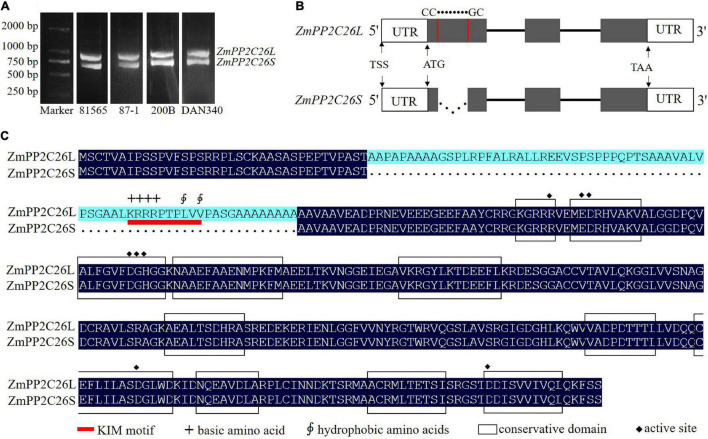
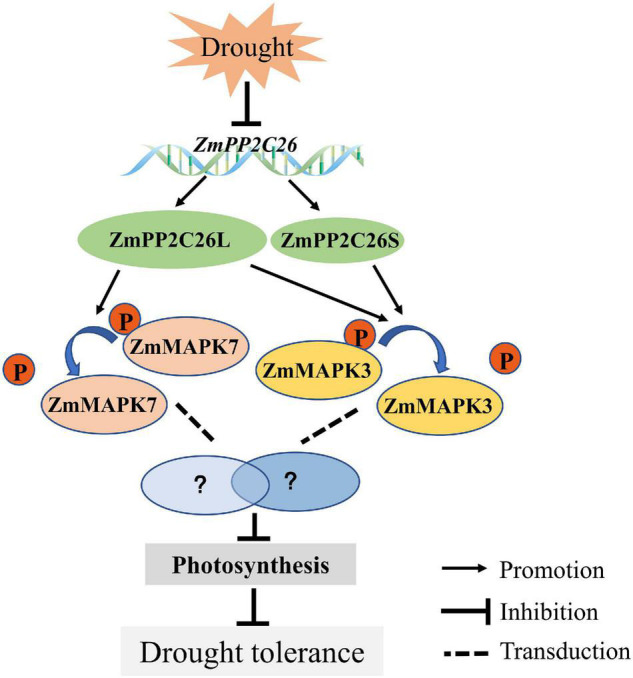
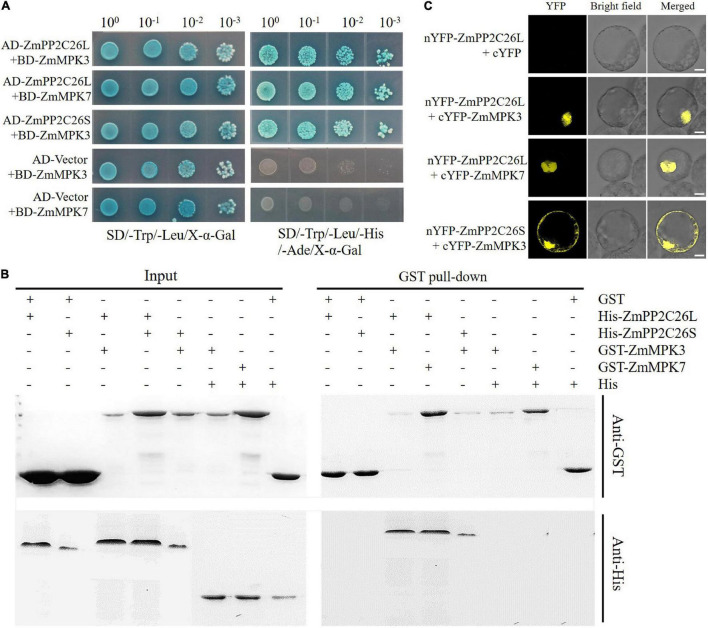
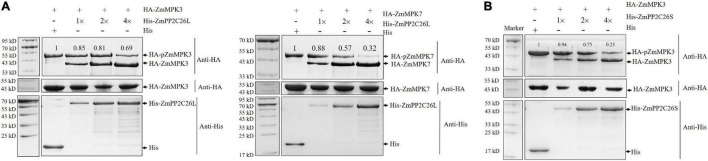
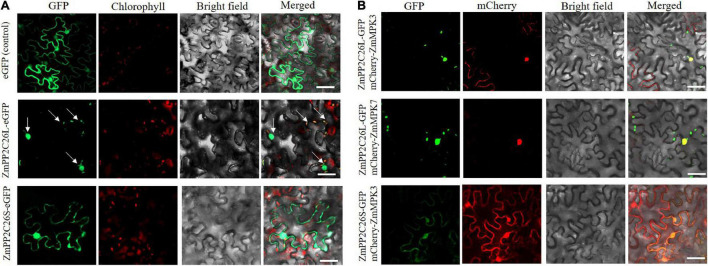
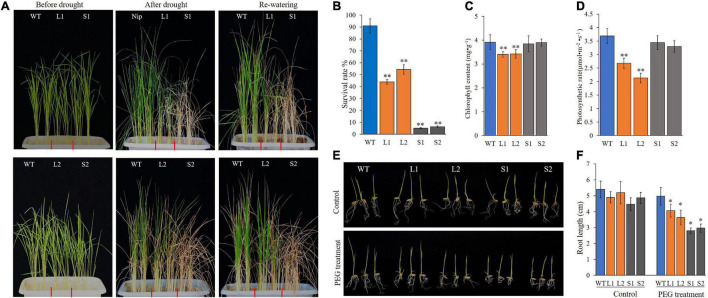
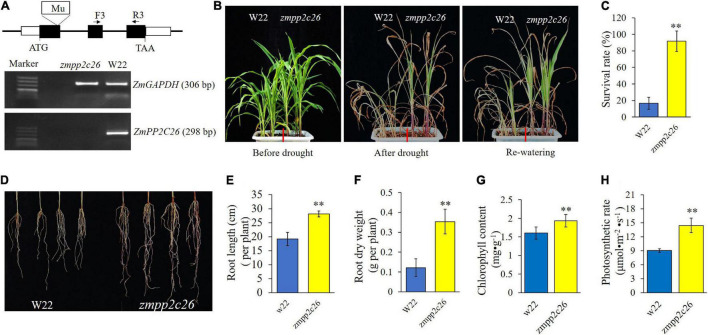
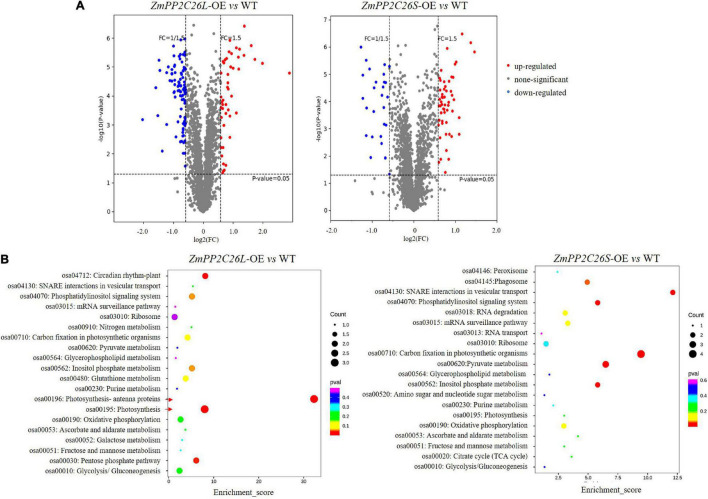
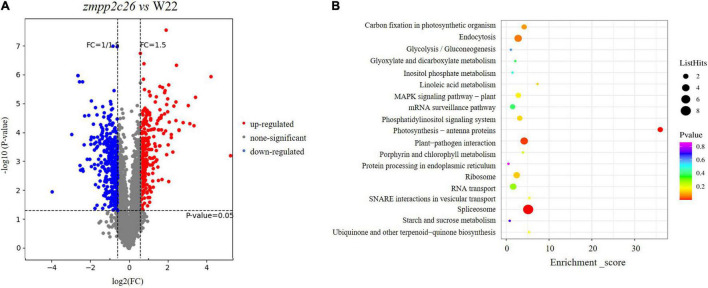
Serine/threonine protein phosphatase 2C (PP2C) dephosphorylates proteins and plays crucial roles in plant growth, development, and stress response. In this study, we characterized a clade B member of maize PP2C family, i.e., ZmPP2C26, that negatively regulated drought tolerance by dephosphorylating ZmMAPK3 and ZmMAPK7 in maize. The gene generated and isoforms through untypical alternative splicing. ZmPP2C26S lost 71 amino acids including an MAPK interaction motif and showed higher phosphatase activity than ZmPP2C26L. ZmPP2C26L directly interacted with, dephosphorylated ZmMAPK3 and ZmMAPK7, and localized in chloroplast and nucleus, but ZmPP2C26S only dephosphorylated ZmMAPK3 and localized in cytosol and nucleus. The expression of and was significantly inhibited by drought stress. Meanwhile, the maize mutant exhibited enhancement of drought tolerance with higher root length, root weight, chlorophyll content, and photosynthetic rate compared with wild type. However, overexpression of and significantly decreased drought tolerance in and rice with lower root length, chlorophyll content, and photosynthetic rate. Phosphoproteomic analysis revealed that the ZmPP2C26 protein also altered phosphorylation level of proteins involved in photosynthesis. This study provides insights into understanding the mechanism of PP2C in response to abiotic stress.
丝氨酸/苏氨酸蛋白磷酸酶2C(PP2C)使蛋白质去磷酸化,并在植物生长、发育和应激反应中发挥关键作用。在本研究中,我们对玉米PP2C家族的一个B类成员ZmPP2C26进行了表征,该成员通过使玉米中的ZmMAPK3和ZmMAPK7去磷酸化来负调控耐旱性。该基因通过非典型可变剪接产生了两种异构体。ZmPP2C26S缺失了71个氨基酸,包括一个MAPK相互作用基序,并且显示出比ZmPP2C26L更高的磷酸酶活性。ZmPP2C26L直接与ZmMAPK3和ZmMAPK7相互作用并使其去磷酸化,定位于叶绿体和细胞核,但ZmPP2C26S仅使ZmMAPK3去磷酸化,定位于细胞质和细胞核。ZmPP2C26L和ZmPP2C26S的表达受到干旱胁迫的显著抑制。同时,玉米ZmPP2C26突变体与野生型相比,根长、根重、叶绿素含量和光合速率更高,耐旱性增强。然而,ZmPP2C26L和ZmPP2C26S在玉米和水稻中的过表达显著降低了耐旱性,根长、叶绿素含量和光合速率较低。磷酸化蛋白质组分析表明,ZmPP2C26蛋白还改变了参与光合作用的蛋白质的磷酸化水平。本研究为理解PP2C响应非生物胁迫的机制提供了见解。