
分布式神经网络模拟中尖峰与缝隙连接相互作用的统一框架。
A unified framework for spiking and gap-junction interactions in distributed neuronal network simulations.
作者信息
Hahne Jan, Helias Moritz, Kunkel Susanne, Igarashi Jun, Bolten Matthias, Frommer Andreas, Diesmann Markus
机构信息
Department of Mathematics and Science, Bergische Universität Wuppertal Wuppertal, Germany.
Institute of Neuroscience and Medicine (INM-6), Institute for Advanced Simulation (IAS-6), JARA BRAIN Institute I, Jülich Research Centre Jülich, Germany ; Programming Environment Research Team, RIKEN Advanced Institute for Computational Science Kobe, Japan.
出版信息
Front Neuroinform. 2015 Sep 9;9:22. doi: 10.3389/fninf.2015.00022. eCollection 2015.
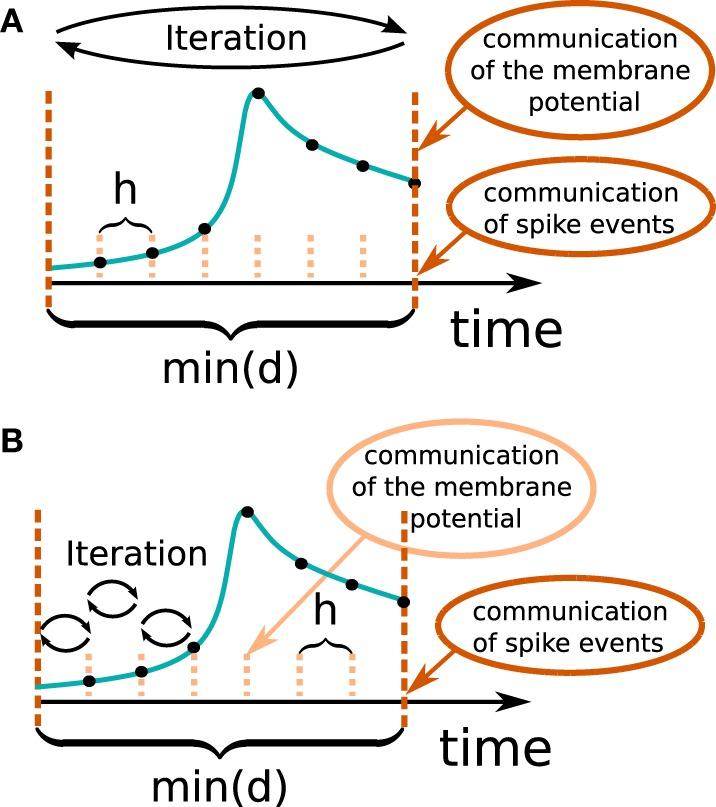
Contemporary simulators for networks of point and few-compartment model neurons come with a plethora of ready-to-use neuron and synapse models and support complex network topologies. Recent technological advancements have broadened the spectrum of application further to the efficient simulation of brain-scale networks on supercomputers. In distributed network simulations the amount of spike data that accrues per millisecond and process is typically low, such that a common optimization strategy is to communicate spikes at relatively long intervals, where the upper limit is given by the shortest synaptic transmission delay in the network. This approach is well-suited for simulations that employ only chemical synapses but it has so far impeded the incorporation of gap-junction models, which require instantaneous neuronal interactions. Here, we present a numerical algorithm based on a waveform-relaxation technique which allows for network simulations with gap junctions in a way that is compatible with the delayed communication strategy. Using a reference implementation in the NEST simulator, we demonstrate that the algorithm and the required data structures can be smoothly integrated with existing code such that they complement the infrastructure for spiking connections. To show that the unified framework for gap-junction and spiking interactions achieves high performance and delivers high accuracy in the presence of gap junctions, we present benchmarks for workstations, clusters, and supercomputers. Finally, we discuss limitations of the novel technology.
当代用于点模型神经元和少室模型神经元网络的模拟器提供了大量现成的神经元和突触模型,并支持复杂的网络拓扑结构。最近的技术进步进一步拓宽了应用范围,可在超级计算机上对脑规模网络进行高效模拟。在分布式网络模拟中,每毫秒和每个进程产生的尖峰数据量通常较低,因此一种常见的优化策略是以相对较长的时间间隔传输尖峰,其上限由网络中最短的突触传递延迟决定。这种方法非常适合仅使用化学突触的模拟,但迄今为止它阻碍了间隙连接模型的纳入,因为间隙连接模型需要即时神经元相互作用。在此,我们提出一种基于波形松弛技术的数值算法,该算法允许以与延迟通信策略兼容的方式对具有间隙连接的网络进行模拟。通过在NEST模拟器中的参考实现,我们证明该算法和所需的数据结构可以与现有代码顺利集成,从而补充用于尖峰连接的基础设施。为了表明间隙连接和尖峰相互作用的统一框架在存在间隙连接的情况下实现了高性能并具有高精度,我们给出了针对工作站、集群和超级计算机的基准测试。最后,我们讨论了这项新技术的局限性。




 Zotero 插件