Kunkel Susanne, Schenck Wolfram
Simulation Laboratory Neuroscience, Bernstein Facility for Simulation and Database Technology, Institute for Advanced Simulation, Jülich Aachen Research Alliance, Forschungszentrum JülichJülich, Germany.
Department of Computational Science and Technology, School of Computer Science and Communication, KTH Royal Institute of TechnologyStockholm, Sweden.
Front Neuroinform. 2017 Jun 28;11:40. doi: 10.3389/fninf.2017.00040. eCollection 2017.
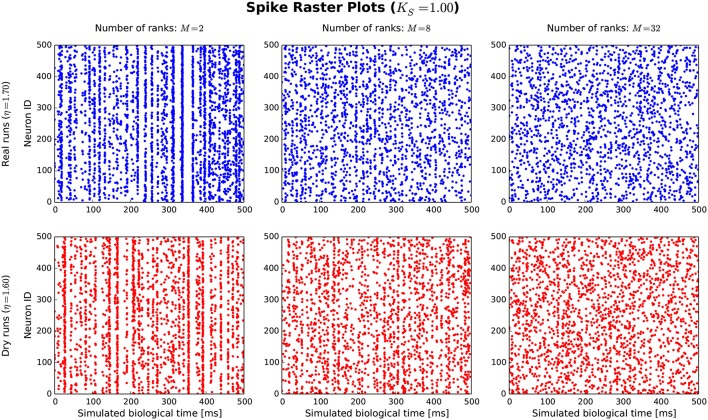
NEST is a simulator for spiking neuronal networks that commits to a general purpose approach: It allows for high flexibility in the design of network models, and its applications range from small-scale simulations on laptops to brain-scale simulations on supercomputers. Hence, developers need to test their code for various use cases and ensure that changes to code do not impair scalability. However, running a full set of benchmarks on a supercomputer takes up precious compute-time resources and can entail long queuing times. Here, we present the NEST dry-run mode, which enables comprehensive dynamic code analysis without requiring access to high-performance computing facilities. A dry-run simulation is carried out by a single process, which performs all simulation steps except communication as if it was part of a parallel environment with many processes. We show that measurements of memory usage and runtime of neuronal network simulations closely match the corresponding dry-run data. Furthermore, we demonstrate the successful application of the dry-run mode in the areas of profiling and performance modeling.
NEST是一种用于脉冲神经网络的模拟器,它采用通用方法:它允许在网络模型设计中具有高度灵活性,其应用范围从笔记本电脑上的小规模模拟到超级计算机上的大脑规模模拟。因此,开发人员需要针对各种用例测试他们的代码,并确保代码更改不会损害可扩展性。然而,在超级计算机上运行一整套基准测试会占用宝贵的计算时间资源,并且可能导致长时间的排队等待。在这里,我们介绍NEST空运行模式,它无需访问高性能计算设施就能进行全面的动态代码分析。空运行模拟由单个进程执行,该进程执行除通信之外的所有模拟步骤,就好像它是具有许多进程的并行环境的一部分。我们表明,神经网络模拟的内存使用和运行时测量结果与相应的空运行数据密切匹配。此外,我们展示了空运行模式在性能分析和性能建模领域的成功应用。