Jordan Jakob, Helias Moritz, Diesmann Markus, Kunkel Susanne
Department of Physiology, University of Bern, Bern, Switzerland.
Institute of Neuroscience and Medicine (INM-6), Jülich Research Centre, Jülich, Germany.
Front Neuroinform. 2020 May 5;14:12. doi: 10.3389/fninf.2020.00012. eCollection 2020.
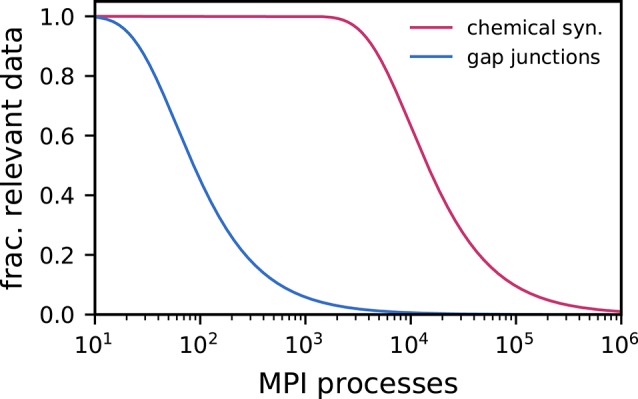
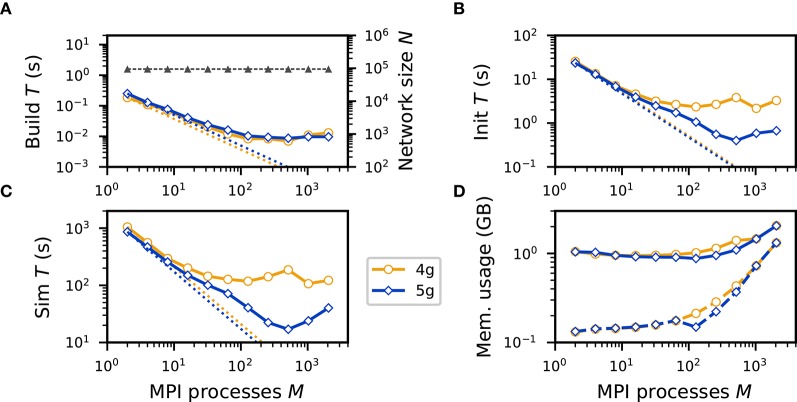
Investigating the dynamics and function of large-scale spiking neuronal networks with realistic numbers of synapses is made possible today by state-of-the-art simulation code that scales to the largest contemporary supercomputers. However, simulations that involve electrical interactions, also called gap junctions, besides chemical synapses scale only poorly due to a communication scheme that collects global data on each compute node. In comparison to chemical synapses, gap junctions are far less abundant. To improve scalability we exploit this sparsity by integrating an existing framework for continuous interactions with a recently proposed directed communication scheme for spikes. Using a reference implementation in the NEST simulator we demonstrate excellent scalability of the integrated framework, accelerating large-scale simulations with gap junctions by more than an order of magnitude. This allows, for the first time, the efficient exploration of the interactions of chemical and electrical coupling in large-scale neuronal networks models with natural synapse density distributed across thousands of compute nodes.
如今,借助可扩展至当代最大型超级计算机的先进模拟代码,研究具有实际突触数量的大规模脉冲神经元网络的动力学和功能成为可能。然而,除化学突触外还涉及电相互作用(也称为缝隙连接)的模拟,由于一种在每个计算节点上收集全局数据的通信方案,其扩展性很差。与化学突触相比,缝隙连接的数量要少得多。为了提高扩展性,我们通过将现有的连续相互作用框架与最近提出的用于脉冲的定向通信方案相结合,来利用这种稀疏性。通过在NEST模拟器中的参考实现,我们展示了集成框架出色的扩展性,将具有缝隙连接的大规模模拟加速了一个多数量级。这首次使得能够高效探索大规模神经元网络模型中化学和电耦合的相互作用,其中自然突触密度分布在数千个计算节点上。