Institute of Neuroscience and Medicine (INM-6) and Institute for Advanced Simulation (IAS-6), Jülich Research Centre and JARA Jülich, Germany.
Front Comput Neurosci. 2013 Oct 18;7:131. doi: 10.3389/fncom.2013.00131. eCollection 2013.
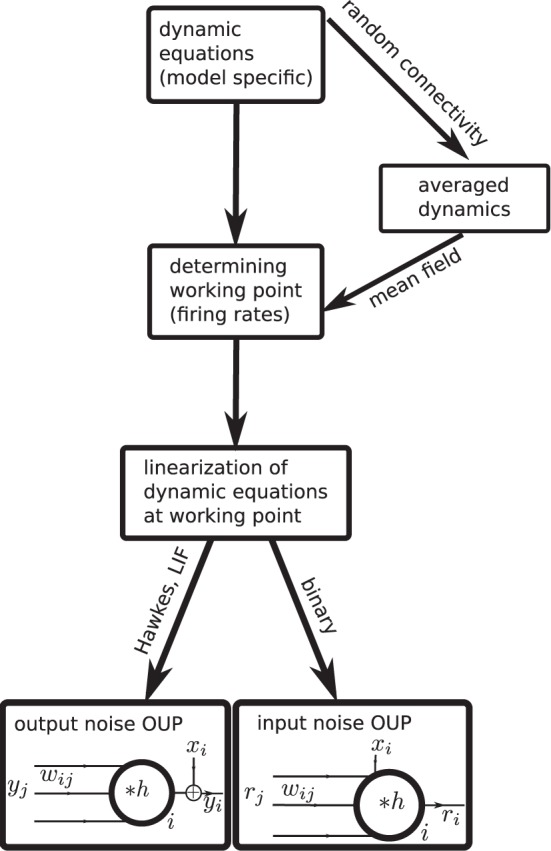
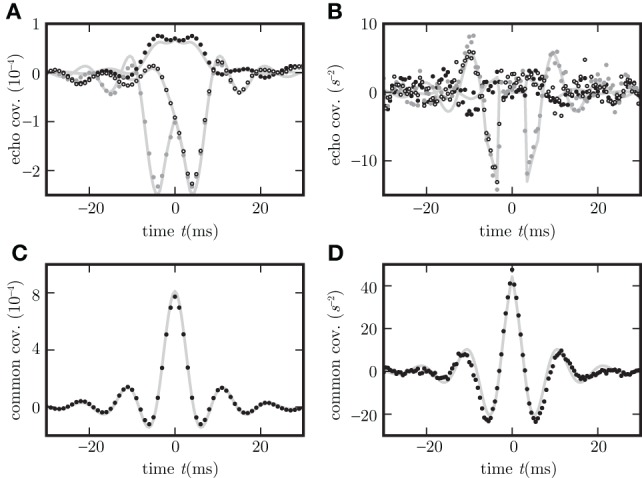
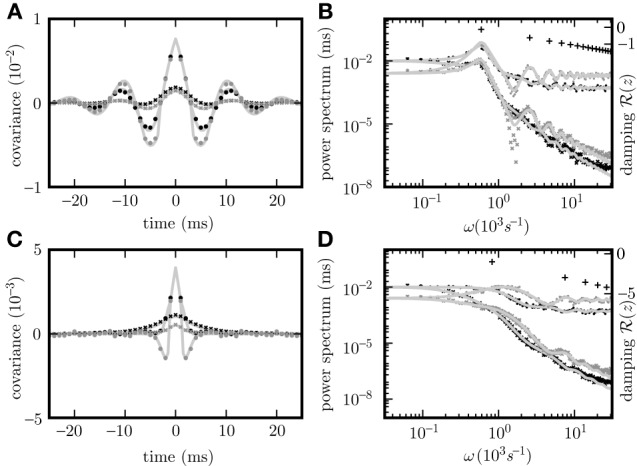
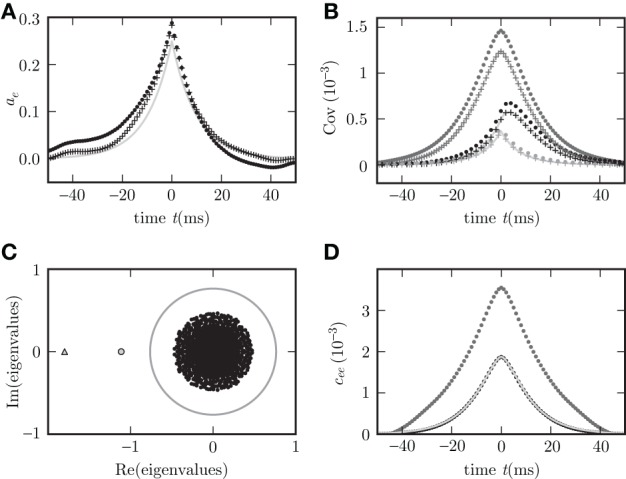
The diversity of neuron models used in contemporary theoretical neuroscience to investigate specific properties of covariances in the spiking activity raises the question how these models relate to each other. In particular it is hard to distinguish between generic properties of covariances and peculiarities due to the abstracted model. Here we present a unified view on pairwise covariances in recurrent networks in the irregular regime. We consider the binary neuron model, the leaky integrate-and-fire (LIF) model, and the Hawkes process. We show that linear approximation maps each of these models to either of two classes of linear rate models (LRM), including the Ornstein-Uhlenbeck process (OUP) as a special case. The distinction between both classes is the location of additive noise in the rate dynamics, which is located on the output side for spiking models and on the input side for the binary model. Both classes allow closed form solutions for the covariance. For output noise it separates into an echo term and a term due to correlated input. The unified framework enables us to transfer results between models. For example, we generalize the binary model and the Hawkes process to the situation with synaptic conduction delays and simplify derivations for established results. Our approach is applicable to general network structures and suitable for the calculation of population averages. The derived averages are exact for fixed out-degree network architectures and approximate for fixed in-degree. We demonstrate how taking into account fluctuations in the linearization procedure increases the accuracy of the effective theory and we explain the class dependent differences between covariances in the time and the frequency domain. Finally we show that the oscillatory instability emerging in networks of LIF models with delayed inhibitory feedback is a model-invariant feature: the same structure of poles in the complex frequency plane determines the population power spectra.
当代理论神经科学中用于研究尖峰活动协方差特定性质的神经元模型多样性提出了这样一个问题,即这些模型如何相互关联。特别是,由于模型的抽象性,很难区分协方差的通用属性和特殊性。在这里,我们呈现了一个在不规则状态下的递归网络中对成对协方差的统一观点。我们考虑了二进制神经元模型、漏电积分和放电(LIF)模型和 Hawkes 过程。我们表明,线性近似将这些模型中的每一个都映射到两个线性率模型(LRM)类别之一,包括 Ornstein-Uhlenbeck 过程(OUP)作为特例。这两个类别的区别在于率动力学中加性噪声的位置,对于尖峰模型位于输出侧,对于二进制模型位于输入侧。这两个类别都允许协方差的闭式解。对于输出噪声,它分为回声项和相关输入项。统一框架使我们能够在模型之间传递结果。例如,我们将二进制模型和 Hawkes 过程推广到具有突触传导延迟的情况,并简化了已建立结果的推导。我们的方法适用于一般的网络结构,适合于种群平均值的计算。推导的平均值对于固定的出度网络架构是精确的,对于固定的入度是近似的。我们展示了在线性化过程中考虑波动如何提高有效理论的准确性,并解释了在时间和频率域中协方差的类依赖性差异。最后,我们表明,具有延迟抑制反馈的 LIF 模型网络中出现的振荡不稳定性是一种不变的模型特征:复数频率平面中极点的相同结构决定了种群功率谱。