Carraro Nicolas, Matteau Dominick, Burrus Vincent, Rodrigue Sébastien
Laboratory of Bacterial Molecular Genetics; Département de Biologie; Université de Sherbrooke ; Sherbrooke, Canada.
Laboratory of Microbial Systems and Synthetic Biology; Département de Biologie; Université de Sherbrooke ; Sherbrooke, Canada.
Mob Genet Elements. 2015 May 21;5(3):1-5. doi: 10.1080/2159256X.2015.1045116. eCollection 2015 May-Jun.
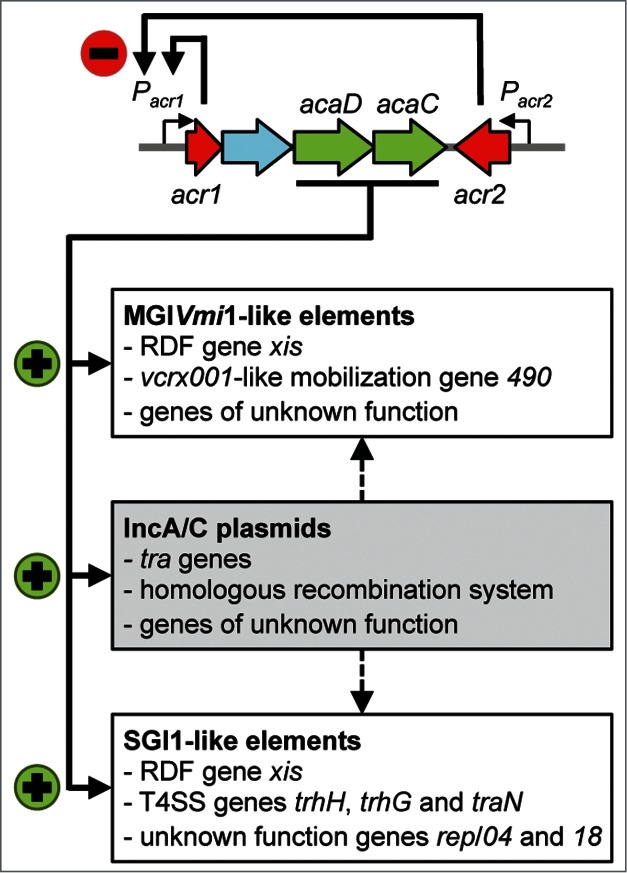
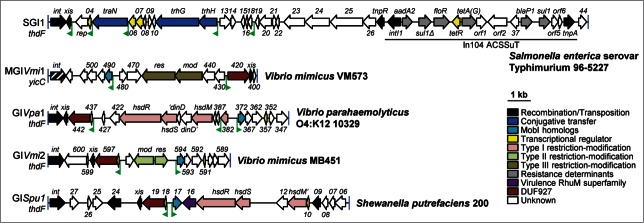
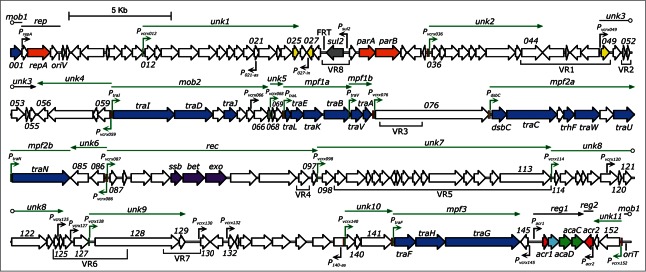
Conjugative plasmids of the A/C incompatibility group (IncA/C) have become substantial players in the dissemination of multidrug resistance. These large conjugative plasmids are characterized by their broad host-range, extended spectrum of antimicrobials resistance, and prevalence in enteric bacteria recovered from both environmental and clinical settings. Until recently, relatively little was known about the basic biology of IncA/C plasmids, mostly because of the hindrance of multidrug resistance for molecular biology experiments. To circumvent this issue, we previously developed pVCR94ΔX, a convenient prototype that codes for a reduced set of antibiotic resistances. Using pVCR94ΔX, we then characterized the regulatory pathway governing IncA/C plasmid dissemination. We found that the expression of roughly 2 thirds of the genes encoded by this plasmid, including large operons involved in the conjugation process, depends on an FlhCD-like master activator called AcaCD. Beyond the mobility of IncA/C plasmids, AcaCD was also shown to play a key role in the mobilization of different classes of genomic islands (GIs) identified in various pathogenic bacteria. By doing so, IncA/C plasmids can have a considerable impact on bacterial genomes plasticity and evolution.
A/C不相容群(IncA/C)的接合质粒已成为多重耐药性传播的重要因素。这些大型接合质粒的特点是宿主范围广、抗菌耐药谱广,且在从环境和临床环境中分离出的肠道细菌中普遍存在。直到最近,人们对IncA/C质粒的基本生物学特性了解相对较少,主要是因为多重耐药性给分子生物学实验带来了阻碍。为了解决这个问题,我们之前开发了pVCR94ΔX,这是一个方便的原型,编码一组减少的抗生素耐药性。利用pVCR94ΔX,我们随后对控制IncA/C质粒传播的调控途径进行了表征。我们发现,该质粒编码的大约三分之二的基因,包括参与接合过程的大型操纵子,其表达依赖于一种名为AcaCD的FlhCD样主激活因子。除了IncA/C质粒的移动性外,AcaCD还被证明在多种病原菌中鉴定出的不同类型基因组岛(GIs)的移动中起关键作用。通过这种方式,IncA/C质粒可以对细菌基因组的可塑性和进化产生相当大的影响。