de Cobelli Ottavio, Terracciano Daniela, Tagliabue Elena, Raimondi Sara, Bottero Danilo, Cioffi Antonio, Jereczek-Fossa Barbara, Petralia Giuseppe, Cordima Giovanni, Almeida Gilberto Laurino, Lucarelli Giuseppe, Buonerba Carlo, Matei Deliu Victor, Renne Giuseppe, Di Lorenzo Giuseppe, Ferro Matteo
Division of Urology, European Institute of Oncology, Milan, Italy.
Department of Translational Medical Sciences, University "Federico II", Naples, Italy.
PLoS One. 2015 Oct 7;10(10):e0139696. doi: 10.1371/journal.pone.0139696. eCollection 2015.
The aim of this study was to investigate the prognostic performance of multiparametric magnetic resonance imaging (mpMRI) and Prostate Imaging Reporting and Data System (PIRADS) score in predicting pathologic features in a cohort of patients eligible for active surveillance who underwent radical prostatectomy.
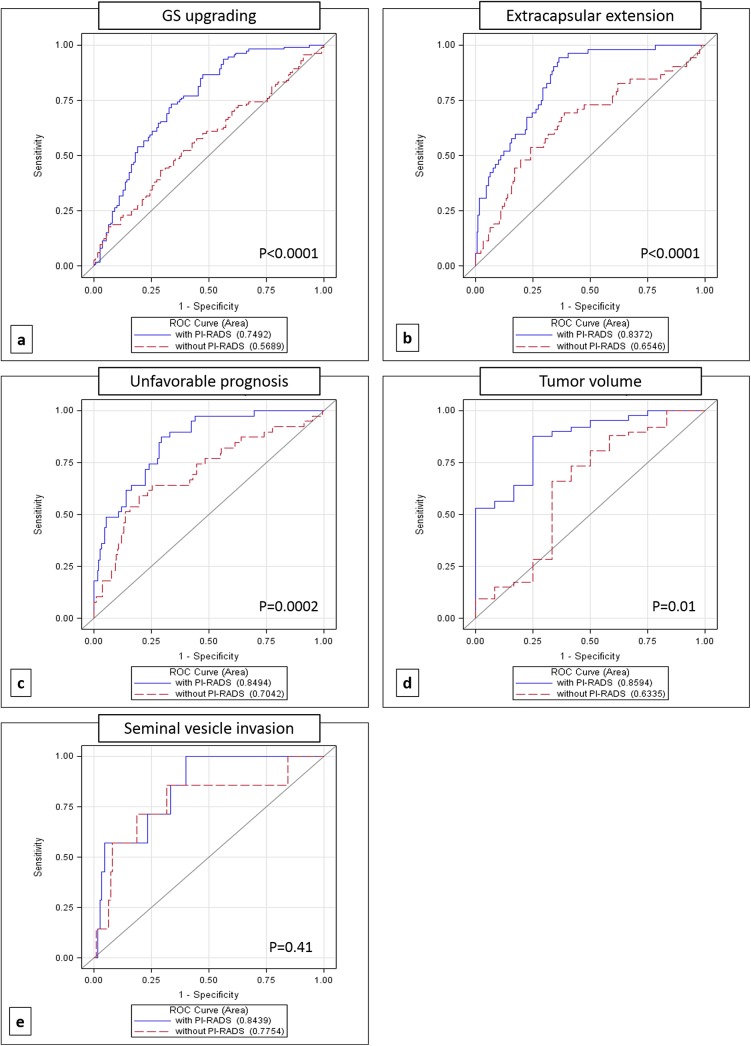
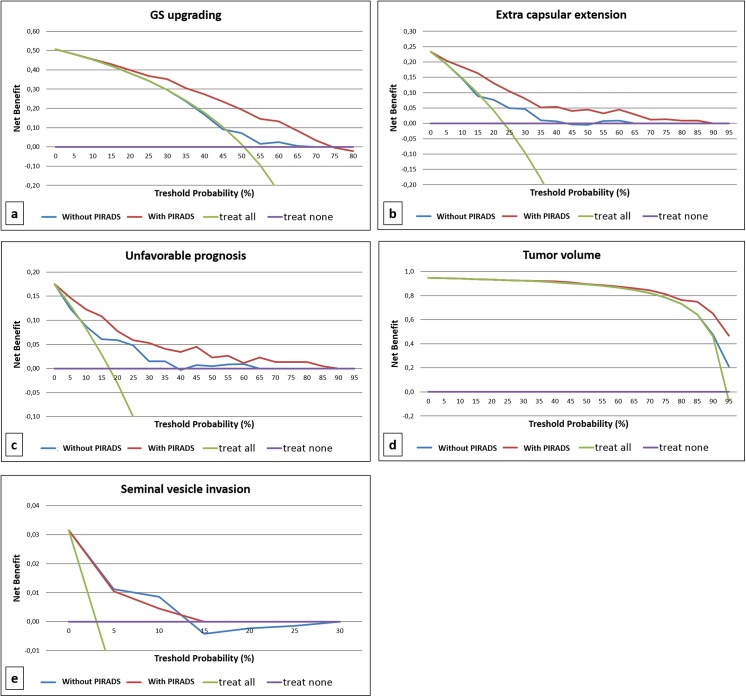
A total of 223 patients who fulfilled the criteria for "Prostate Cancer Research International: Active Surveillance", were included. Mp-1.5 Tesla MRI examination staging with endorectal coil was performed at least 6-8 weeks after TRUS-guided biopsy. In all patients, the likelihood of the presence of cancer was assigned using PIRADS score between 1 and 5. Outcomes of interest were: Gleason score upgrading, extra capsular extension (ECE), unfavorable prognosis (occurrence of both upgrading and ECE), large tumor volume (≥ 0.5 ml), and seminal vesicle invasion (SVI). Receiver Operating Characteristic (ROC) curves and Decision Curve Analyses (DCA) were performed for models with and without inclusion of PIRADS score.
Multivariate analysis demonstrated the association of PIRADS score with upgrading (P < 0.0001), ECE (P < 0.0001), unfavorable prognosis (P < 0.0001), and large tumor volume (P = 0.002). ROC curves and DCA showed that models including PIRADS score resulted in greater net benefit for almost all the outcomes of interest, with the only exception of SVI.
mpMRI and PIRADS scoring are feasible tools in clinical setting and could be used as decision-support systems for a more accurate selection of patients eligible for AS.
本研究旨在调查多参数磁共振成像(mpMRI)和前列腺影像报告和数据系统(PIRADS)评分在预测接受根治性前列腺切除术的主动监测合格患者队列的病理特征方面的预后性能。
共纳入223例符合“国际前列腺癌研究:主动监测”标准的患者。在经直肠超声引导下活检至少6 - 8周后,使用直肠内线圈进行1.5特斯拉mpMRI检查分期。在所有患者中,使用1至5分的PIRADS评分来确定癌症存在的可能性。感兴趣的结果包括: Gleason评分升级、包膜外侵犯(ECE)、不良预后(升级和ECE均发生)、大肿瘤体积(≥0.5毫升)和精囊侵犯(SVI)。对包含和不包含PIRADS评分的模型进行了受试者操作特征(ROC)曲线和决策曲线分析(DCA)。
多变量分析表明PIRADS评分与升级(P < 0.0001)、ECE(P < 0.0001)、不良预后(P < 0.0001)和大肿瘤体积(P = 0.002)相关。ROC曲线和DCA显示,除SVI外,包含PIRADS评分的模型几乎对所有感兴趣的结果都产生了更大的净效益。
mpMRI和PIRADS评分在临床环境中是可行的工具,可作为决策支持系统,用于更准确地选择适合主动监测的患者。