Baron Frédéric, Labopin Myriam, Ruggeri Annalisa, Mohty Mohamad, Sanz Guillermo, Milpied Noel, Bacigalupo Andrea, Rambaldi Alessandro, Bonifazi Francesca, Bosi Alberto, Sierra Jorge, Yakoub-Agha Ibrahim, Santasusana Josep Maria Ribera, Gluckman Eliane, Nagler Arnon
Department of Hematology, University of Liège, CHU Sart-Tilman, 4000, Liège, Belgium.
EBMT Paris Office, Hospital Saint Antoine, Paris, France.
J Hematol Oncol. 2015 Oct 6;8:107. doi: 10.1186/s13045-015-0207-4.
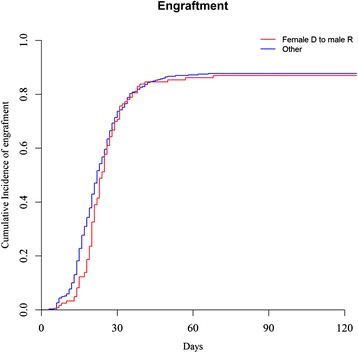
In the setting of allogeneic human leukocyte antigen (HLA)-matched bone marrow transplantation, transplanting male patients with grafts from female donors has been associated with a higher incidence of graft-versus-host disease (GVHD) and of nonrelapse mortality (NRM). The aim of the current analysis was to compare transplantation outcomes in male patients given female unrelated cord blood (UCB) versus other gender combinations.
Data from 552 consecutive patients with acute myeloid leukemia (AML) given a single UCB transplantation between 2000 and 2014 were included.
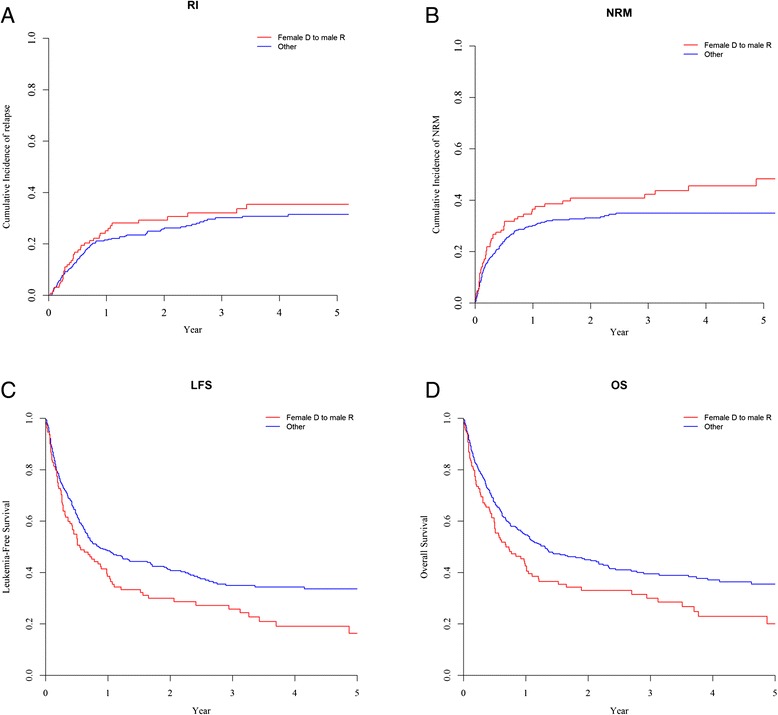
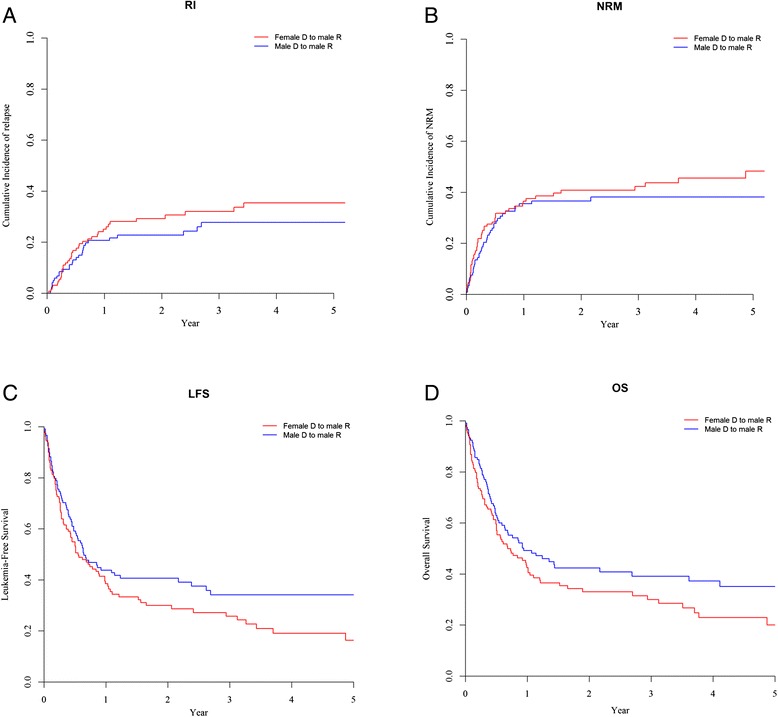
In comparison with other gender combination, male patients given female UCB (n = 131) had a trend for a higher incidence of grades II-IV acute GVHD (33 versus 25 %, P = 0.08), a trend for a higher incidence of NRM (41 versus 33 %, P = 0.06), and a lower leukemia-free (LFS, 30 versus 41 %, P = 0.01) and overall survival (OS, 33 versus 45 %, P = 0.008). In multivariate analyses, taking into consideration all patients for which data on HLA-matching and cell dose transplanted were fully available (n = 363), male patients transplanted with a female UCB had a trend for a higher incidence of grade III-IV acute GVHD (hazard ratio (HR) = 2.0, P = 0.06), a trend for a higher NRM (HR = 1.5, P = 0.06), and a worse LFS (HR = 1.4, P = 0.04) and OS (HR = 1.3, P = 0.06).
Our data suggest that male patients transplanted with female UCB might have higher risk of acute GVHD and of NRM leading to worse LFS and OS. These results should be confirmed in other large cohorts of patients before used for determining the choice of an UCB unit.
在人类白细胞抗原(HLA)匹配的同种异体骨髓移植中,男性患者接受女性供体的移植物与较高的移植物抗宿主病(GVHD)发病率和非复发死亡率(NRM)相关。本分析的目的是比较男性患者接受女性无关脐血(UCB)与其他性别组合的移植结果。
纳入2000年至2014年间连续接受单次UCB移植的552例急性髓系白血病(AML)患者的数据。
与其他性别组合相比,接受女性UCB的男性患者(n = 131)有II-IV级急性GVHD发病率较高的趋势(33%对25%,P = 0.08),NRM发病率较高的趋势(41%对33%,P = 0.06),以及较低的无白血病生存率(LFS,30%对41%,P = 0.01)和总生存率(OS,33%对45%,P = 0.008)。在多变量分析中,考虑到HLA匹配和移植细胞剂量数据完全可用的所有患者(n = 363),接受女性UCB移植的男性患者有III-IV级急性GVHD发病率较高的趋势(风险比(HR)= 2.0,P = 0.06),NRM较高的趋势(HR = 1.5,P = 0.06),以及较差的LFS(HR = 1.4,P = 0.04)和OS(HR = 1.3,P = 0.06)。
我们的数据表明,接受女性UCB移植的男性患者可能有更高的急性GVHD和NRM风险,导致更差的LFS和OS。在用于确定UCB单位的选择之前,这些结果应在其他大型患者队列中得到证实。