Chen Zhen, Sun He, Huang Jinhai, Wu Yao, Liu Dehua
Institute of Applied Chemistry, Department of Chemical Engineering, Tsinghua University, Beijing 100084, China; Tsinghua Innovation Center in Dongguan, Dongguan 523808, China.
Institute of Applied Chemistry, Department of Chemical Engineering, Tsinghua University, Beijing 100084, China.
PLoS One. 2015 Oct 14;10(10):e0140508. doi: 10.1371/journal.pone.0140508. eCollection 2015.
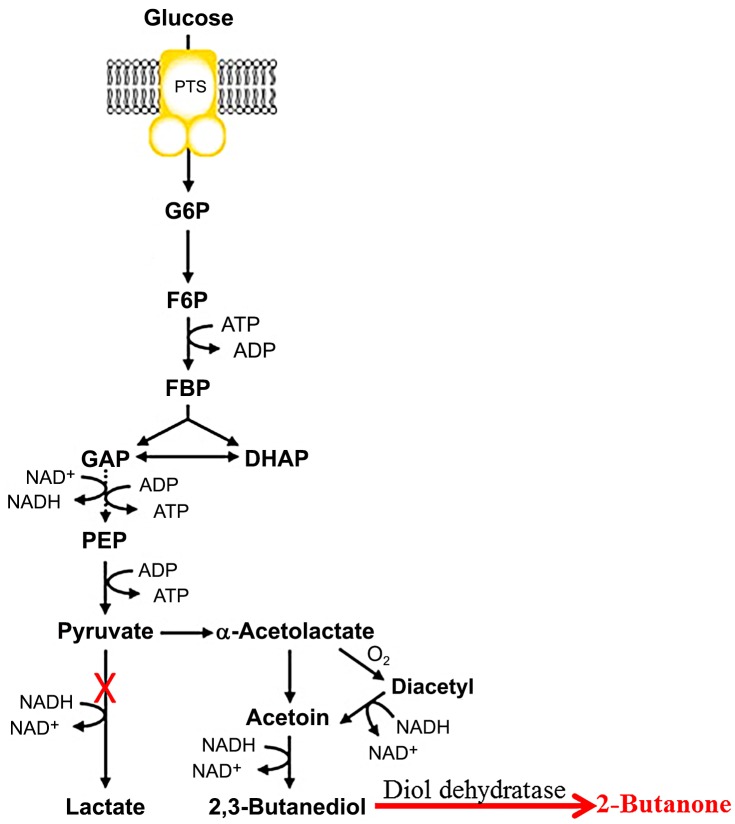
2-Butanone is an important commodity chemical of wide application in different areas. In this study, Klebsiella pneumoniae was engineered to directly produce 2-butanone from glucose by extending its native 2, 3-butanediol synthesis pathway. To identify the potential enzyme for the efficient conversion of 2, 3-butanediol to 2-butanone, we screened different glycerol dehydratases and diol dehydratases. By introducing the diol dehydratase from Lactobacillus brevis and deleting the ldhA gene encoding lactate dehydrogenase, the engineered K. pneumoniae was able to accumulate 246 mg/L of 2-butanone in shake flask. With further optimization of culture condition, the titer of 2-butanone was increased to 450 mg/L. This study lays the basis for developing an efficient biological process for 2-butanone production.
2-丁酮是一种重要的化工产品,在不同领域有着广泛的应用。在本研究中,通过扩展肺炎克雷伯菌天然的2,3-丁二醇合成途径,对其进行工程改造,使其能够直接从葡萄糖生产2-丁酮。为了鉴定将2,3-丁二醇高效转化为2-丁酮的潜在酶,我们筛选了不同的甘油脱水酶和二醇脱水酶。通过引入短乳杆菌的二醇脱水酶并删除编码乳酸脱氢酶的ldhA基因,工程改造后的肺炎克雷伯菌能够在摇瓶中积累246 mg/L的2-丁酮。随着培养条件的进一步优化,2-丁酮的产量提高到了450 mg/L。本研究为开发高效生产2-丁酮的生物工艺奠定了基础。