Crawley Amy A, Sherman Ross A, Crawley William R, Cosio-Lima Ludmila M
1Department of Exercise Science and Community Health, University of West Florida, Pensacola, Florida; 2Department of Movement Science, Grand Valley State University, Allendale, Michigan; and 3Criminology and Criminal Justice, University of West Florida, Pensacola, Florida.
J Strength Cond Res. 2016 May;30(5):1416-24. doi: 10.1519/JSC.0000000000001229.
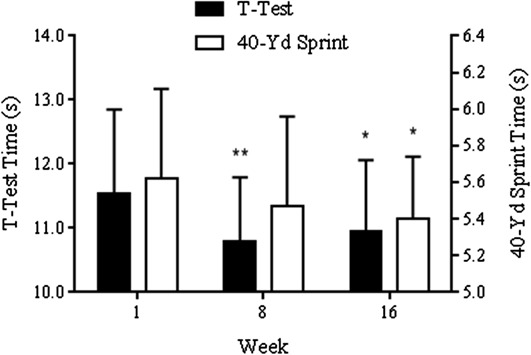
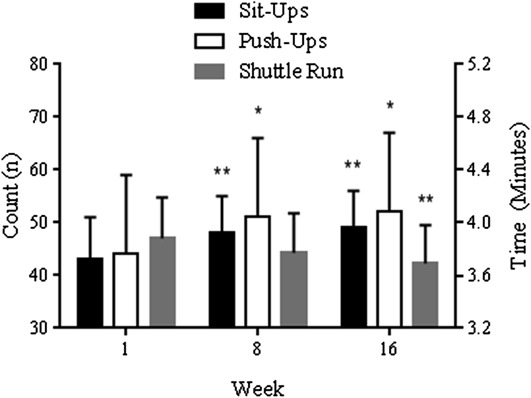
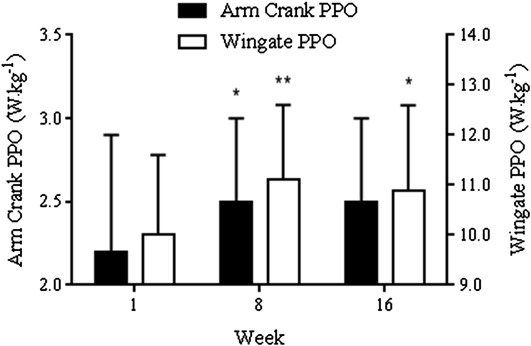
Police academies traditionally emphasize the importance of being physically fit. The purpose of this research was to determine cadet baseline physical fitness characteristics and assess effectiveness of a 16-week training program. Sixty-eight cadets (61 men, 7 women) volunteered to have baseline physical fitness characteristics assessed, and 55 cadets (49 men, 6 women) completed further testing at weeks 8 and 16. The testing comprised hand grip (strength), arm crank (upper-body power), 30 seconds Wingate (lower body power), sum of skinfolds and percentage body fat (body composition), 40-yard dash (sprint speed), 1 repetition maximum bench press (strength), T-test (agility), and sit-and-reach (flexibility). In addition, cadets completed standardized state testing (push-ups, sit-ups, vertical jump, and half-mile shuttle run). The training program consisted of 1 hour sessions, 3 d·wk, including aerobic, plyometrics, body weight, and resistance exercise. Significant changes were found in agility (p < 0.01), upper-body and lower-body peak power (p ≤ 0.05), sit-ups (p < 0.01), push-ups (p ≤ 0.05) across the first 8 weeks, and in agility (p ≤ 0.05), lower-body peak power (p ≤ 0.05), sit-ups (p < 0.01), push-ups (p ≤ 0.05), half-mile shuttle run (p < 0.01) across the full 16 weeks. However, none of the variables showed significant change across the second half of the program (weeks 8-16). A number of individual parameters of physical fitness showed evidence of improvement in the first 8 weeks, whereas none of the variables showed significant improvement in the second 8 weeks. This suggests modifications could be made to increase overall effectiveness of cadet physical training specifically after the 8-week mark.
警察院校传统上强调身体健康的重要性。本研究的目的是确定学员的基线体能特征,并评估一项为期16周的训练计划的有效性。68名学员(61名男性,7名女性)自愿接受基线体能特征评估,55名学员(49名男性,6名女性)在第8周和第16周完成了进一步测试。测试包括握力(力量)、手臂曲柄运动(上身力量)、30秒温盖特测试(下身力量)、皮褶厚度总和及体脂百分比(身体成分)、40码短跑(冲刺速度)、1次最大重复卧推(力量)、T字测试(敏捷性)和坐立前屈(柔韧性)。此外,学员们还完成了标准化的体能测试(俯卧撑、仰卧起坐、垂直纵跳和半英里穿梭跑)。训练计划包括每周3天、每次1小时的课程,包括有氧运动、增强式训练、体重训练和阻力训练。在前8周内,敏捷性(p < 0.01)、上身和下身峰值功率(p ≤ 0.05)、仰卧起坐(p < 0.01)、俯卧撑(p ≤ 0.05)有显著变化,在整个16周内,敏捷性(p ≤ 0.05)、下身峰值功率(p ≤ 0.05)、仰卧起坐(p < 0.01)、俯卧撑(p ≤ 0.05)、半英里穿梭跑(p < 0.01)有显著变化。然而,在训练计划的后半段(第8 - 16周),没有一个变量显示出显著变化。一些体能的个体参数在前8周有改善的迹象,而在第二个8周没有一个变量显示出显著改善。这表明可以进行调整,以提高学员体能训练的整体效果,特别是在8周这个时间节点之后。