Wong Te-Chih, Chen Yu-Tong, Wu Pei-Yu, Chen Tzen-Wen, Chen Hsi-Hsien, Chen Tso-Hsiao, Yang Shwu-Huey
School of Nutrition and Health Sciences, Taipei Medical University, Taipei, Taiwan, R.O.C.
Division of Nephrology, Department of Internal Medicine, Taipei Medical University Hospital, Taipei, Taiwan, R.O.C.
PLoS One. 2015 Oct 14;10(10):e0140402. doi: 10.1371/journal.pone.0140402. eCollection 2015.
n-3 polyunsaturated fatty acids (PUFAs) might be useful nutritional strategy for treating patients with sarcopenia. We evaluated the effect of the intake of dietary n-3 PUFAs on the skeletal muscle mass (SMM), appendicular skeletal muscle mass (ASM), and its determinants in patients receiving standard hemodialysis (HD) treatment for the management of end stage renal disease.
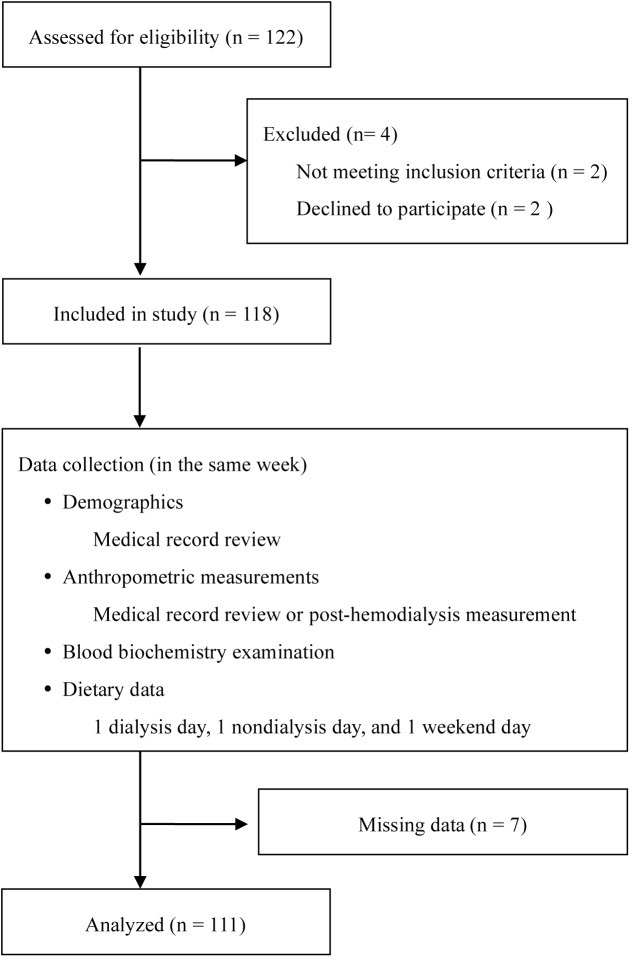
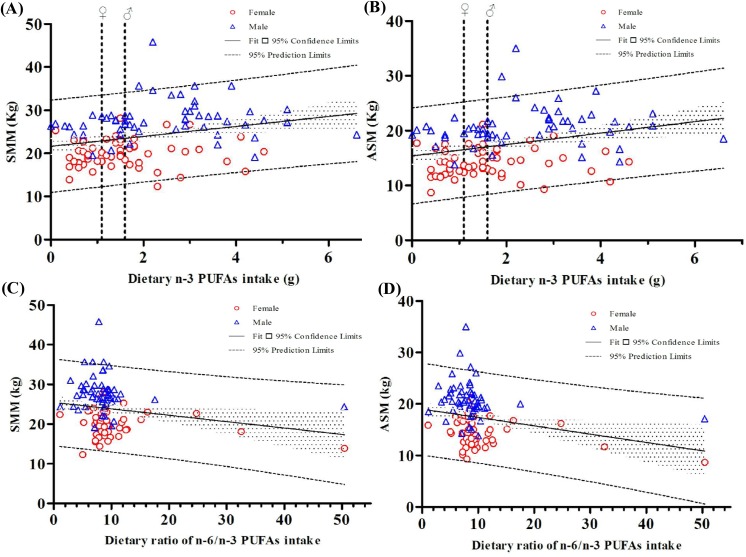
In this cross-sectional study, data of 111 HD patients were analyzed. Anthropometric and bioelectrical impedance measurements used to estimate the muscle mass were performed the day of dialysis immediately after the dialysis session. Routine laboratory and 3-day dietary data were also collected. The cutoff value of adequate intake (AI) for both n-3 PUFAs and alpha-linolenic acid (ALA) was 1.6 g/day and 1.1 g/day for men and women, respectively.
The mean age, mean dietary n-3 PUFAs intake, ALA intake, ratio of n-6/n-3 PUFAs intake, SMM, and ASM of patients were 61.4 ± 10.4 years, 2.0 ± 1.3 g/day, 1.5 ± 1.0 g/day, 9.5 ± 6.7 g/day, 23.9 ± 5.5 kg, and 17.5 ± 4.5 kg, respectively. A higher SMM and ASM significantly observed in patients who achieved an AI of n-3 PUFAs. Similar trends appeared to be observed among those patients who achieved the AI of ALA, but the difference was not significantly, except for ASM (P = 0.047). No relevant differences in demographics, laboratory and nutritional parameters were observed, regardless of whether the patients achieved an AI of n-3 PUFAs. Multivariate analysis showed that the BMI and equilibrated Kt/V were independent determinants of the muscle mass. Moreover, the ratio of n-6/n-3 PUFAs was an independent risk determinant of reduced ASM in HD patients.
Patients with an AI of n-3 PUFAs had better total-body SMM and ASM. A higher dietary ratio of n-6/n-3 PUFAs seemed to be associated with a reduced muscle mass in HD patients.
n-3多不饱和脂肪酸(PUFAs)可能是治疗肌肉减少症患者的有效营养策略。我们评估了饮食中摄入n-3 PUFAs对接受标准血液透析(HD)治疗终末期肾病患者的骨骼肌质量(SMM)、四肢骨骼肌质量(ASM)及其决定因素的影响。
在这项横断面研究中,分析了111例HD患者的数据。在透析 session 结束后立即进行透析当天,使用人体测量和生物电阻抗测量来估计肌肉质量。还收集了常规实验室数据和3天饮食数据。n-3 PUFAs和α-亚麻酸(ALA)的适宜摄入量(AI)临界值,男性分别为1.6 g/天,女性为1.1 g/天。
患者的平均年龄、饮食中n-3 PUFAs平均摄入量、ALA摄入量、n-6/n-3 PUFAs摄入量比值、SMM和ASM分别为61.4±10.4岁、2.0±1.3 g/天、1.5±1.0 g/天、9.5±6.7 g/天、23.9±5.5 kg和17.5±4.5 kg。在达到n-3 PUFAs AI的患者中,显著观察到更高的SMM和ASM。在达到ALA AI的患者中似乎也观察到类似趋势,但除ASM外,差异不显著(P = 0.047)。无论患者是否达到n-3 PUFAs的AI,在人口统计学、实验室和营养参数方面均未观察到相关差异。多变量分析表明,BMI和平衡的Kt/V是肌肉质量的独立决定因素。此外,n-6/n-3 PUFAs比值是HD患者ASM降低的独立风险决定因素。
达到n-3 PUFAs AI的患者具有更好的全身SMM和ASM。HD患者中较高的饮食n-6/n-3 PUFAs比值似乎与肌肉质量降低有关。