Gruwell Matthew E, Flarhety Meghan, Dittmar Katharina
Penn State Erie, School of Science. P-1 Prischak Building, 4205 College Drive, Erie, PA 16563, USA.
Department of Biological Sciences, 109 Cooke Hall, SUNY at Buffalo, Buffalo, NY 14260, USA.
Insects. 2012 Feb 29;3(1):262-9. doi: 10.3390/insects3010262.
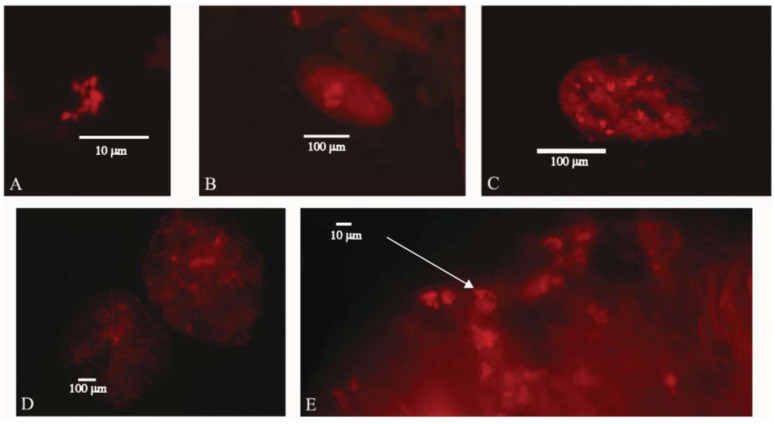
It has long been known that armored scale insects harbor endosymbiotic bacteria inside specialized cells called bacteriocytes. Originally, these endosymbionts were thought to be fungal symbionts but they are now known to be bacterial and have been named Uzinura diaspidicola. Bacteriocyte and endosymbiont distribution patterns within host insects were visualized using in situ hybridization via 16S rRNA specific probes. Images of scale insect embryos, eggs and adult scale insects show patterns of localized bacteriocytes in embryos and randomly distributed bacteriocytes in adults. The symbiont pocket was not found in the armored scale insect eggs that were tested. The pattern of dispersed bacteriocytes in adult scale insects suggest that Uzinura and Blattabacteria may share some homologous traits that coincide with similar life style requirements, such as dispersal in fat bodies and uric acid recycling.
长期以来,人们一直知道介壳虫在称为含菌细胞的特殊细胞内携带着内共生细菌。最初,这些内共生体被认为是真菌共生体,但现在已知它们是细菌,并被命名为Uzinura diaspidicola。通过16S rRNA特异性探针原位杂交观察宿主昆虫体内含菌细胞和内共生体的分布模式。介壳虫胚胎、卵和成虫的图像显示,胚胎中的含菌细胞呈局部化模式,而成虫中的含菌细胞呈随机分布。在所测试的介壳虫卵中未发现共生体囊。成虫介壳虫中含菌细胞的分散模式表明,Uzinura和蜚蠊杆菌可能具有一些同源特征,这些特征与类似的生活方式需求相吻合,如在脂肪体中的分散和尿酸循环利用。