Joung Jae Young, Lim Jiwon, Oh Chang-Mo, Jung Kyu-Won, Cho Hyunsoon, Kim Sung Han, Seo Ho Kyung, Park Weon Seo, Chung Jinsoo, Lee Kang Hyun, Won Young-Joo
Center for Prostate Cancer, National Cancer Center, Goyang, Korea.
Cancer Registration and Statistics Branch, National Cancer Center, Goyang, Korea.
PLoS One. 2015 Oct 15;10(10):e0140693. doi: 10.1371/journal.pone.0140693. eCollection 2015.
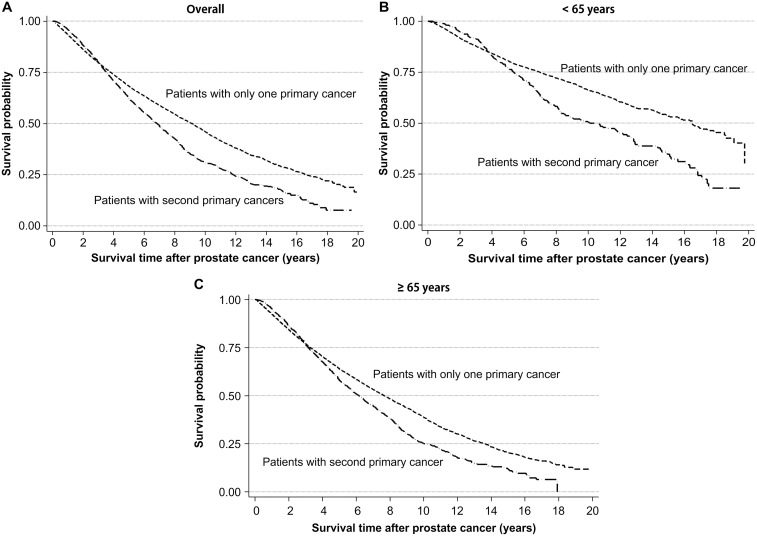
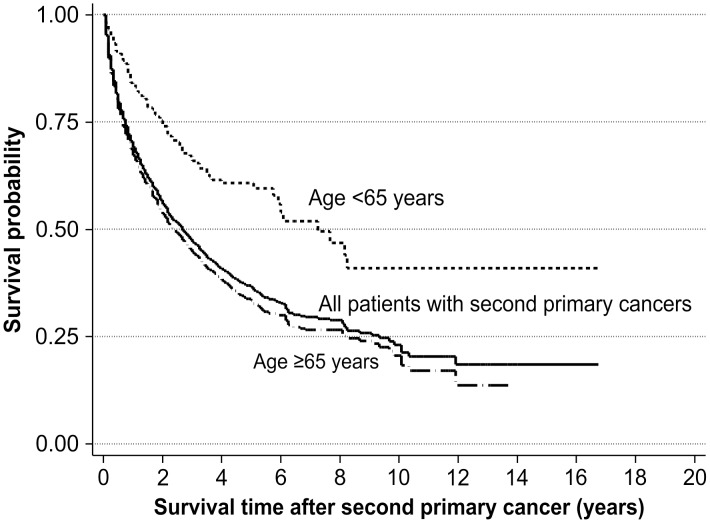
As patients with prostate cancer have a long life expectancy, there is increasing interest in predicting the risk of development of a second primary cancer (SPC), and we therefore designed this study to estimate the overall risk of developing SPCs among Korean prostate cancer patients. We used a population-based cohort from the Korean Central Cancer Registry composed of 55,378 men diagnosed with a first primary prostate cancer between 1993 and 2011. Standardized incidence ratios (SIRs) of SPCs were analyzed by age at diagnosis, latency period, period of diagnosis, and type of initial treatment. Survival analysis was stratified by development of SPC. Men with primary prostate cancer had an overall lower risk of developing an SPC [SIR = 0.75; 95% CI, 0.72-0.78], which was significant for SPCs of the esophagus, stomach, rectum, liver, gallbladder, bile duct, pancreas, larynx, lung, and bronchus. In contrast, there were significant increases in the risk of bladder and thyroid cancers, which tended to decrease after longer follow-up. Patients who received initial radiation therapy had an increased risk of subsequent rectal cancer, although this was still lower than that of the general male population. Other urinary tract cancers including those of the kidney, renal pelvis, and ureter tended to be associated with a higher risk of developing an SPC, but this difference did not reach statistical significance. The patients with prostate cancer and SPC had lower overall survival rates than those with one primary prostate cancer. Our findings suggest that men with prostate cancer have a 25% lower risk of developing an SPC in Korea, but a higher risk of developing subsequent bladder and thyroid cancers, which suggests the need for continued cancer surveillance among prostate cancer survivors.
由于前列腺癌患者预期寿命较长,人们对预测发生第二原发性癌症(SPC)的风险越来越感兴趣,因此我们设计了本研究,以评估韩国前列腺癌患者发生SPC的总体风险。我们使用了来自韩国中央癌症登记处的基于人群的队列,该队列由1993年至2011年间被诊断为原发性前列腺癌的55378名男性组成。通过诊断时的年龄、潜伏期、诊断时期和初始治疗类型分析SPC的标准化发病率(SIR)。生存分析按SPC的发生情况进行分层。原发性前列腺癌男性发生SPC的总体风险较低[SIR = 0.75;95% CI,0.72 - 0.78],这在食管、胃、直肠、肝、胆囊、胆管、胰腺、喉、肺和支气管的SPC中具有显著性。相比之下,膀胱癌和甲状腺癌的风险显著增加,且在较长随访期后有下降趋势。接受初始放射治疗的患者随后发生直肠癌的风险增加,尽管仍低于一般男性人群。包括肾、肾盂和输尿管在内的其他泌尿系统癌症发生SPC的风险往往较高,但这种差异未达到统计学显著性。患有前列腺癌和SPC的患者的总生存率低于仅患有原发性前列腺癌的患者。我们的研究结果表明,在韩国,前列腺癌男性发生SPC的风险降低25%,但发生随后的膀胱癌和甲状腺癌的风险较高,这表明前列腺癌幸存者需要持续的癌症监测。