Kratochwil Claudius F, Geissler Laura, Irisarri Iker, Meyer Axel
Department of Biology, University of Konstanz, Germany Zukunftskolleg, University of Konstanz, Germany.
Department of Biology, University of Konstanz, Germany.
Genome Biol Evol. 2015 Oct 15;7(11):3033-46. doi: 10.1093/gbe/evv200.
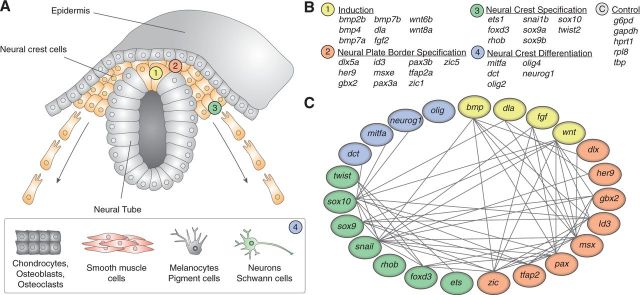
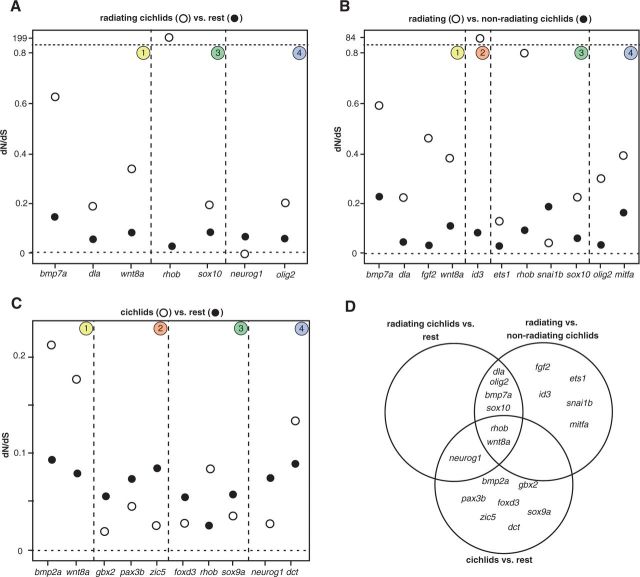
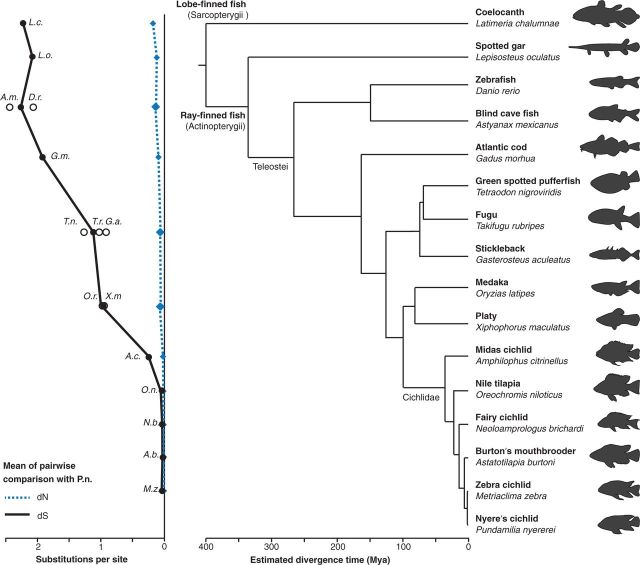
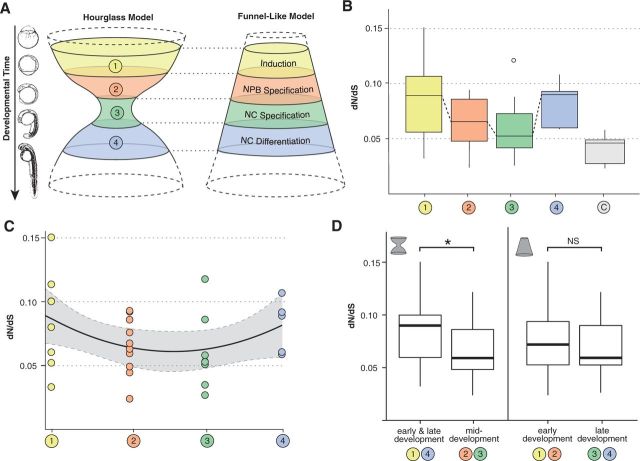
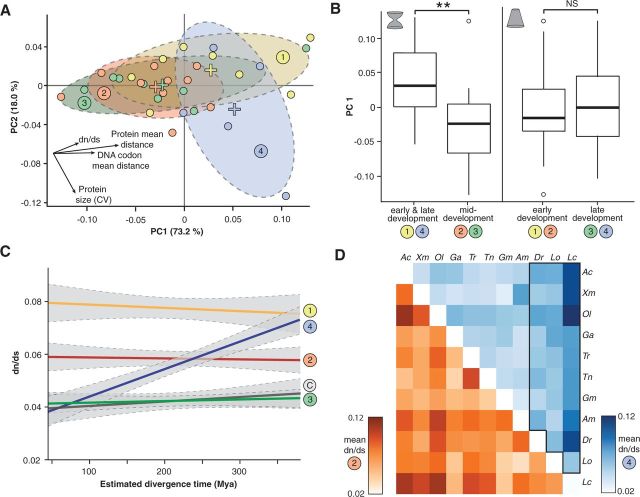
Gene regulatory networks (GRN) are central to developmental processes. They are composed of transcription factors and signaling molecules orchestrating gene expression modules that tightly regulate the development of organisms. The neural crest (NC) is a multipotent cell population that is considered a key innovation of vertebrates. Its derivatives contribute to shaping the astounding morphological diversity of jaws, teeth, head skeleton, or pigmentation. Here, we study the molecular evolution of the NC GRN by analyzing patterns of molecular divergence for a total of 36 genes in 16 species of bony fishes. Analyses of nonsynonymous to synonymous substitution rate ratios (dN/dS) support patterns of variable selective pressures among genes deployed at different stages of NC development, consistent with the developmental hourglass model. Model-based clustering techniques of sequence features support the notion of extreme conservation of NC-genes across the entire network. Our data show that most genes are under strong purifying selection that is maintained throughout ray-finned fish evolution. Late NC development genes reveal a pattern of increased constraints in more recent lineages. Additionally, seven of the NC-genes showed signs of relaxation of purifying selection in the famously species-rich lineage of cichlid fishes. This suggests that NC genes might have played a role in the adaptive radiation of cichlids by granting flexibility in the development of NC-derived traits-suggesting an important role for NC network architecture during the diversification in vertebrates.
基因调控网络(GRN)是发育过程的核心。它们由转录因子和信号分子组成,这些分子协调基因表达模块,从而严格调控生物体的发育。神经嵴(NC)是一种多能细胞群体,被认为是脊椎动物的一项关键创新。它的衍生物有助于塑造颌骨、牙齿、头部骨骼或色素沉着等令人惊叹的形态多样性。在这里,我们通过分析16种硬骨鱼中总共36个基因的分子分歧模式,研究了神经嵴基因调控网络的分子进化。非同义替换率与同义替换率之比(dN/dS)的分析支持了在神经嵴发育不同阶段所涉及基因之间存在可变选择压力的模式,这与发育沙漏模型一致。基于模型的序列特征聚类技术支持了神经嵴基因在整个网络中极度保守的观点。我们的数据表明,大多数基因处于强烈的纯化选择之下,这种选择在辐鳍鱼的整个进化过程中一直保持。神经嵴后期发育基因在最近的谱系中显示出约束增加的模式。此外,在物种丰富的丽鱼科鱼类谱系中,有7个神经嵴基因显示出纯化选择放松的迹象。这表明神经嵴基因可能通过赋予神经嵴衍生性状发育的灵活性,在丽鱼科鱼类的适应性辐射中发挥了作用——这表明神经嵴网络结构在脊椎动物多样化过程中具有重要作用。