Beachley Vince Z, Wolf Matthew T, Sadtler Kaitlyn, Manda Srikanth S, Jacobs Heather, Blatchley Michael R, Bader Joel S, Pandey Akhilesh, Pardoll Drew, Elisseeff Jennifer H
Translational Tissue Engineering Center, Wilmer Eye Institute and Department of Biomedical Engineering, Johns Hopkins University, Baltimore, Maryland, USA.
Department of Biomedical Engineering, Rowan University, Glassboro, New Jersey, USA.
Nat Methods. 2015 Dec;12(12):1197-204. doi: 10.1038/nmeth.3619. Epub 2015 Oct 19.
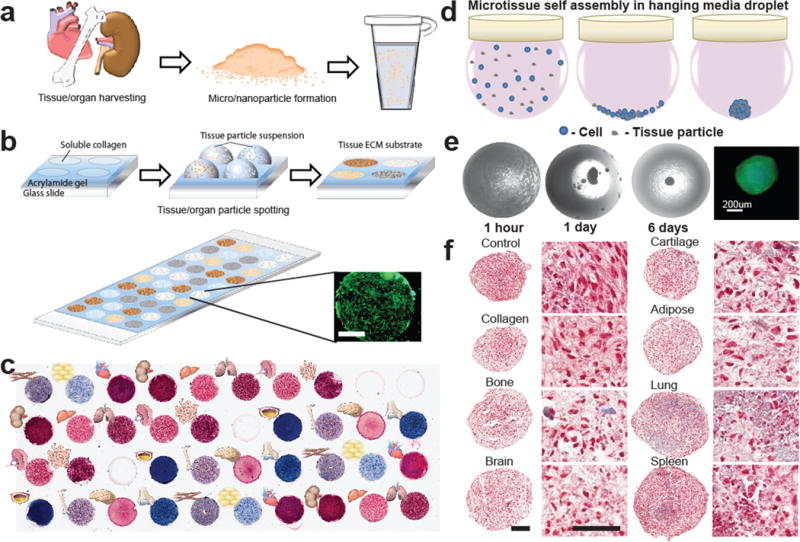
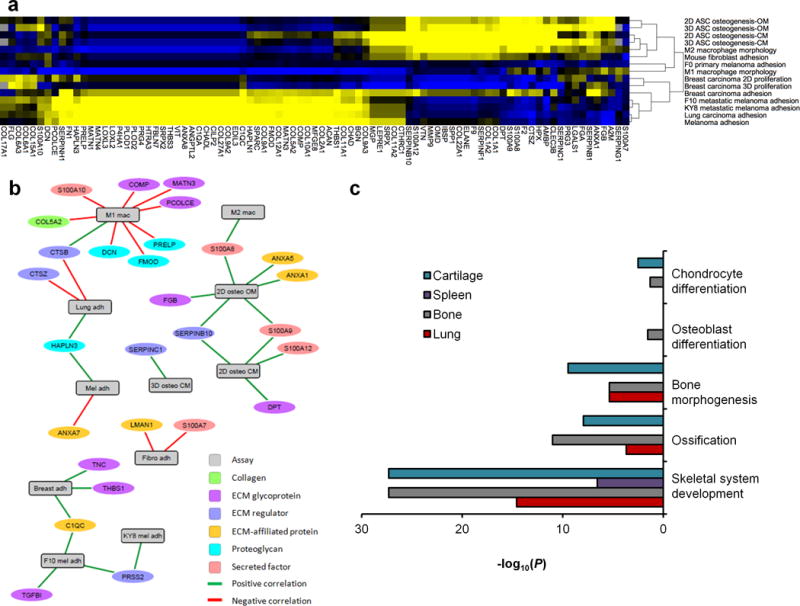
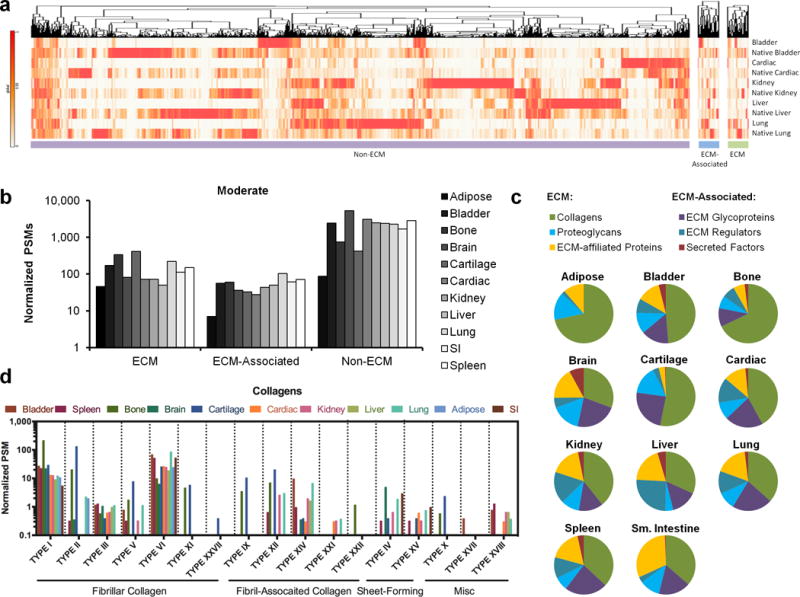
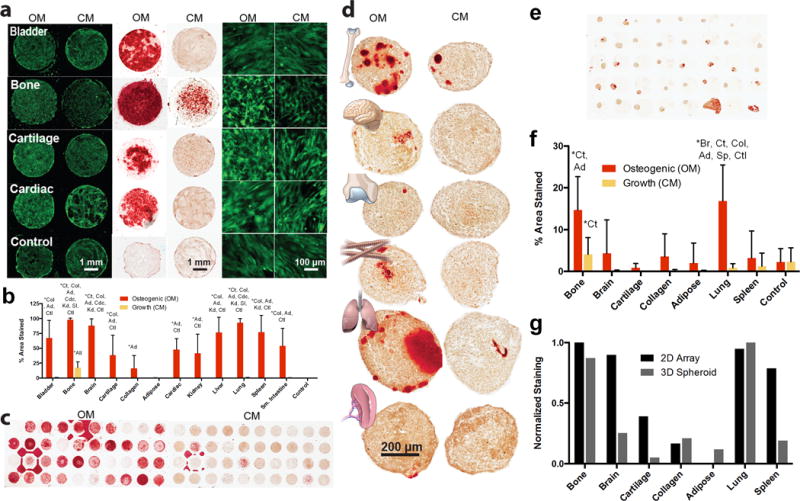
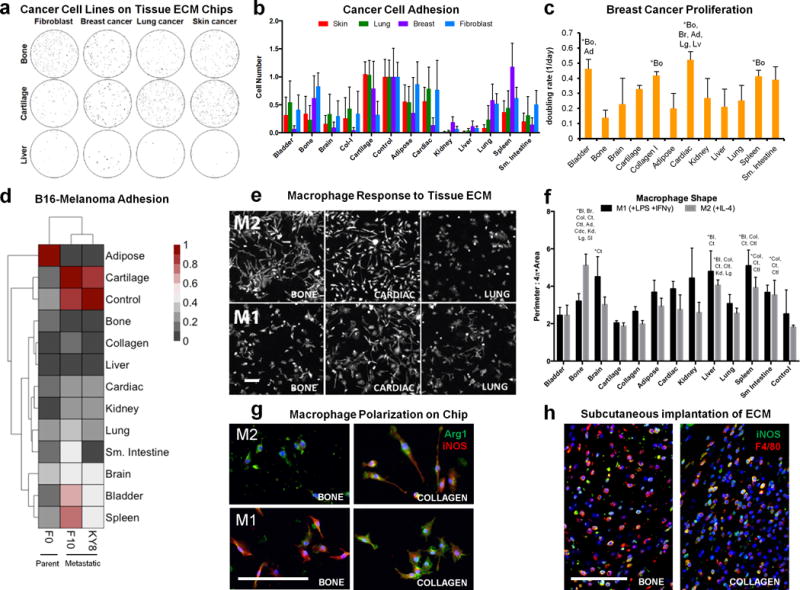
Cell and protein arrays have demonstrated remarkable utility in the high-throughput evaluation of biological responses; however, they lack the complexity of native tissue and organs. Here we spotted tissue extracellular matrix (ECM) particles as two-dimensional (2D) arrays or incorporated them with cells to generate three-dimensional (3D) cell-matrix microtissue arrays. We then investigated the responses of human stem, cancer and immune cells to tissue ECM arrays originating from 11 different tissues. We validated the 2D and 3D arrays as representative of the in vivo microenvironment by means of quantitative analysis of tissue-specific cellular responses, including matrix production, adhesion and proliferation, and morphological changes after culture. The biological outputs correlated with tissue proteomics, and network analysis identified several proteins linked to cell function. Our methodology enables broad screening of ECMs to connect tissue-specific composition with biological activity, providing a new resource for biomaterials research and further understanding of regeneration and disease mechanisms.
细胞和蛋白质阵列在生物反应的高通量评估中已显示出显著的效用;然而,它们缺乏天然组织和器官的复杂性。在这里,我们将组织细胞外基质(ECM)颗粒点样制成二维(2D)阵列,或将它们与细胞结合以生成三维(3D)细胞-基质微组织阵列。然后,我们研究了人类干细胞、癌细胞和免疫细胞对源自11种不同组织的组织ECM阵列的反应。我们通过对组织特异性细胞反应进行定量分析,包括基质产生、黏附和增殖以及培养后的形态变化,验证了2D和3D阵列可代表体内微环境。生物学输出与组织蛋白质组学相关,网络分析确定了几种与细胞功能相关的蛋白质。我们的方法能够广泛筛选ECM,以将组织特异性组成与生物活性联系起来,为生物材料研究以及进一步理解再生和疾病机制提供了新的资源。