Schwartz B S, Pollak J, Bailey-Davis L, Hirsch A G, Cosgrove S E, Nau C, Kress A M, Glass T A, Bandeen-Roche K
Department of Environmental Health Sciences, Johns Hopkins Bloomberg School of Public Health, Baltimore, MD, USA.
Department of Epidemiology, Johns Hopkins Bloomberg School of Public Health, Baltimore, MD, USA.
Int J Obes (Lond). 2016 Apr;40(4):615-21. doi: 10.1038/ijo.2015.218. Epub 2015 Oct 21.
BACKGROUND/OBJECTIVES: Antibiotics are commonly prescribed for children. Use of antibiotics early in life has been linked to weight gain but there are no large-scale, population-based, longitudinal studies of the full age range among mainly healthy children.
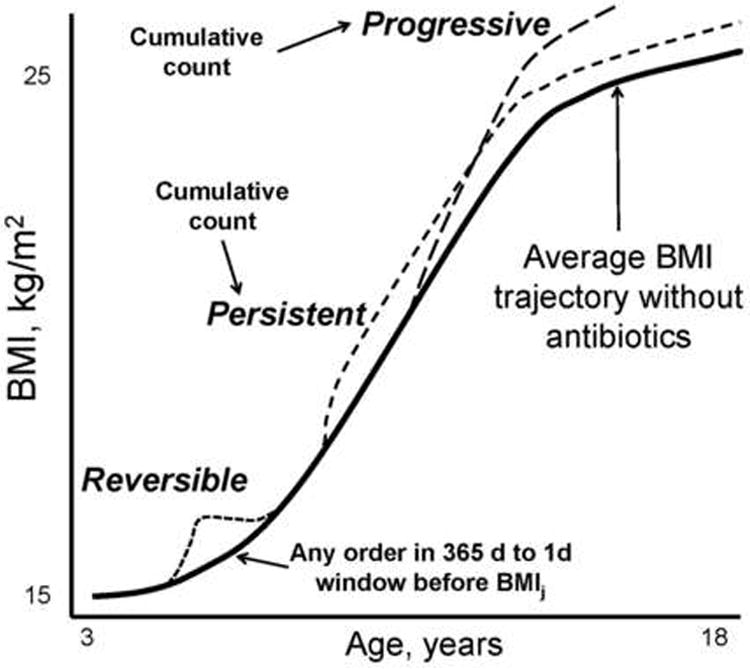
SUBJECTS/METHODS: We used electronic health record data on 163 820 children aged 3-18 years and mixed effects linear regression to model associations of antibiotic orders with growth curve trajectories of annual body mass index (BMI) controlling for confounders. Models evaluated three kinds of antibiotic associations-reversible (time-varying indicator for an order in year before each BMI), persistent (time-varying cumulative orders up to BMIj) and progressive (cumulative orders up to prior BMI (BMIj-1))-and whether these varied by age.
Among 142 824 children under care in the prior year, a reversible association was observed and this short-term BMI gain was modified by age (P<0.001); effect size peaked in mid-teen years. A persistent association was observed and this association was stronger with increasing age (P<0.001). The addition of the progressive association among children with at least three BMIs (n=79 752) revealed that higher cumulative orders were associated with progressive weight gain; this did not vary by age. Among children with an antibiotic order in the prior year and at least seven lifetime orders, antibiotics (all classes combined) were associated with an average weight gain of approximately 1.4 kg at age 15 years. When antibiotic classes were evaluated separately, the largest weight gain at 15 years was associated with macrolide use.
We found evidence of reversible, persistent and progressive effects of antibiotic use on BMI trajectories, with different effects by age, among mainly healthy children. The results suggest that antibiotic use may influence weight gain throughout childhood and not just during the earliest years as has been the primary focus of most prior studies.
背景/目的:抗生素常用于儿童。儿童早期使用抗生素与体重增加有关,但在主要为健康儿童的全年龄段中,尚无大规模、基于人群的纵向研究。
受试者/方法:我们使用了163820名3至18岁儿童的电子健康记录数据,并采用混合效应线性回归模型来分析抗生素处方与年度体重指数(BMI)生长曲线轨迹之间的关联,同时控制混杂因素。模型评估了三种抗生素关联——可逆性(各BMI前一年的处方随时间变化的指标)、持续性(截至BMIj的随时间变化的累积处方)和渐进性(截至前一体重指数(BMIj - 1)的累积处方)——以及这些关联是否随年龄而变化。
在前一年接受护理的142824名儿童中,观察到一种可逆性关联,且这种短期BMI增加受年龄影响(P<0.001);效应大小在青少年中期达到峰值。观察到一种持续性关联,且这种关联随年龄增长而增强(P<0.001)。在至少有三个BMI数据的儿童(n = 79752)中加入渐进性关联分析后发现,较高的累积处方与渐进性体重增加有关;这并不随年龄变化。在前一年有抗生素处方且终身至少有七次处方的儿童中,抗生素(所有类别合计)与15岁时平均体重增加约1.4千克有关。当分别评估抗生素类别时,15岁时体重增加最多与使用大环内酯类抗生素有关。
我们发现,在主要为健康儿童中,抗生素使用对BMI轨迹有可逆、持续和渐进的影响,且随年龄不同而有不同影响。结果表明,抗生素使用可能在整个儿童期影响体重增加,而不仅仅是在大多数先前研究主要关注的最早几年。