Demari-Silva Bruna, Foster Peter G, de Oliveira Tatiane M P, Bergo Eduardo S, Sanabani Sabri S, Pessôa Rodrigo, Sallum Maria Anice M
Departamento de Epidemiologia, Faculdade de Saúde Pública, Universidade de São Paulo, São Paulo, Brazil.
Department of Life Sciences, Natural History Museum, Cromwell Road, London, England.
BMC Genomics. 2015 Oct 21;16:831. doi: 10.1186/s12864-015-1951-0.
The Coronator Group currently encompasses six morphologically similar species (Culex camposi Dyar, Culex coronator Dyar and Knab, Culex covagarciai Forattini, Culex usquatus Dyar, Culex usquatissimus Dyar, and Culex ousqua Dyar). Culex coronator has been incriminated as a potential vector of West Nile Virus (WNV), Saint Louis Encephalitis Virus (SLEV), and Venezuelan Equine Encephalitis Virus (VEEV). The complete mitochondrial genome of Cx. coronator, Cx. usquatus, Cx.usquatissimus, and Cx. camposi was sequenced, annotated, and analyzed to provide genetic information about these species.
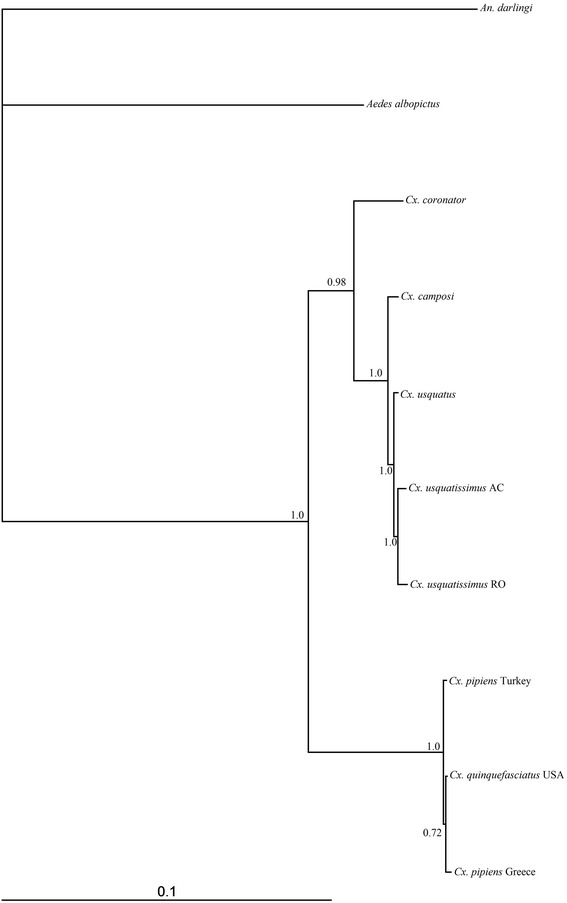
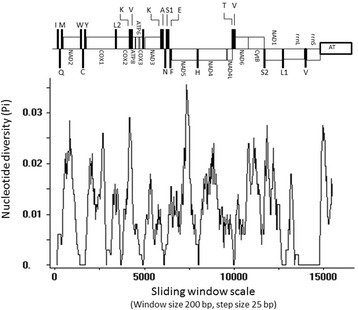
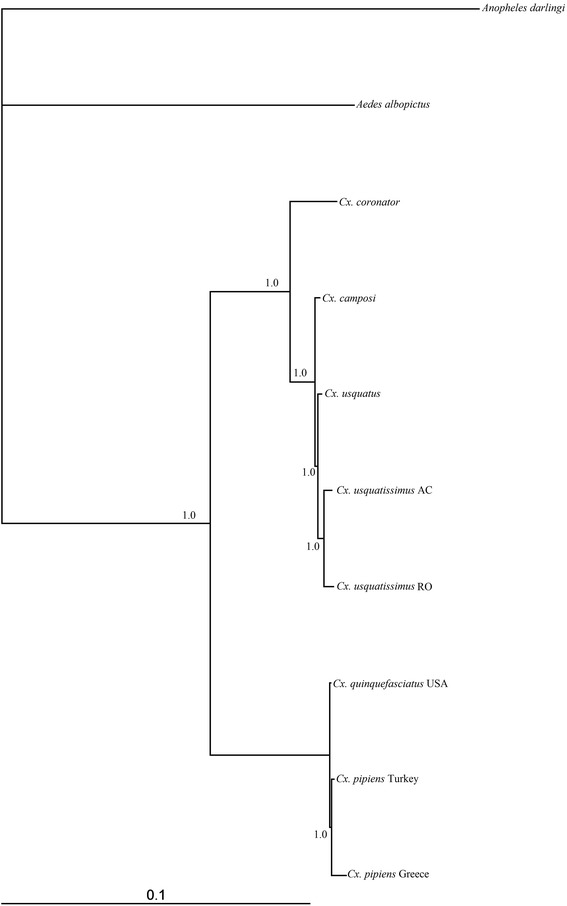
The mitochondrial genomes of Cx. coronator, Cx. usquatus, Cx.usquatissimus, and Cx. camposi varied from 15,573 base pairs in Cx. usquatus to 15,576 in Cx. coronator. They contained 37 genes (13 protein-encoding genes, 2 rRNA genes, and 22 tRNA genes) and the AT-rich control region. Comparative analyses of the 37 genes demonstrated the mitochondrial genomes to be composed of variable and conserved genes. Despite the small size, the ATP8, ATP6 plus NADH5 protein-encoding genes were polymorphic, whereas tRNAs and rRNAs were conserved. The control region contained some poly-T stretch. The Bayesian phylogenetic tree corroborated that both the Coronator Group and the Culex pipens complex are monophyletic taxa.
The mitochondrial genomes of Cx. coronator, Cx. usquatus, Cx. usquatissimus and Cx. camposi share the same gene composition and arrangement features that match to those reported for most Culicidae species. They are composed of the same 37 genes and the AT-rich control region, which contains poly-T stretches that may be involved in the functional role of the mitochondrial genome. Taken together, results of the dN/dS ratios, the sliding window analyses and the Bayesian phylogenetic analyses suggest that ATP6, ATP8 and NADH5 are promising genes to be employed in phylogenetic studies involving species of the Coronator Group, and probably other species groups of the subgenus Culex. Bayesian topology corroborated the morphological hypothesis of the Coronator Group as monophyletic lineage within the subgenus Culex.
科罗纳托库蚊组目前包含六个形态相似的物种(坎波西库蚊、科罗纳托库蚊、科瓦加西亚伊库蚊、乌斯夸图斯库蚊、乌斯夸蒂西姆斯库蚊和奥斯科库蚊)。科罗纳托库蚊被认为是西尼罗河病毒(WNV)、圣路易斯脑炎病毒(SLEV)和委内瑞拉马脑炎病毒(VEEV)的潜在传播媒介。对科罗纳托库蚊、乌斯夸图斯库蚊、乌斯夸蒂西姆斯库蚊和坎波西库蚊的完整线粒体基因组进行了测序、注释和分析,以提供有关这些物种的遗传信息。
科罗纳托库蚊、乌斯夸图斯库蚊、乌斯夸蒂西姆斯库蚊和坎波西库蚊的线粒体基因组大小各异,乌斯夸图斯库蚊为15,573个碱基对,科罗纳托库蚊为15,576个碱基对。它们包含37个基因(13个蛋白质编码基因、2个rRNA基因和22个tRNA基因)以及富含AT的控制区。对这37个基因的比较分析表明,线粒体基因组由可变基因和保守基因组成。尽管线粒体基因组较小,但ATP8、ATP6加NADH5蛋白质编码基因具有多态性,而tRNA和rRNA则是保守的。控制区包含一些多聚T序列。贝叶斯系统发育树证实,科罗纳托库蚊组和尖音库蚊复合组都是单系类群。
科罗纳托库蚊、乌斯夸图斯库蚊、乌斯夸蒂西姆斯库蚊和坎波西库蚊的线粒体基因组具有相同的基因组成和排列特征,与大多数蚊科物种的情况相符。它们由相同的37个基因和富含AT的控制区组成,该控制区包含可能与线粒体基因组功能作用有关的多聚T序列。综合来看,非同义替换与同义替换率比值、滑动窗口分析和贝叶斯系统发育分析的结果表明,ATP6、ATP8和NADH5是用于涉及科罗纳托库蚊组物种以及可能尖音库蚊亚属其他物种组的系统发育研究的有前景的基因。贝叶斯拓扑结构证实了科罗纳托库蚊组作为尖音库蚊亚属内单系谱系的形态学假设。