Kim Su Kang, Seok Hosik, Park Hae Jeong, Jeon Hye Sook, Kang Sang Wook, Lee Byung-Cheol, Yi Jooil, Song Sang Yeol, Lee Sang Hyub, Kim Young Ock, Chung Joo-Ho
Kohwang Medical Research Institute, School of Medicine, Kyung Hee University, Seoul, 130-701, Republic of Korea.
Department of Internal Medicine, College of Oriental Medicine, Kyung Hee University, Seoul, 130-702, Republic of Korea.
BMC Complement Altern Med. 2015 Oct 22;15:380. doi: 10.1186/s12906-015-0825-y.
Benign prostatic hyperplasia (BPH) is one of the common male diseases, which is provoked by dihydrotestosterone (DHT) and androgen signals. Several studies showed that curcumin has various effects of prevention and treatment to diseases. We investigated whether curcumin may repress the development of BPH in male Wistar rats.
Seven weeks male Wistar rats were and divided into 4 groups (normal group, BPH group, finasteride group, curcumin group; n = 8 for each group). In order to induce BPH in rats, rats were castrated and testosterone was injected subcutaneously everyday (s.c., 20 mg/kg). Rats in the curcumin group were treated 50 mg/kg, administered orally for 4 weeks. After 4 weeks, all rats were sacrificed and their prostate and serum were analyzed.
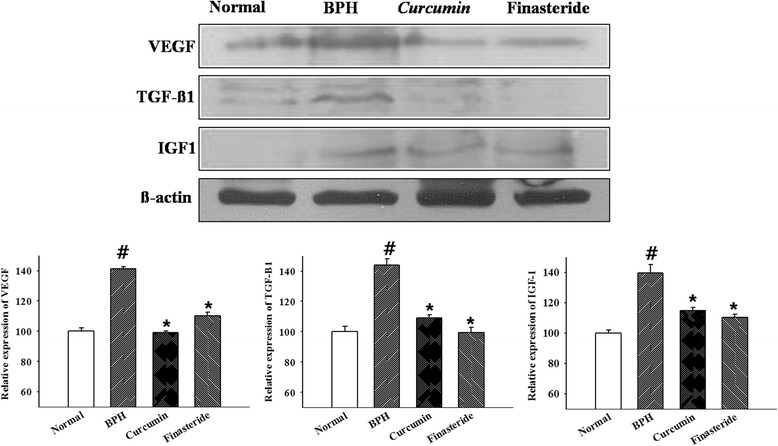
Compared to the finasteride group as positive group, the curcumin group showed similarly protective effect on BPH in histopathologic morphology, prostate volume. Results of immunohistochemistry and western-blot showed decreased expressions of VEGF, TGF-ß1, and IGF1 were also decreased in the curcumin group.
These results suggested that curcumin inhibited the development of BPH and might a useful herbal treatment or functional food for BPH.
良性前列腺增生(BPH)是常见的男性疾病之一,由二氢睾酮(DHT)和雄激素信号引发。多项研究表明,姜黄素对疾病具有多种防治作用。我们研究了姜黄素是否能抑制雄性Wistar大鼠良性前列腺增生的发展。
将7周龄雄性Wistar大鼠分为4组(正常组、BPH组、非那雄胺组、姜黄素组;每组n = 8)。为诱导大鼠发生BPH,对大鼠进行去势,并每天皮下注射睾酮(20 mg/kg)。姜黄素组大鼠以50 mg/kg的剂量口服给药4周。4周后,处死所有大鼠,分析其前列腺及血清情况。
与作为阳性对照的非那雄胺组相比,姜黄素组在组织病理学形态、前列腺体积方面对BPH显示出相似的保护作用。免疫组化和蛋白质印迹结果显示,姜黄素组中血管内皮生长因子(VEGF)、转化生长因子-β1(TGF-β1)和胰岛素样生长因子1(IGF1)的表达也降低。
这些结果表明,姜黄素可抑制BPH的发展,可能是一种用于治疗BPH的有效草药或功能性食品。