
在法国传播的普马拉汉坦病毒分离株的全基因组与系统发育研究
Complete Genome and Phylogeny of Puumala Hantavirus Isolates Circulating in France.
作者信息
Castel Guillaume, Couteaudier Mathilde, Sauvage Frank, Pons Jean-Baptiste, Murri Séverine, Plyusnina Angelina, Pontier Dominique, Cosson Jean-François, Plyusnin Alexander, Marianneau Philippe, Tordo Noël
机构信息
INRA-UMR 1062 CBGP, 755 Avenue Campus Agropolis, CS30016, 34988 Montferrier sur Lez, France.
Institut de Biologie Computationnelle, 34095 Montpellier, France.
出版信息
Viruses. 2015 Oct 22;7(10):5476-88. doi: 10.3390/v7102884.
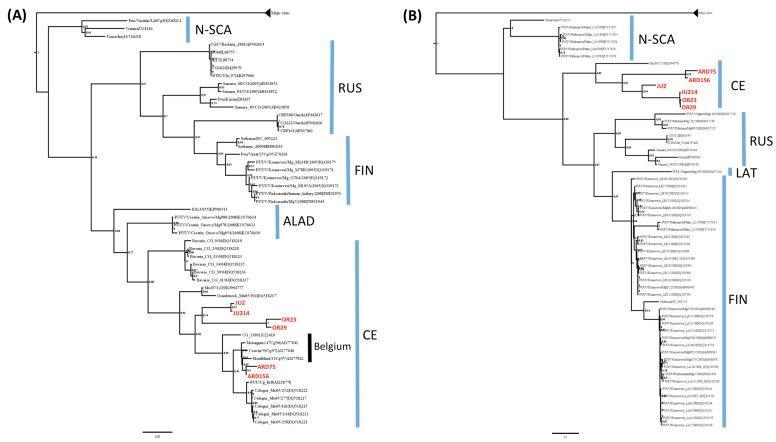
Puumala virus (PUUV) is the agent of nephropathia epidemica (NE), a mild form of hemorrhagic fever with renal syndrome (HFRS) in Europe. NE incidence presents a high spatial variation throughout France, while the geographical distribution of the wild reservoir of PUUV, the bank vole, is rather continuous. A missing piece of the puzzle is the current distribution and the genetic variation of PUUV in France, which has been overlooked until now and remains poorly understood. During a population survey, from 2008 to 2011, bank voles were trapped in eight different forests of France located in areas known to be endemic for NE or in area from where no NE case has been reported until now. Bank voles were tested for immunoglobulin (Ig)G ELISA serology and two seropositive animals for each of three different areas (Ardennes, Jura and Orleans) were then subjected to laboratory analyses in order to sequence the whole S, M and L segments of PUUV. Phylogenetic analyses revealed that French PUUV isolates globally belong to the central European (CE) lineage although isolates from Ardennes are clearly distinct from those in Jura and Orleans, suggesting a different evolutionary history and origin of PUUV introduction in France. Sequence analyses revealed specific amino acid signatures along the N protein, including in PUUV from the Orleans region from where NE in humans has never been reported. The relevance of these mutations in term of pathophysiology is discussed.
普马拉病毒(PUUV)是肾综合征出血热(HFRS)轻型——流行性肾病(NE)的病原体,该病在欧洲流行。法国各地NE的发病率存在很大的空间差异,而PUUV野生宿主——棕背䶄的地理分布却相当连续。目前法国PUUV的分布和基因变异情况是拼图中缺失的一块,至今一直被忽视,仍知之甚少。在2008年至2011年的一项种群调查中,在法国八个不同的森林中捕获了棕背䶄,这些森林位于已知为NE流行的地区或至今尚未报告过NE病例的地区。对棕背䶄进行了免疫球蛋白(Ig)G ELISA血清学检测,然后对三个不同地区(阿登省、汝拉省和奥尔良)的每两个血清阳性动物进行实验室分析,以便对PUUV的整个S、M和L片段进行测序。系统发育分析表明,法国的PUUV分离株总体上属于中欧(CE)谱系,尽管来自阿登省的分离株明显不同于汝拉省和奥尔良的分离株,这表明法国PUUV的进化历史和引入来源不同。序列分析揭示了N蛋白上特定的氨基酸特征,包括来自奥尔良地区的PUUV,该地区从未报告过人类NE病例。讨论了这些突变在病理生理学方面的相关性。


 Zotero 插件