Institute of Novel and Emerging Infectious Diseases, Friedrich-Loeffler-Institut, Federal Research Institute for Animal Health, Südufer 10, 17493Greifswald-Insel Riems, Germany.
Institute of Diagnostic Virology, Friedrich-Loeffler-Institut, Federal Research Institute for Animal Health, Südufer 10, 17493Greifswald-Insel Riems, Germany.
Epidemiol Infect. 2021 Feb 22;149:e97. doi: 10.1017/S0950268821000443.
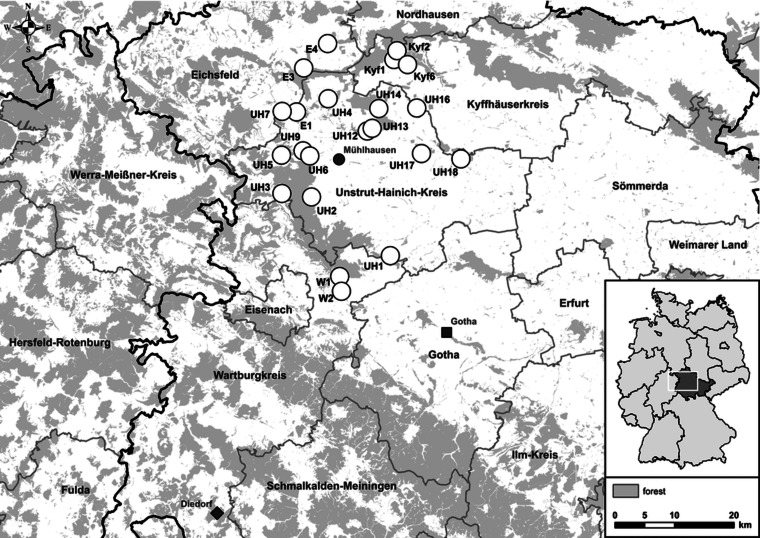
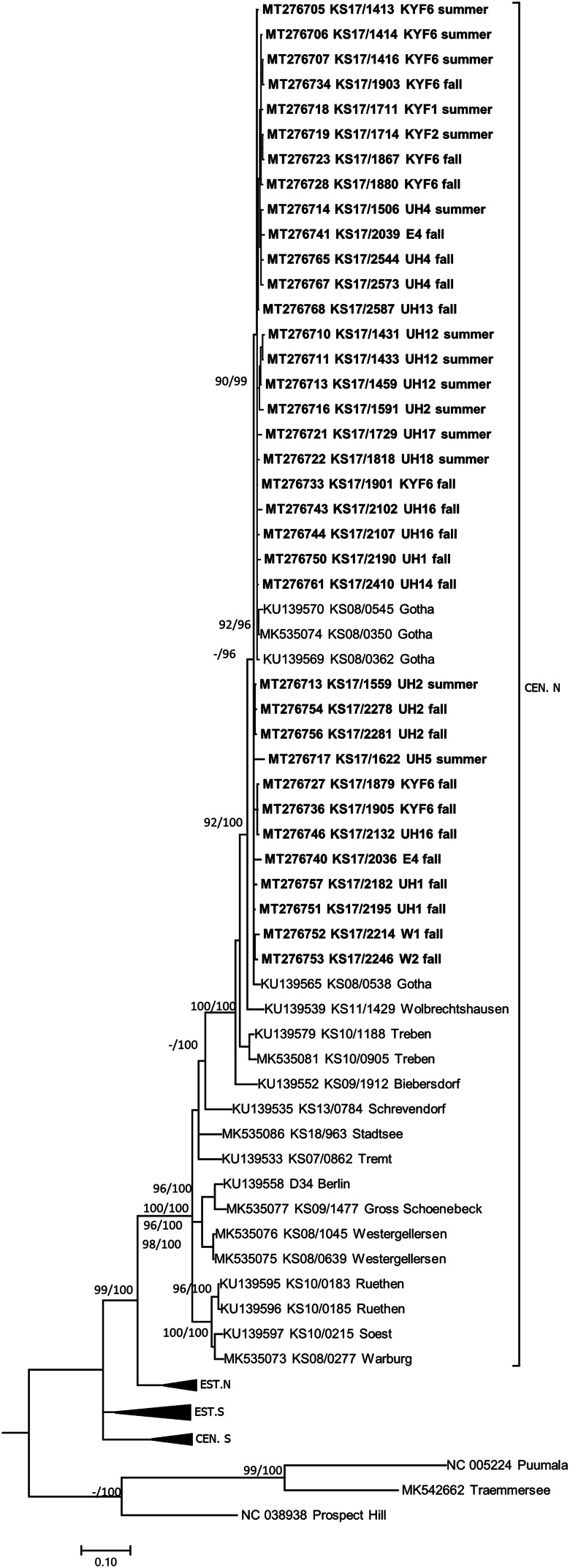
European orthohantaviruses (Puumala orthohantavirus (PUUV); Dobrava-Belgrade orthohantavirus (DOBV), genotype Kurkino; Tula orthohantavirus (TULV)), and Leptospira spp. are small mammal-associated zoonotic pathogens that cause diseases with potentially similar symptoms in humans. We investigated the frequency of Leptospira spp. and hantavirus single and double infections in small mammals from 22 sites in Thuringia, central Germany, during 2017. TULV infections were detected at 18 of 22 sites (mean prevalence 13.8%, 93/674). PUUV infections were detected at four of 22 sites (mean prevalence 1.5%, 7/471), and respective PUUV sequences formed a novel phylogenetic clade, but DOBV infections were not detected at all. Leptospira infections were detected at 21 of 22 sites with the highest overall prevalence in field voles (Microtus agrestis) with 54.5% (6/11) and common voles (Microtus arvalis) with 30.3% (205/676). Leptospira-hantavirus coinfections were found in 6.6% (44/671) of common voles but only in two of 395 bank voles. TULV and Leptospira coinfection probability in common voles was driven by individual (age) and population-level factors. Coinfections seemed to be particularly associated with sites where Leptospira spp. prevalence exceeded 35%. Future investigations should evaluate public health consequences of this strong spatial clustering of coinfections.
欧洲正呼肠孤病毒(普马拉正呼肠孤病毒(PUUV);多布拉瓦-贝尔格莱德正呼肠孤病毒(DOBV),库尔基诺基因型;图拉正呼肠孤病毒(TULV))和钩端螺旋体属。是与小型哺乳动物相关的人畜共患病原体,可导致人类出现潜在类似症状的疾病。我们调查了德国中部图林根州 22 个地点的小型哺乳动物中钩端螺旋体属和汉坦病毒单重和双重感染的频率,2017 年期间。在 22 个地点中的 18 个地点检测到 TULV 感染(平均流行率为 13.8%,93/674)。在 22 个地点中的 4 个地点检测到 PUUV 感染(平均流行率为 1.5%,7/471),相应的 PUUV 序列形成了一个新的系统发育分支,但在所有地点均未检测到 DOBV 感染。在 22 个地点中的 21 个地点检测到钩端螺旋体感染,在田鼠(Microtus agrestis)和普通田鼠(Microtus arvalis)中总流行率最高,分别为 54.5%(6/11)和 30.3%(205/676)。在 6.6%(44/671)的普通田鼠中发现了钩端螺旋体-汉坦病毒共感染,但在 395 只巢鼠中仅发现了 2 例。普通田鼠中 TULV 和钩端螺旋体共感染的概率受个体(年龄)和种群水平因素的驱动。共感染似乎与钩端螺旋体属流行率超过 35%的地点特别相关。未来的研究应评估这种共感染的强烈空间聚类对公共卫生的影响。