Ho Thai H, Kapur Payal, Joseph Richard W, Serie Daniel J, Eckel-Passow Jeanette E, Tong Pan, Wang Jing, Castle Erik P, Stanton Melissa L, Cheville John C, Jonasch Eric, Brugarolas James, Parker Alexander S
Division of Hematology and Medical Oncology, Mayo Clinic, Scottsdale, AZ, USA.
Epigenomics Program, Center for Individualized Medicine, Mayo Clinic, Rochester, MN, USA.
Mod Pathol. 2016 Jan;29(1):34-42. doi: 10.1038/modpathol.2015.123. Epub 2015 Oct 30.
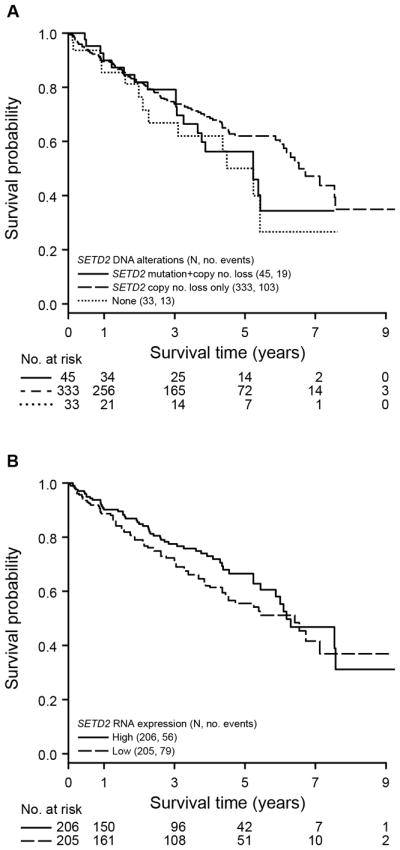
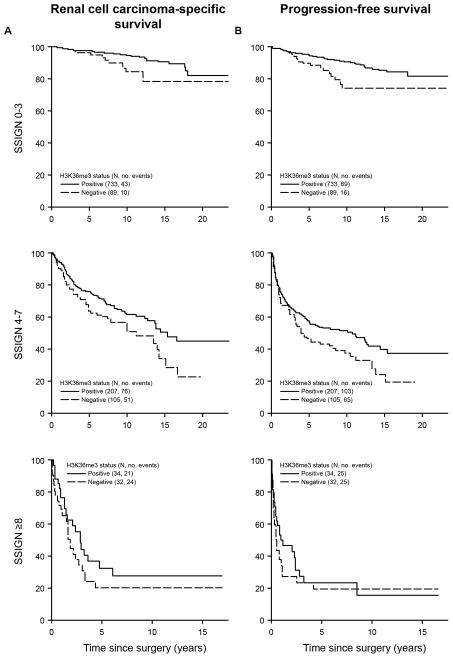
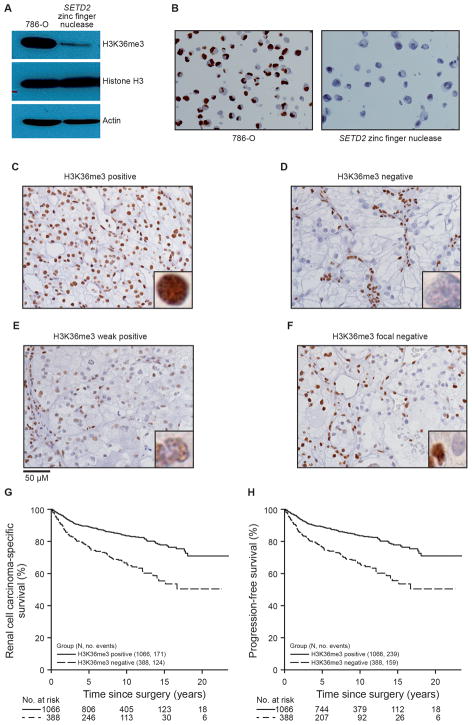
Sequencing of clear cell renal cell carcinomas identified loss-of-function mutations of SETD2, a gene that encodes a nonredundant methytransferase responsible for histone H3 lysine 36 trimethylation (H3K36me3), and H3K36me3 is progressively deregulated in metastases. However, few data exist regarding the impact of loss of H3K36me3 on outcomes. We assessed the association of SETD2 DNA alterations and mRNA expression with overall survival using The Cancer Genome Atlas clear cell renal carcinoma data (N=411). Additionally, we assessed the association of H3K36 loss of methylation with renal cell carcinoma-specific survival and progression-free survival using an independent cohort at Mayo Clinic (N=1454). Overall survival, renal cell carcinoma-specific survival and progression-free survival were estimated using Kaplan-Meier method, and differences in survival across groups was compared using Cox regression models, adjusted for age and the Mayo SSIGN (stage, size, grade, and necrosis) score. In The Cancer Genome Atlas cohort, SETD2 DNA alterations or mRNA expression was not associated with overall survival (P>0.05). In the Mayo cohort, patients with H3K36me3-negative tumors were two times more likely to experience renal cell carcinoma-specific death than patients with H3K36me3-positive tumors (hazard ratio, 2.23; 95% confidence interval, 1.77-2.81); P<0.0001. After stratifying for the SSIGN score, H3K36me3-negative tumors in the low-risk SSIGN group had a worse renal cell carcinoma-specific survival (hazard ratio, 2.18; 95% confidence interval, 1.09-4.36); P=0.03. Although SETD2 DNA and mRNA alterations are not associated with overall survival, we provide evidence that deregulation of the H3K36me3 axis is associated with a higher risk of renal cell carcinoma-specific death. This association remains significant after stratifying for the SSIGN score, particularly among those patients with low-risk tumors.
透明细胞肾细胞癌的测序发现SETD2存在功能丧失突变,该基因编码一种负责组蛋白H3赖氨酸36三甲基化(H3K36me3)的非冗余甲基转移酶,且H3K36me3在转移灶中逐渐失调。然而,关于H3K36me3缺失对预后影响的数据很少。我们使用癌症基因组图谱透明细胞肾细胞癌数据(N = 411)评估了SETD2 DNA改变和mRNA表达与总生存期的关联。此外,我们使用梅奥诊所的一个独立队列(N = 1454)评估了H3K36甲基化缺失与肾细胞癌特异性生存期和无进展生存期的关联。使用Kaplan-Meier方法估计总生存期、肾细胞癌特异性生存期和无进展生存期,并使用Cox回归模型比较各组生存差异,对年龄和梅奥SSIGN(分期、大小、分级和坏死)评分进行校正。在癌症基因组图谱队列中,SETD2 DNA改变或mRNA表达与总生存期无关(P>0.05)。在梅奥队列中,H3K36me3阴性肿瘤患者发生肾细胞癌特异性死亡的可能性是H3K36me3阳性肿瘤患者的两倍(风险比,2.23;95%置信区间,1.77 - 2.81);P<0.0,001。在对SSIGN评分进行分层后,低风险SSIGN组中的H3K36me3阴性肿瘤患者的肾细胞癌特异性生存期更差(风险比,2.18;95%置信区间,1.09 - 4.36);P = 0.03。虽然SETD2 DNA和mRNA改变与总生存期无关,但我们提供的证据表明,H3K36me3轴失调与肾细胞癌特异性死亡风险较高相关。在对SSIGN评分进行分层后,这种关联仍然显著,尤其是在那些低风险肿瘤患者中。