Schütte Kurt H, Maas Ellen A, Exadaktylos Vasileios, Berckmans Daniel, Venter Rachel E, Vanwanseele Benedicte
Human Movement Biomechanics Research Group, Department of Kinesiology, KU Leuven, Leuven, Belgium; Measure, Model & Manage Bioresponses (M3-BIORES) Group, Department of Biosystems, KU Leuven, Leuven, Belgium; Movement Laboratory, Department of Sport Science, Stellenbosch University, Stellenbosch, Western Cape, South Africa.
Human Movement Biomechanics Research Group, Department of Kinesiology, KU Leuven, Leuven, Belgium.
PLoS One. 2015 Oct 30;10(10):e0141957. doi: 10.1371/journal.pone.0141957. eCollection 2015.
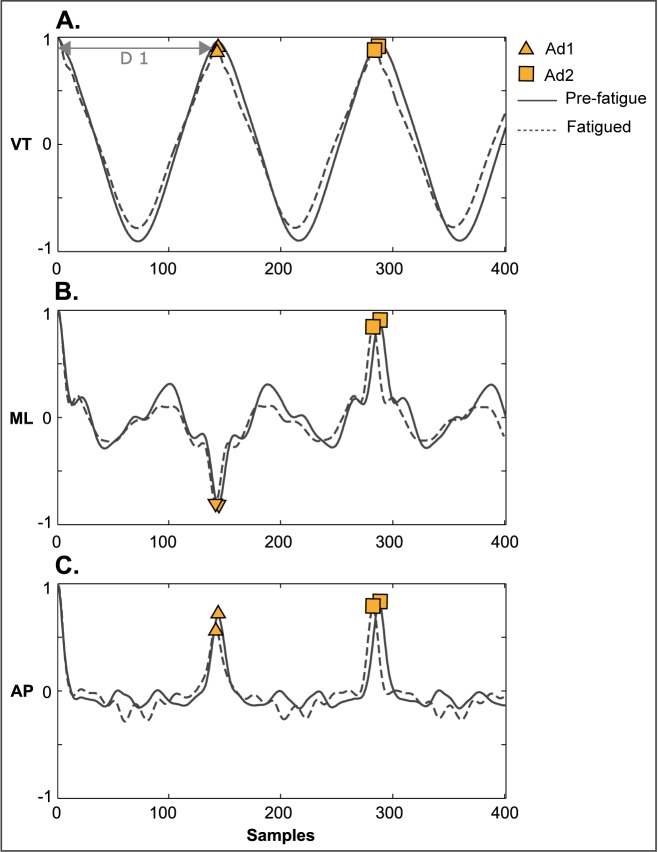
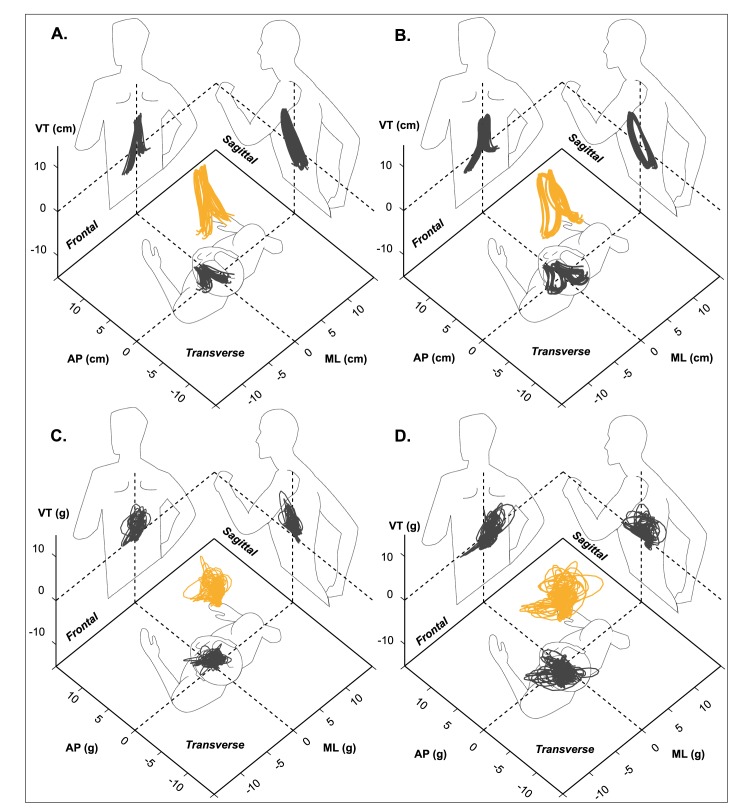
Small wireless trunk accelerometers have become a popular approach to unobtrusively quantify human locomotion and provide insights into both gait rehabilitation and sports performance. However, limited evidence exists as to which trunk accelerometry measures are suitable for the purpose of detecting movement compensations while running, and specifically in response to fatigue. The aim of this study was therefore to detect deviations in the dynamic center of mass (CoM) motion due to running-induced fatigue using tri-axial trunk accelerometry. Twenty runners aged 18-25 years completed an indoor treadmill running protocol to volitional exhaustion at speeds equivalent to their 3.2 km time trial performance. The following dependent measures were extracted from tri-axial trunk accelerations of 20 running steps before and after the treadmill fatigue protocol: the tri-axial ratio of acceleration root mean square (RMS) to the resultant vector RMS, step and stride regularity (autocorrelation procedure), and sample entropy. Running-induced fatigue increased mediolateral and anteroposterior ratios of acceleration RMS (p < .05), decreased the anteroposterior step regularity (p < .05), and increased the anteroposterior sample entropy (p < .05) of trunk accelerometry patterns. Our findings indicate that treadmill running-induced fatigue might reveal itself in a greater contribution of variability in horizontal plane trunk accelerations, with anteroposterior trunk accelerations that are less regular from step-to-step and are less predictable. It appears that trunk accelerometry parameters can be used to detect deviations in dynamic CoM motion induced by treadmill running fatigue, yet it is unknown how robust or generalizable these parameters are to outdoor running environments.
小型无线躯干加速度计已成为一种流行的方法,可在不引人注意的情况下量化人体运动,并为步态康复和运动表现提供见解。然而,关于哪些躯干加速度测量方法适用于检测跑步时的运动补偿,特别是对疲劳的反应,目前证据有限。因此,本研究的目的是使用三轴躯干加速度计检测跑步引起的疲劳导致的动态质心(CoM)运动偏差。20名年龄在18 - 25岁的跑步者完成了一项室内跑步机跑步方案,以相当于他们3.2公里计时赛成绩的速度自愿跑至精疲力竭。从跑步机疲劳方案前后的20个跑步步骤的三轴躯干加速度中提取了以下相关测量指标:加速度均方根(RMS)与合成矢量RMS的三轴比率、步幅和步长规律性(自相关程序)以及样本熵。跑步引起的疲劳增加了躯干加速度测量模式的内外侧和前后向加速度RMS比率(p < .05),降低了前后向步幅规律性(p < .05),并增加了前后向样本熵(p < .05)。我们的研究结果表明,跑步机跑步引起的疲劳可能表现为水平面躯干加速度变异性的更大贡献,前后向躯干加速度的逐步规律性降低且可预测性降低。似乎躯干加速度测量参数可用于检测跑步机跑步疲劳引起 的动态CoM运动偏差,但这些参数在户外跑步环境中的稳健性或通用性尚不清楚。