Ross Brittany N, Rojas-Lopez Maricarmen, Cieza Roberto J, McWilliams Brian D, Torres Alfredo G
Department of Microbiology and Immunology, University of Texas Medical Branch, Galveston, Texas, 77555-1070, United States of America.
Department of Microbiology and Immunology, University of Texas Medical Branch, Galveston, Texas, 77555-1070, United States of America; Department of Pathology and Sealy Center for Vaccine Development, University of Texas Medical Branch, Galveston, Texas, 77555-1070, United States of America.
PLoS One. 2015 Oct 30;10(10):e0141845. doi: 10.1371/journal.pone.0141845. eCollection 2015.
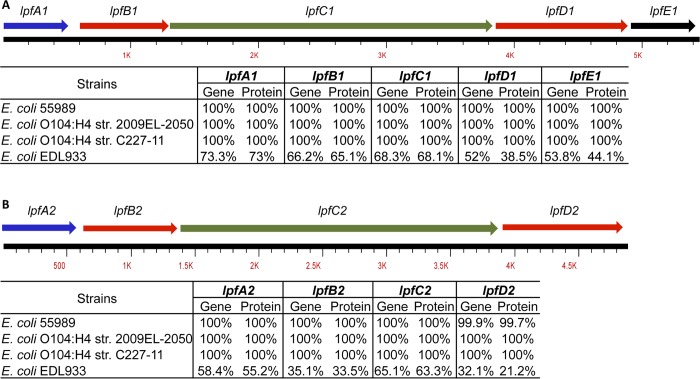
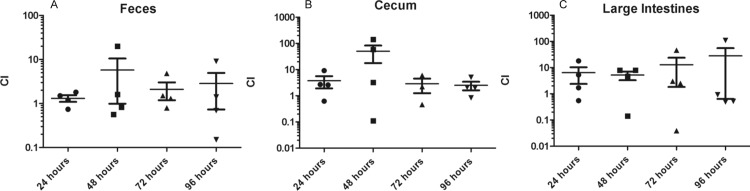
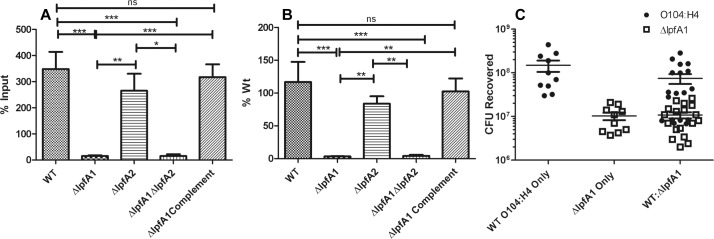
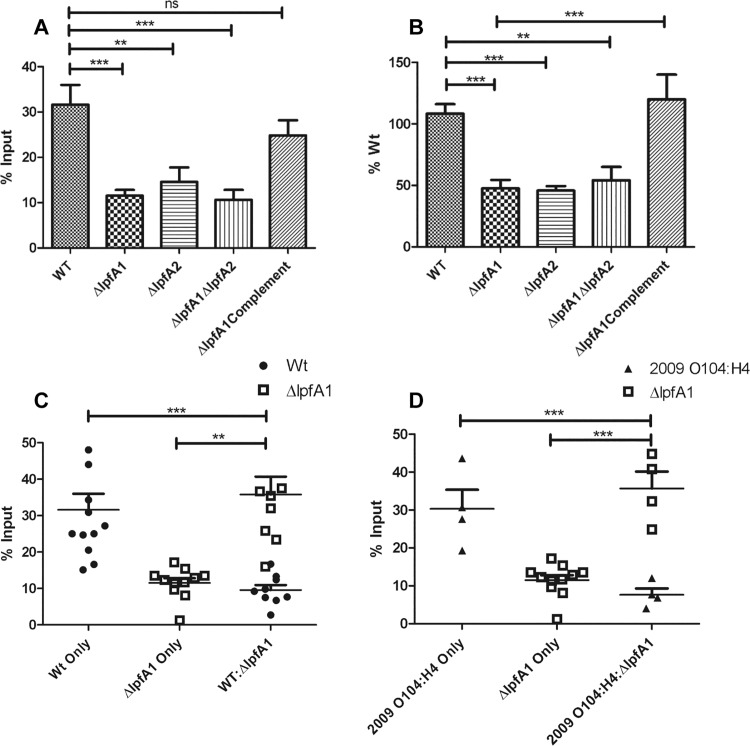
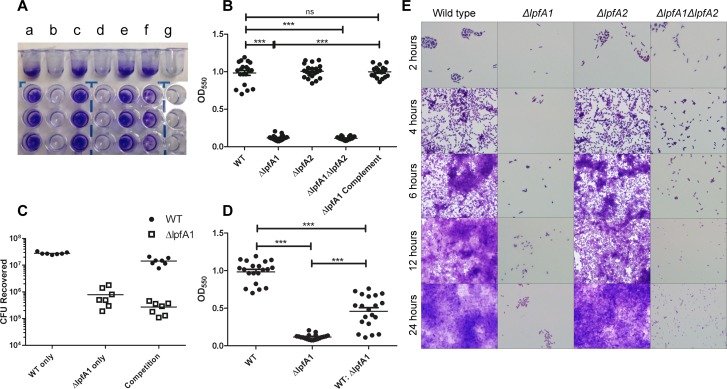
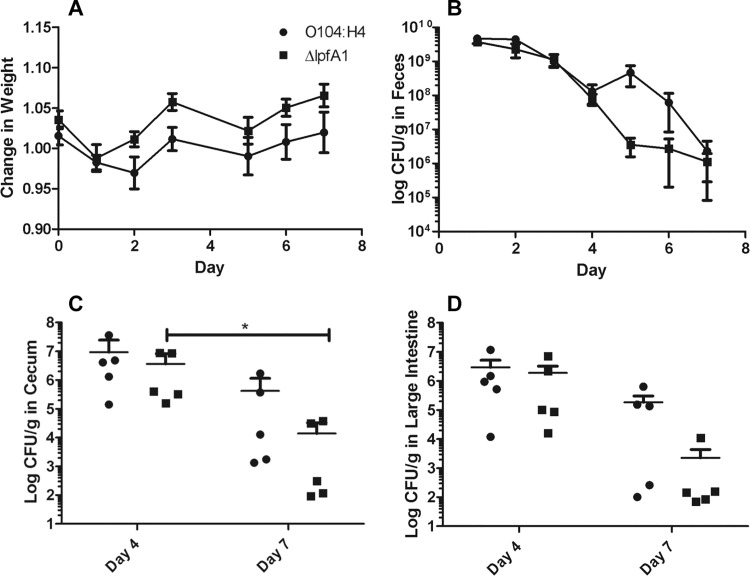
A renewed interest in Shiga toxin-producing Escherichia coli (STEC) strains was sparked due to the appearance of an outbreak in 2011, causing 3,816 diarrheal cases and some deaths in Europe. The causative strain was classified as enteroaggregative E. coli of serotype O104:H4 that had acquired Shiga toxin genes. The ability of STEC O104:H4 to cause disease relies greatly on the bacteria's capacity to colonize, persist, and produce Shiga toxin. However, not much is known about the colonization factors of this strain. Because long polar fimbriae (lpf) lpf1 and lpf2 operons encode important colonization factors in other STEC isolates and E. coli O104:H4 possesses both loci, we hypothesized that Lpf is required for adhesion and colonization. In this study, isogenic lpfA1 and lpfA2 major fimbrial subunit mutants were constructed. To determine their role in O104:H4's virulence, we assessed their ability to adhere to non-polarized and polarized intestinal epithelial cells. The ΔlpfA1 showed decreased adherence in both cell systems, while the ΔlpfA2 only showed a decrease in adherence to polarized Caco-2 cells. We also tested the O104:H4 mutants' ability to form biofilm and found that the ΔlpfA1 was unable to form a stable biofilm. In an in vivo murine model of intestinal colonization, the ΔlpfA1 had a reduced ability to colonize the cecum and large intestine, consistent with the in vitro data. Further, we tested the lpfA1 mutants' ability to compete against the wild type. We found that in the in vitro and in vivo models, the presence of the wild type O104:H4 facilitates increased adherence of the ΔlpfA1 to levels exceeding that of the wild type. Overall, our data demonstrated that Lpf1 is one of the factors responsible for O104:H4 intestinal adhesion and colonization.
2011年欧洲爆发了一起疫情,导致3816例腹泻病例并造成了一些死亡,这引发了人们对产志贺毒素大肠杆菌(STEC)菌株的新关注。致病菌株被归类为血清型O104:H4的肠聚集性大肠杆菌,该菌株获得了志贺毒素基因。STEC O104:H4致病的能力很大程度上依赖于细菌的定植、持续存在和产生志贺毒素的能力。然而,关于该菌株的定植因子知之甚少。由于长极毛(lpf)lpf1和lpf2操纵子在其他STEC分离株中编码重要的定植因子,且大肠杆菌O104:H4同时拥有这两个基因座,我们推测Lpf是粘附和定植所必需的。在本研究中,构建了同基因的lpfA1和lpfA2主要菌毛亚基突变体。为了确定它们在O104:H4毒力中的作用,我们评估了它们粘附非极化和极化肠上皮细胞的能力。ΔlpfA1在两种细胞系统中的粘附能力均下降,而ΔlpfA2仅在粘附极化的Caco-2细胞时表现出下降。我们还测试了O104:H4突变体形成生物膜的能力,发现ΔlpfA1无法形成稳定的生物膜。在体内肠道定植的小鼠模型中,ΔlpfA1在盲肠和大肠中的定植能力降低,这与体外数据一致。此外,我们测试了lpfA1突变体与野生型竞争的能力。我们发现,在体外和体内模型中,野生型O104:H4的存在促进了ΔlpfA1的粘附增加,使其水平超过野生型。总体而言,我们的数据表明Lpf1是负责O104:H4肠道粘附和定植的因素之一。