Thomas L R, Foshage A M, Weissmiller A M, Popay T M, Grieb B C, Qualls S J, Ng V, Carboneau B, Lorey S, Eischen C M, Tansey W P
Department of Cell and Developmental Biology, Vanderbilt University School of Medicine, Nashville, TN, USA.
Vanderbilt International Scholar Program, Vanderbilt University, Nashville, TN, USA.
Oncogene. 2016 Jul 7;35(27):3613-8. doi: 10.1038/onc.2015.416. Epub 2015 Nov 2.
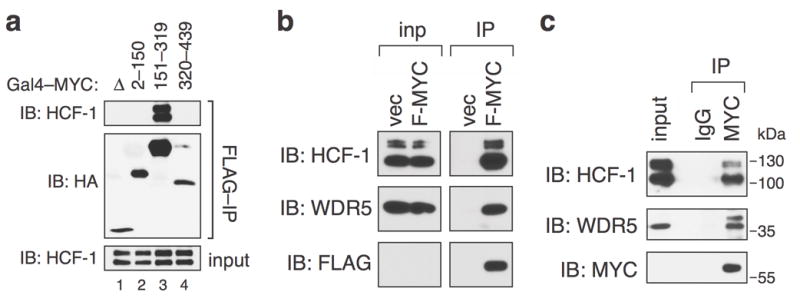
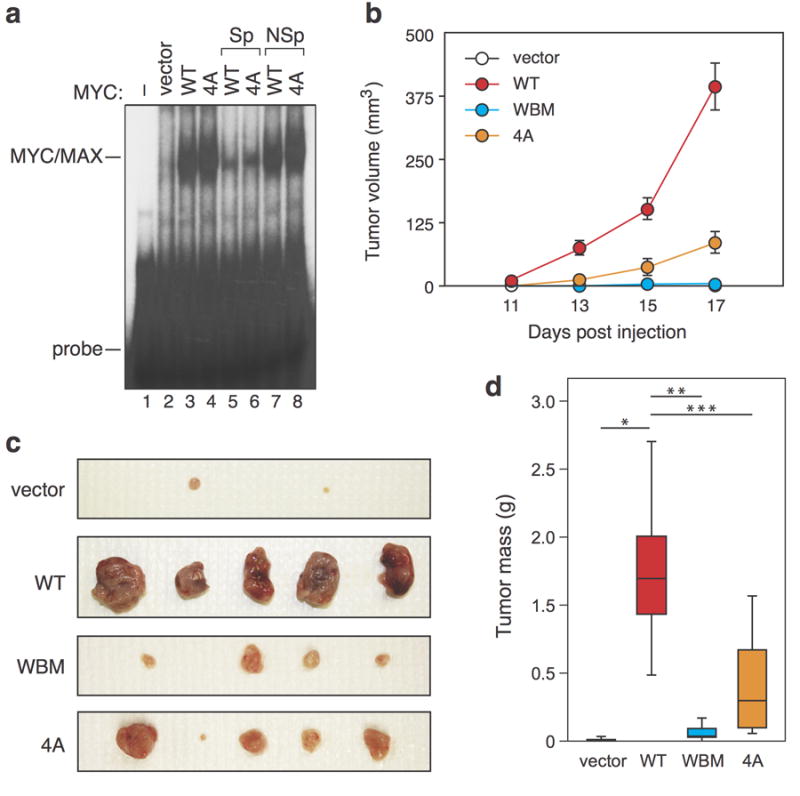
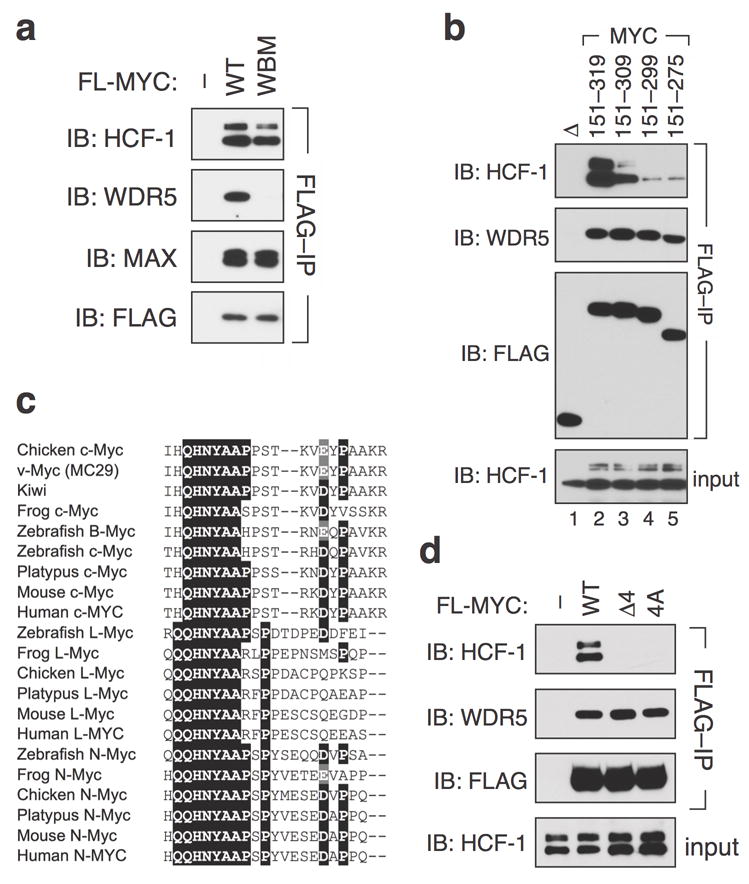
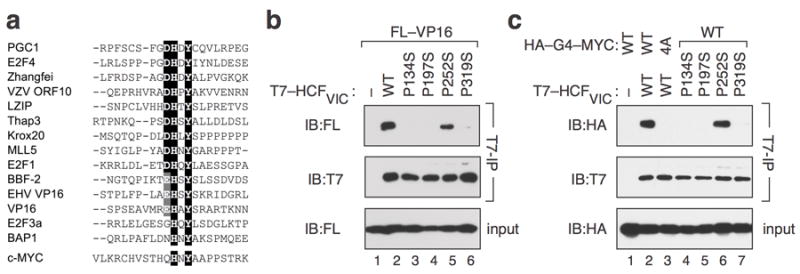
The MYC family of oncogenes encodes a set of three related transcription factors that are overexpressed in many human tumors and contribute to the cancer-related deaths of more than 70,000 Americans every year. MYC proteins drive tumorigenesis by interacting with co-factors that enable them to regulate the expression of thousands of genes linked to cell growth, proliferation, metabolism and genome stability. One effective way to identify critical co-factors required for MYC function has been to focus on sequence motifs within MYC that are conserved throughout evolution, on the assumption that their conservation is driven by protein-protein interactions that are vital for MYC activity. In addition to their DNA-binding domains, MYC proteins carry five regions of high sequence conservation known as Myc boxes (Mb). To date, four of the Mb motifs (MbI, MbII, MbIIIa and MbIIIb) have had a molecular function assigned to them, but the precise role of the remaining Mb, MbIV, and the reason for its preservation in vertebrate Myc proteins, is unknown. Here, we show that MbIV is required for the association of MYC with the abundant transcriptional coregulator host cell factor-1 (HCF-1). We show that the invariant core of MbIV resembles the tetrapeptide HCF-binding motif (HBM) found in many HCF-interaction partners, and demonstrate that MYC interacts with HCF-1 in a manner indistinguishable from the prototypical HBM-containing protein VP16. Finally, we show that rationalized point mutations in MYC that disrupt interaction with HCF-1 attenuate the ability of MYC to drive tumorigenesis in mice. Together, these data expose a molecular function for MbIV and indicate that HCF-1 is an important co-factor for MYC.
致癌基因MYC家族编码一组三个相关的转录因子,这些因子在许多人类肿瘤中过度表达,每年导致超过70000名美国人因癌症死亡。MYC蛋白通过与辅助因子相互作用来驱动肿瘤发生,这些辅助因子使它们能够调节与细胞生长、增殖、代谢和基因组稳定性相关的数千个基因的表达。识别MYC功能所需关键辅助因子的一种有效方法是关注MYC中在整个进化过程中保守的序列基序,假定它们的保守性是由对MYC活性至关重要的蛋白质 - 蛋白质相互作用驱动的。除了它们的DNA结合结构域外,MYC蛋白还带有五个高度保守的序列区域,称为Myc框(Mb)。迄今为止,Mb基序中的四个(MbI、MbII、MbIIIa和MbIIIb)已经被赋予了分子功能,但其余的Mb,即MbIV的精确作用以及它在脊椎动物Myc蛋白中保留的原因尚不清楚。在这里,我们表明MbIV是MYC与丰富的转录共调节因子宿主细胞因子 - 1(HCF - 1)结合所必需的。我们表明MbIV的不变核心类似于在许多HCF相互作用伙伴中发现的四肽HCF结合基序(HBM),并证明MYC与HCF - 1的相互作用方式与典型的含HBM蛋白VP16无法区分。最后,我们表明,MYC中破坏与HCF - 1相互作用的合理点突变会减弱MYC在小鼠中驱动肿瘤发生的能力。总之,这些数据揭示了MbIV的分子功能,并表明HCF - 1是MYC的重要辅助因子。