Strahl H, Ronneau S, González B Solana, Klutsch D, Schaffner-Barbero C, Hamoen L W
Centre for Bacterial Cell Biology, Institute for Cell and Molecular Biosciences, Newcastle University, Richardson Road, Newcastle upon Tyne NE2 4AX, UK.
Swammerdam Institute for Life Sciences (SILS), University of Amsterdam, 1098 XH Amsterdam, The Netherlands.
Nat Commun. 2015 Nov 2;6:8728. doi: 10.1038/ncomms9728.
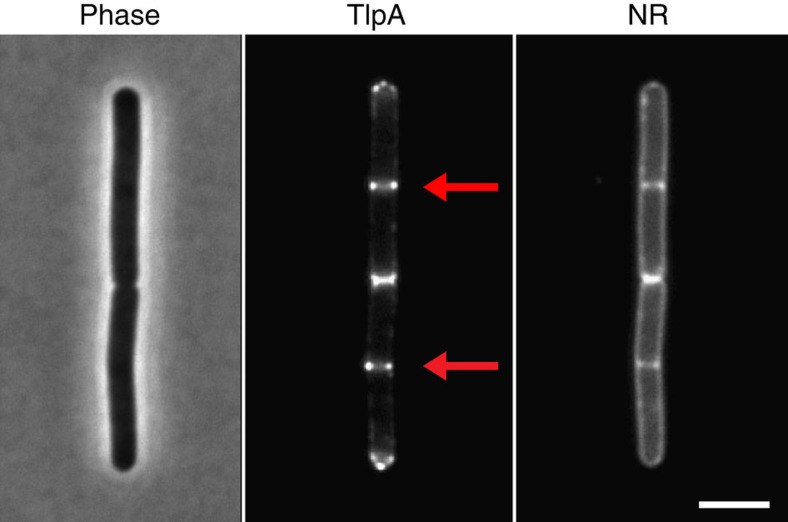
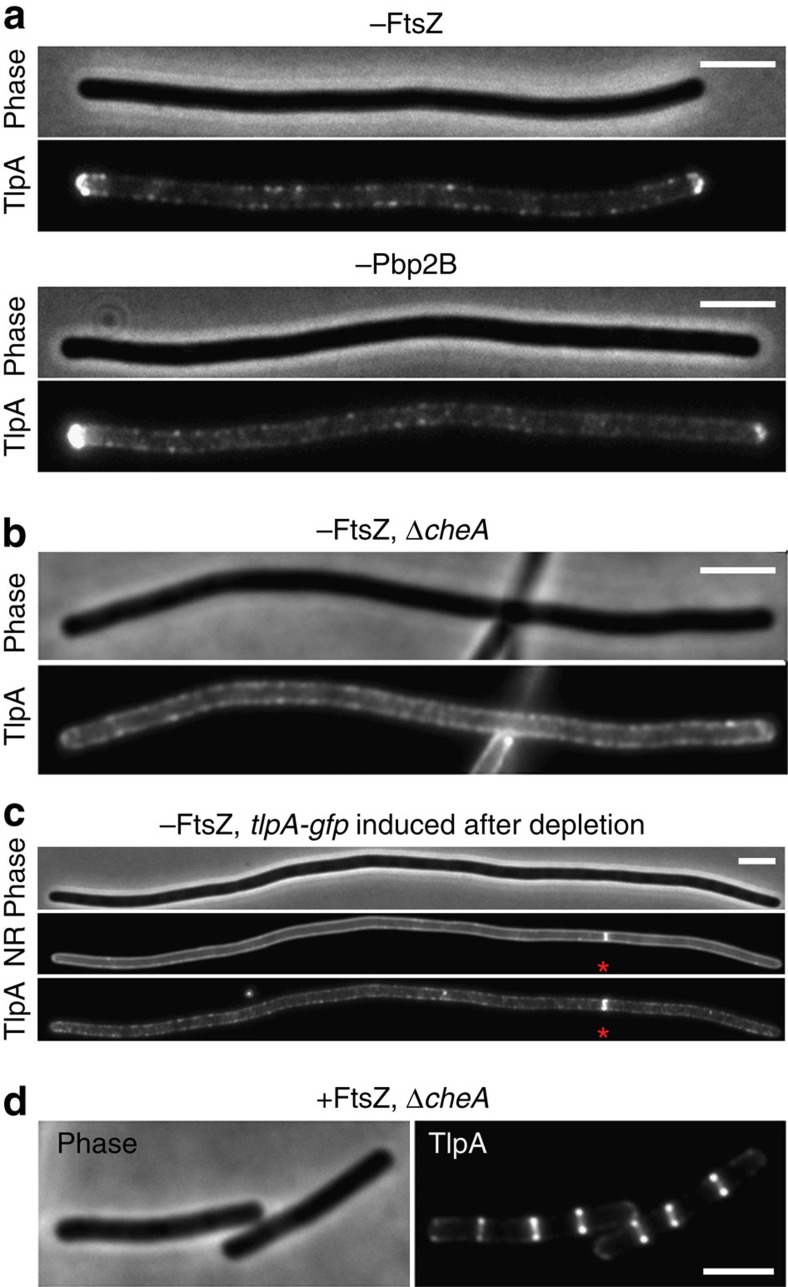
The intricate structure of prokaryotic and eukaryotic cells depends on the ability to target proteins to specific cellular locations. In most cases, we have a poor understanding of the underlying mechanisms. A typical example is the assembly of bacterial chemoreceptors at cell poles. Here we show that the classical chemoreceptor TlpA of Bacillus subtilis does not localize according to the consensus stochastic nucleation mechanism but accumulates at strongly curved membrane areas generated during cell division. This preference was confirmed by accumulation at non-septal curved membranes. Localization appears to be an intrinsic property of the protein complex and does not rely on chemoreceptor clustering, as was previously shown for Escherichia coli. By constructing specific amino-acid substitutions, we demonstrate that the preference for strongly curved membranes arises from the curved shape of chemoreceptor trimer of dimers. These findings demonstrate that the intrinsic shape of transmembrane proteins can determine their cellular localization.
原核细胞和真核细胞的复杂结构取决于将蛋白质靶向特定细胞位置的能力。在大多数情况下,我们对其潜在机制了解甚少。一个典型的例子是细菌化学感受器在细胞两极的组装。在这里,我们表明枯草芽孢杆菌的经典化学感受器TlpA并非按照普遍认为的随机成核机制定位,而是聚集在细胞分裂过程中产生的强弯曲膜区域。在非隔膜弯曲膜处的聚集证实了这种偏好。定位似乎是蛋白质复合物的固有特性,并不像之前在大肠杆菌中所显示的那样依赖于化学感受器的聚集。通过构建特定的氨基酸替换,我们证明了对强弯曲膜的偏好源于二聚体三聚体化学感受器的弯曲形状。这些发现表明跨膜蛋白的固有形状可以决定其细胞定位。