Fahey Jed W, Holtzclaw W David, Wehage Scott L, Wade Kristina L, Stephenson Katherine K, Talalay Paul
Department of Pharmacology and Molecular Sciences, Johns Hopkins University School of Medicine, Baltimore, Maryland, United States of America; Department of International Health, Johns Hopkins University Bloomberg School of Public Health, Baltimore, Maryland, United States of America.
Department of Pharmacology and Molecular Sciences, Johns Hopkins University School of Medicine, Baltimore, Maryland, United States of America.
PLoS One. 2015 Nov 2;10(11):e0140963. doi: 10.1371/journal.pone.0140963. eCollection 2015.
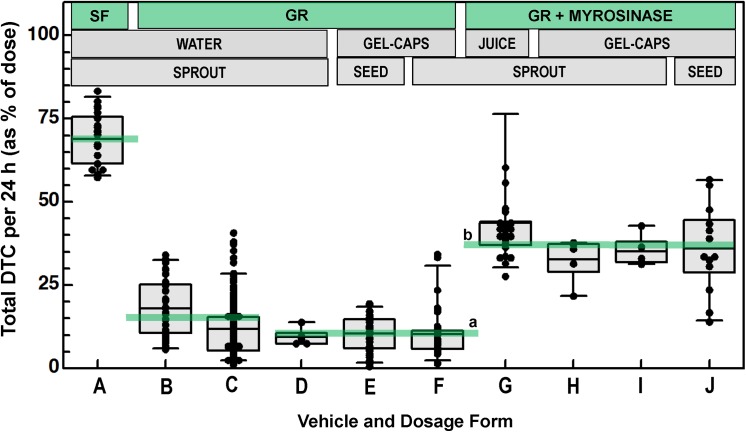
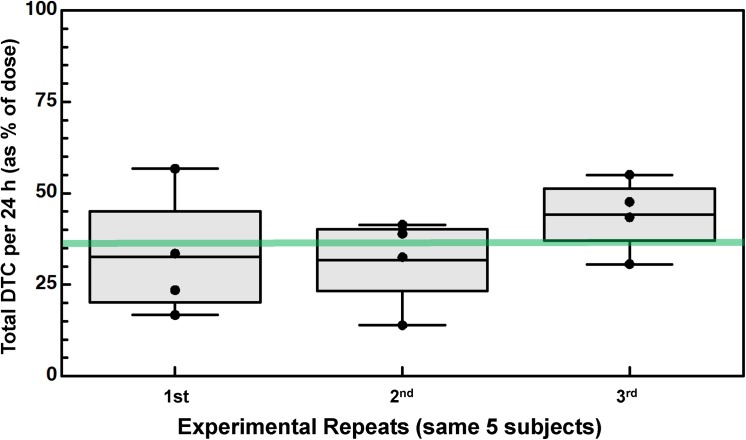
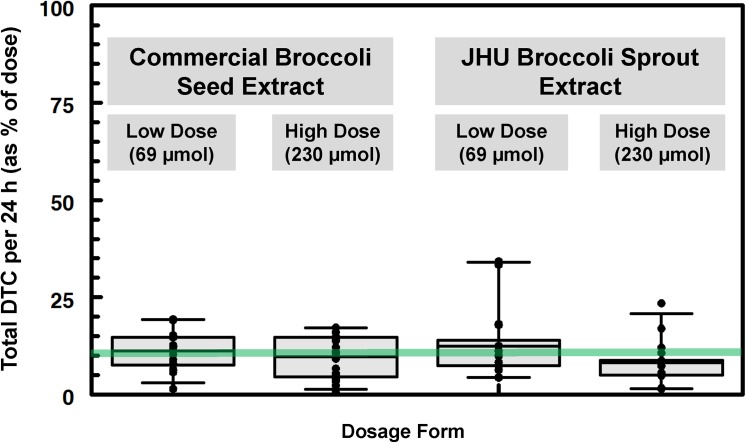
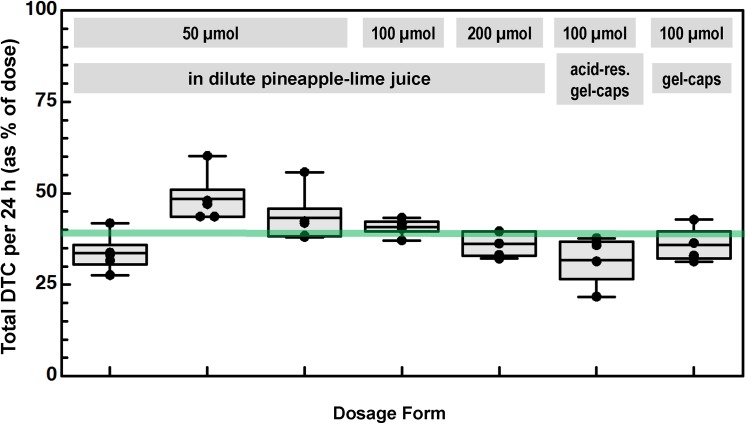
Glucoraphanin from broccoli and its sprouts and seeds is a water soluble and relatively inert precursor of sulforaphane, the reactive isothiocyanate that potently inhibits neoplastic cellular processes and prevents a number of disease states. Sulforaphane is difficult to deliver in an enriched and stable form for purposes of direct human consumption. We have focused upon evaluating the bioavailability of sulforaphane, either by direct administration of glucoraphanin (a glucosinolate, or β-thioglucoside-N-hydroxysulfate), or by co-administering glucoraphanin and the enzyme myrosinase to catalyze its conversion to sulforaphane at economic, reproducible and sustainable yields. We show that following administration of glucoraphanin in a commercially prepared dietary supplement to a small number of human volunteers, the volunteers had equivalent output of sulforaphane metabolites in their urine to that which they produced when given an equimolar dose of glucoraphanin in a simple boiled and lyophilized extract of broccoli sprouts. Furthermore, when either broccoli sprouts or seeds are administered directly to subjects without prior extraction and consequent inactivation of endogenous myrosinase, regardless of the delivery matrix or dose, the sulforaphane in those preparations is 3- to 4-fold more bioavailable than sulforaphane from glucoraphanin delivered without active plant myrosinase. These data expand upon earlier reports of inter- and intra-individual variability, when glucoraphanin was delivered in either teas, juices, or gelatin capsules, and they confirm that a variety of delivery matrices may be equally suitable for glucoraphanin supplementation (e.g. fruit juices, water, or various types of capsules and tablets).
西兰花及其芽苗和种子中的萝卜硫苷是萝卜硫素的水溶性且相对惰性的前体,萝卜硫素是一种活性异硫氰酸盐,能有效抑制肿瘤细胞进程并预防多种疾病状态。萝卜硫素难以以浓缩且稳定的形式直接供人类食用。我们专注于评估萝卜硫素的生物利用度,方法是直接给予萝卜硫苷(一种硫代葡萄糖苷,即β-硫代葡萄糖-N-羟基硫酸盐),或者同时给予萝卜硫苷和黑芥子酶以催化其转化为萝卜硫素,从而实现经济、可重复且可持续的产量。我们发现,在向少数人类志愿者施用市售膳食补充剂中的萝卜硫苷后,志愿者尿液中萝卜硫素代谢物的产出量,与在简单煮沸并冻干的西兰花芽苗提取物中给予等摩尔剂量萝卜硫苷时所产生的产出量相当。此外,当直接向受试者施用西兰花芽苗或种子,而不事先提取并使内源性黑芥子酶失活时,无论递送基质或剂量如何,这些制剂中的萝卜硫素的生物利用度都比未添加活性植物黑芥子酶递送的萝卜硫苷中的萝卜硫素高3至4倍。这些数据扩展了早期关于个体间和个体内变异性的报告,早期报告中萝卜硫苷是以茶、果汁或明胶胶囊的形式递送的,并且它们证实了多种递送基质可能同样适用于补充萝卜硫苷(例如果汁、水或各种类型的胶囊和片剂)。