Aguirre Lina E, Villareal Dennis T
Nestle Nutr Inst Workshop Ser. 2015;83:83-92. doi: 10.1159/000382065. Epub 2015 Nov 2.
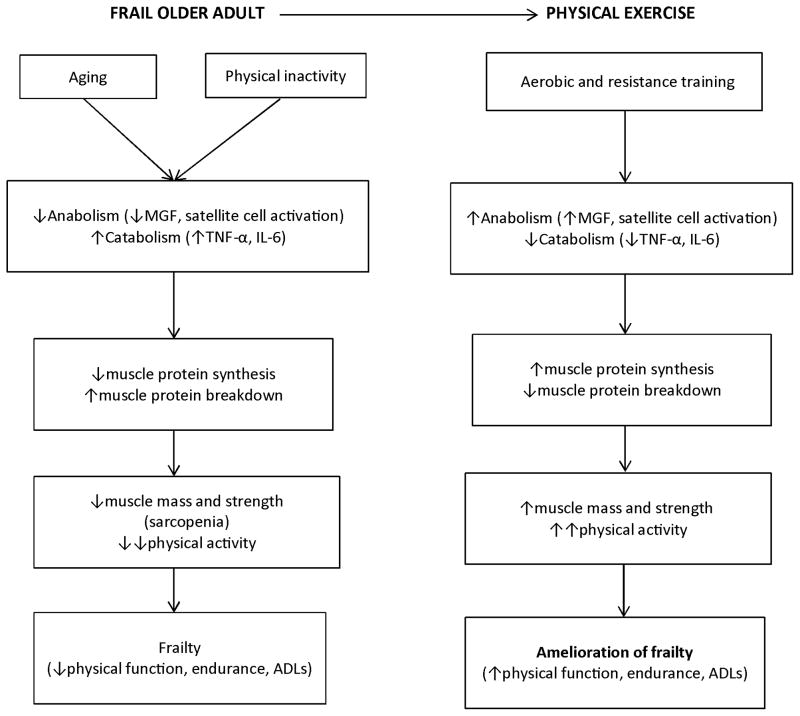
Longitudinal studies demonstrate that regular physical exercise extends longevity and reduces the risk of physical disability. Decline in physical activity with aging is associated with a decrease in exercise capacity that predisposes to frailty. The frailty syndrome includes a lowered activity level, poor exercise tolerance, and loss of lean body and muscle mass. Poor exercise tolerance is related to aerobic endurance. Aerobic endurance training can significantly improve peak oxygen consumption by ∼10-15%. Resistance training is the best way to increase muscle strength and mass. Although the increase in muscle mass in response to resistance training may be attenuated in frail older adults, resistance training can significantly improve muscle strength, particularly in institutionalized patients, by ∼110%. Because both aerobic and resistance training target specific components of frailty, studies combining aerobic and resistance training provide the most promising evidence with respect to successfully treating frailty. At the molecular level, exercise reduces frailty by decreasing muscle inflammation, increasing anabolism, and increasing muscle protein synthesis. More studies are needed to determine which exercises are best suited, most effective, and safe for this population. Based on the available studies, an individualized multicomponent exercise program that includes aerobic activity, strength exercises, and flexibility is recommended to treat frailty.
纵向研究表明,定期体育锻炼可延长寿命并降低身体残疾风险。随着年龄增长,身体活动减少与运动能力下降有关,而运动能力下降易导致身体虚弱。虚弱综合征包括活动水平降低、运动耐量差以及瘦体重和肌肉量减少。运动耐量差与有氧耐力有关。有氧耐力训练可使峰值耗氧量显著提高约10 - 15%。抗阻训练是增加肌肉力量和肌肉量的最佳方法。尽管体弱的老年人对抗阻训练的肌肉量增加反应可能减弱,但抗阻训练可使肌肉力量显著提高,尤其是在机构养老患者中,提高约110%。由于有氧训练和抗阻训练都针对虚弱的特定组成部分,因此将有氧训练和抗阻训练相结合的研究为成功治疗虚弱提供了最有前景的证据。在分子水平上,运动通过减少肌肉炎症、增加合成代谢和增加肌肉蛋白质合成来减轻虚弱。需要更多研究来确定哪些运动最适合该人群、最有效且安全。基于现有研究,建议采用包括有氧运动、力量训练和柔韧性训练的个体化多组分运动计划来治疗虚弱。