Shi Jian, Luo Fengbao, Shi Qianqian, Xu Xianlin, He Xiaozhou, Xia Ying
Third Clinical College of Soochow University, Changzhou, Jiangsu, China.
The University of Texas Medical School at Houston, Houston, TX, USA.
BMC Nephrol. 2015 Nov 3;16:182. doi: 10.1186/s12882-015-0172-8.
Chronic antibody-mediated rejection is a major issue that affects long-term renal allograft survival. Since follicular helper T (Tfh) cells promote the development of antigen-specific B cells in alloimmune responses, we investigated the potential roles of Tfh cells, B cells and their alloimmune-regulating molecules in the pathogenesis of chronic renal allograft rejection in this study.
The frequency of Tfh, B cells and the levels of their alloimmune-regulating molecules including chemokine receptor type 5 (CXCR5), inducible T cell co-stimulator (ICOS), programmed death-1 (PD-1), ICOSL, PDL-1 and interleukin-21 (IL-21), of peripheral blood were comparatively measured in 42 primary renal allograft recipients within 1-3 years after transplantation. Among them, 24 patients had definite chronic rejection, while other 18 patients had normal renal function.
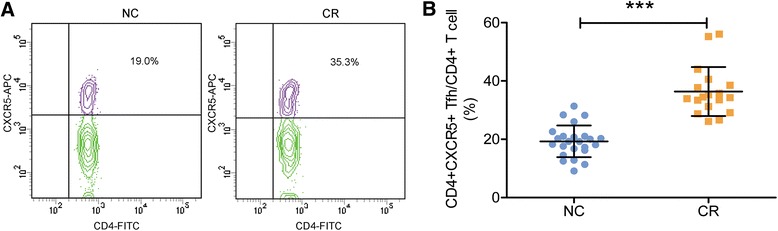
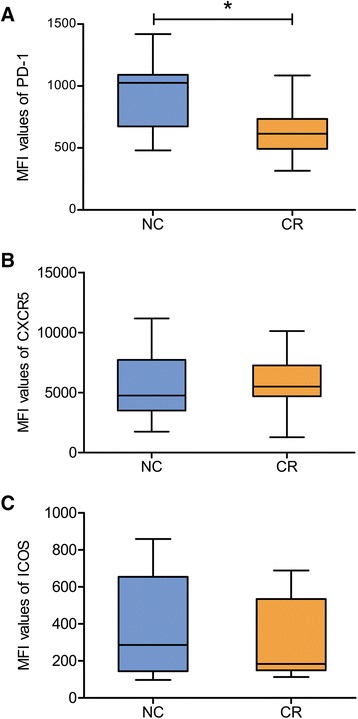
Tfh-cell ratio was significantly increased with PD-1 down-regulation in the patients with chronic renal allograft rejection, while B cells and the alloimmune-regulating molecules studied did not show any appreciable change in parallel.
The patients with chronic renal allograft rejection have a characteristic increase in circulating Tfh cells with a decrease in PD-1 expression. These pathological changes may be a therapeutic target for the treatment of chronic renal allograft rejection and can be useful as a clinical index for monitoring conditions of renal transplant.
慢性抗体介导的排斥反应是影响肾移植长期存活的主要问题。由于滤泡辅助性T(Tfh)细胞在同种免疫反应中促进抗原特异性B细胞的发育,本研究中我们调查了Tfh细胞、B细胞及其同种免疫调节分子在慢性肾移植排斥反应发病机制中的潜在作用。
对42例初次肾移植受者在移植后1至3年内外周血中Tfh细胞、B细胞的频率及其同种免疫调节分子水平进行比较测量,这些分子包括趋化因子受体5型(CXCR5)、诱导性T细胞共刺激分子(ICOS)、程序性死亡蛋白1(PD-1)、ICOS配体(ICOSL)、程序性死亡蛋白配体1(PDL-1)和白细胞介素21(IL-21)。其中24例患者有明确的慢性排斥反应,另外18例患者肾功能正常。
慢性肾移植排斥反应患者的Tfh细胞比例显著增加,同时PD-1下调,而B细胞及所研究的同种免疫调节分子未呈现相应的明显变化。
慢性肾移植排斥反应患者循环Tfh细胞特征性增加,PD-1表达降低。这些病理变化可能是治疗慢性肾移植排斥反应的治疗靶点,并且可作为监测肾移植状况的临床指标。