Meirow Yaron, Kanterman Julia, Baniyash Michal
The Lautenberg Center for General and Tumor Immunology, Israel-Canada Medical Research Institute, Faculty of Medicine, The Hebrew University , Jerusalem , Israel.
Front Immunol. 2015 Oct 12;6:523. doi: 10.3389/fimmu.2015.00523. eCollection 2015.
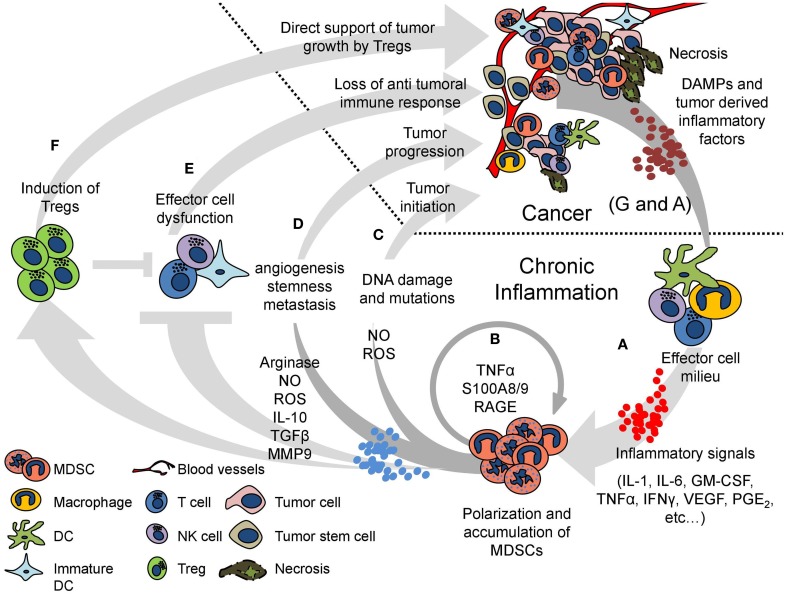
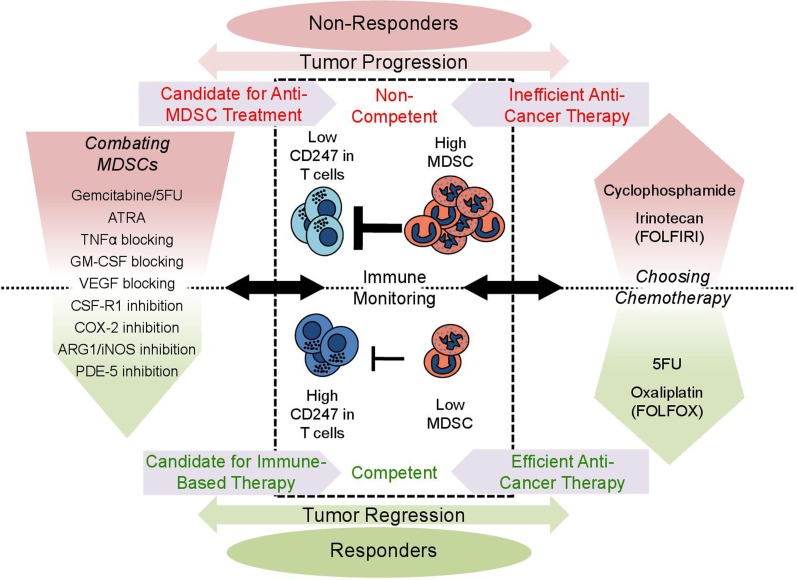
Cancer development is dependent on intrinsic cellular changes as well as inflammatory factors in the tumor macro and microenvironment. The inflammatory milieu nourishes the tumor and contributes to cancer progression. Numerous studies, including ours, have demonstrated that the tumor microenvironment is immunosuppressive, impairing the anticancer immune responses. Chronic inflammation was identified as the key process responsible for this immunosuppression via induction of immature myeloid-derived suppressor cells (MDSCs). Upon a prolonged immune response, MDSCs are polarized toward immunosuppressive cells meant to control the exacerbated immune response. In cancer, the chronic inflammatory response renders the MDSCs harmful. Polarized MDSCs suppress T-cells and natural killer cells, as well as antigen-presenting cells, abrogating the beneficial immune response. These changes in the immunological milieu could also lead to high frequency of mutations, enhanced cancer cell stemness, and angiogenesis, directly supporting tumor initiation, growth, and spreading. The presence of MDSCs in cancer poses a serious obstacle in a variety of immune-based therapies, which rely on the stimulation of antitumor immune responses. Cumulative data, including our own, suggest that the selection of an appropriate and effective anticancer therapy must take into consideration the host's immune status as well as tumor-related parameters. Merging biomarkers for immune monitoring into the traditional patient's categorization and follow-up can provide new predictive and diagnostic tools to the clinical practice. Chronic inflammation and MDSCs could serve as novel targets for therapeutic interventions, which can be combined with conventional cancer treatments such as chemotherapy, radiotherapy, and cancer cell-targeted and immune-based therapies. Intervention in environmental and tumor-specific inflammatory mechanisms will allow better clinical management of cancer toward more efficient treatment.
癌症的发展依赖于内在的细胞变化以及肿瘤宏观和微观环境中的炎症因子。炎症环境滋养肿瘤并促进癌症进展。包括我们的研究在内,众多研究表明肿瘤微环境具有免疫抑制作用,会损害抗癌免疫反应。慢性炎症被确定为通过诱导未成熟的髓源性抑制细胞(MDSC)导致这种免疫抑制的关键过程。在长时间的免疫反应后,MDSC会极化为旨在控制过度免疫反应的免疫抑制细胞。在癌症中,慢性炎症反应使MDSC变得有害。极化的MDSC会抑制T细胞、自然杀伤细胞以及抗原呈递细胞,从而消除有益的免疫反应。免疫环境的这些变化还可能导致高频率的突变、增强癌细胞的干性以及血管生成,直接支持肿瘤的起始、生长和扩散。癌症中MDSC的存在给多种基于免疫的疗法带来了严重障碍,这些疗法依赖于抗肿瘤免疫反应的刺激。包括我们自己的数据在内的累积数据表明,选择合适且有效的抗癌疗法必须考虑宿主的免疫状态以及肿瘤相关参数。将用于免疫监测的生物标志物纳入传统的患者分类和随访中,可以为临床实践提供新的预测和诊断工具。慢性炎症和MDSC可作为治疗干预的新靶点,可与化疗、放疗以及针对癌细胞和基于免疫的疗法等传统癌症治疗方法相结合。干预环境和肿瘤特异性炎症机制将有助于更好地对癌症进行临床管理,以实现更有效的治疗。