Danneels Ellen L, Van Vaerenbergh Matthias, Debyser Griet, Devreese Bart, de Graaf Dirk C
Laboratory of Molecular Entomology and Bee Pathology, Ghent University, Krijgslaan 281 S2, B-9000 Ghent, Belgium.
Laboratory of Protein Biochemistry and Biomolecular Engineering, Ghent University, K.L. Ledeganckstraat 35, B-9000 Ghent, Belgium.
Toxins (Basel). 2015 Oct 30;7(11):4468-83. doi: 10.3390/toxins7114468.
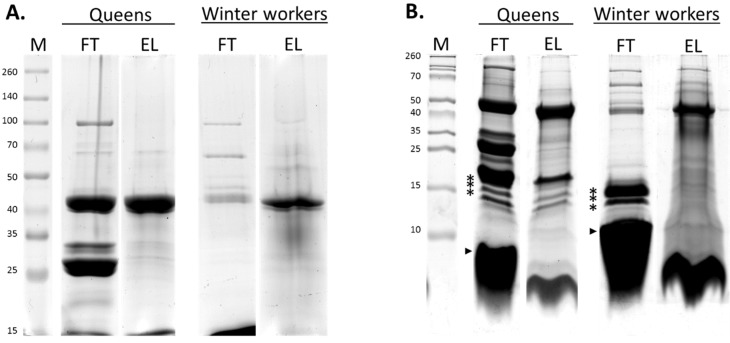
Venoms of invertebrates contain an enormous diversity of proteins, peptides, and other classes of substances. Insect venoms are characterized by a large interspecific variation resulting in extended lists of venom compounds. The venom composition of several hymenopterans also shows different intraspecific variation. For instance, venom from different honeybee castes, more specifically queens and workers, shows quantitative and qualitative variation, while the environment, like seasonal changes, also proves to be an important factor. The present study aimed at an in-depth analysis of the intraspecific variation in the honeybee venom proteome. In summer workers, the recent list of venom proteins resulted from merging combinatorial peptide ligand library sample pretreatment and targeted tandem mass spectrometry realized with a Fourier transform ion cyclotron resonance mass spectrometer (FT-ICR MS/MS). Now, the same technique was used to determine the venom proteome of queens and winter bees, enabling us to compare it with that of summer bees. In total, 34 putative venom toxins were found, of which two were never described in honeybee venoms before. Venom from winter workers did not contain toxins that were not present in queens or summer workers, while winter worker venom lacked the allergen Api m 12, also known as vitellogenin. Venom from queen bees, on the other hand, was lacking six of the 34 venom toxins compared to worker bees, while it contained two new venom toxins, in particularly serine proteinase stubble and antithrombin-III. Although people are hardly stung by honeybees during winter or by queen bees, these newly identified toxins should be taken into account in the characterization of a putative allergic response against Apis mellifera stings.
无脊椎动物的毒液含有种类繁多的蛋白质、肽和其他各类物质。昆虫毒液的特点是种间差异很大,导致毒液化合物的清单很长。几种膜翅目昆虫的毒液组成也表现出不同的种内差异。例如,来自不同蜜蜂群体(更具体地说是蜂王和工蜂)的毒液表现出定量和定性的差异,而环境因素,如季节变化,也被证明是一个重要因素。本研究旨在深入分析蜜蜂毒液蛋白质组的种内差异。在夏季工蜂中,最近的毒液蛋白质清单是通过将组合肽配体库样品预处理与使用傅里叶变换离子回旋共振质谱仪(FT-ICR MS/MS)实现的靶向串联质谱相结合而得出的。现在,使用相同的技术来确定蜂王和冬季蜜蜂的毒液蛋白质组,使我们能够将其与夏季蜜蜂的进行比较。总共发现了34种推定的毒液毒素,其中两种以前从未在蜜蜂毒液中被描述过。冬季工蜂的毒液不含蜂王或夏季工蜂中不存在的毒素,而冬季工蜂毒液缺乏过敏原Api m 12,也称为卵黄蛋白原。另一方面,与工蜂相比,蜂王的毒液缺少34种毒液毒素中的6种,同时它含有两种新的毒液毒素,特别是丝氨酸蛋白酶茬蛋白和抗凝血酶III。尽管人们在冬季很少被蜜蜂蜇伤,或者很少被蜂王蜇伤,但在对意大利蜜蜂蜇伤的推定过敏反应的特征描述中,应考虑这些新发现的毒素。