Sonnenberg Pam, Ison Catherine A, Clifton Soazig, Field Nigel, Tanton Clare, Soldan Kate, Beddows Simon, Alexander Sarah, Khanom Rumena, Saunders Pamela, Copas Andrew J, Wellings Kaye, Mercer Catherine H, Johnson Anne M
Research Department of Infection and Population Health, University College London, London, UK.
Int J Epidemiol. 2015 Dec;44(6):1982-94. doi: 10.1093/ije/dyv194.
There are currently no large general population epidemiological studies of Mycoplasma genitalium (MG), which include prevalence, risk factors, symptoms and co-infection in men and women across a broad age range.
In 2010-–12, we conducted the third National Survey of Sexual Attitudes and Lifestyles (Natsal-3), a probability sample survey in Britain. Urine from 4507 sexually-experienced participants, aged 16–44 years, was tested for MG.
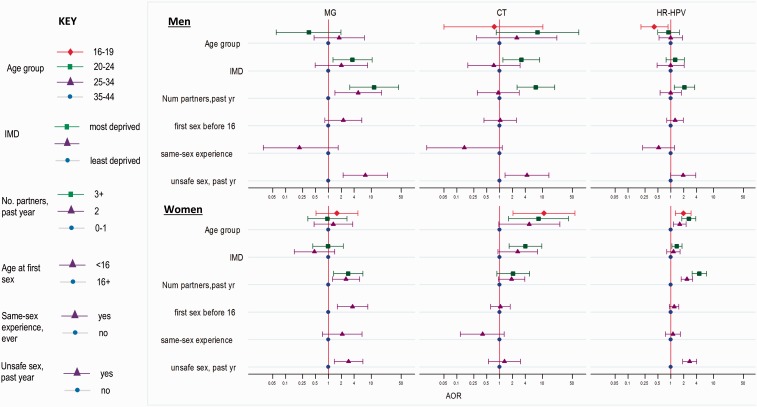
MG prevalence was 1.2% [95% confidence interval (CI): 0.7–1.8%] in men and 1.3% (0.9–1.9%) in women. There were no positive MG tests in men aged 16–19, and prevalence peaked at 2.1% (1.2–3.7%) in men aged 25–34 years. In women, prevalence was highest in 16–19 year olds, at 2.4% (1.2–4.8%), and decreased with age. Men of Black ethnicity were more likely to test positive for MG [adjusted odds ratio (AOR) 12.1; 95% CI: 3.7–39.4). For both men and women, MG was strongly associated with reporting sexual risk behaviours (increasing number of total and new partners, and unsafe sex, in the past year). Women with MG were more likely to report post-coital bleeding (AOR 5.8; 95%CI 1.4–23.3). However, the majority of men (94.4%), and over half of women (56.2%) with MG did not report any sexually transmitted infection (STI) symptoms. Men with MG were more likely to report previously diagnosed gonorrhoea, syphilis or non-specific urethritis, and women previous trichomoniasis.
This study strengthens evidence that MG is an STI. MG was identified in over 1% of the population, including in men with high-risk behaviours in older age groups that are often not included in STI prevention measures.
目前尚无关于生殖支原体(MG)的大规模普通人群流行病学研究,此类研究应涵盖广泛年龄范围内男性和女性的患病率、风险因素、症状及合并感染情况。
在2010 - 2012年,我们开展了第三次全国性态度与生活方式调查(Natsal - 3),这是一项在英国进行的概率抽样调查。对4507名年龄在16 - 44岁有性经历的参与者的尿液进行了MG检测。
男性中MG患病率为1.2%[95%置信区间(CI):0.7 - 1.8%],女性为1.3%(0.9 - 1.9%)。16 - 19岁男性中未检测到MG阳性,25 - 34岁男性患病率最高,为2.1%(1.2 - 3.7%)。在女性中,16 - 19岁患病率最高,为2.4%(1.2 - 4.8%),且随年龄增长而下降。黑人男性MG检测呈阳性的可能性更高[调整优势比(AOR)12.1;95% CI:3.7 - 39.4]。对于男性和女性而言,MG都与报告的性风险行为密切相关(过去一年中性伴侣总数和新伴侣数量增加以及不安全性行为)。感染MG的女性更有可能报告性交后出血(AOR 5.8;95% CI 1.4 - 23.3)。然而,大多数感染MG的男性(94.4%)和超过一半的女性(56.2%)未报告任何性传播感染(STI)症状。感染MG的男性更有可能报告先前诊断的淋病、梅毒或非特异性尿道炎,女性则更有可能报告先前的滴虫病。
本研究进一步证明MG是一种性传播感染。在超过1%的人群中检测到MG,包括在年龄较大的具有高危行为的男性中,而这些人群通常未被纳入性传播感染预防措施范围内。