Department of Orthopedics, University Hospital North Norway, Tromsø, Norway. ; Bone and Joint Research Group, Institute of Clinical Medicine, University of Tromsø, Tromsø, Norway.
Department of Orthopedics, University Hospital North Norway, Tromsø, Norway.
Orthop J Sports Med. 2013 Sep 27;1(4):2325967113505433. doi: 10.1177/2325967113505433. eCollection 2013 Sep.
Recalcitrant lateral epicondylitis (elbow extensor-origin tendinosis) is a common cause of elbow pain with many treatment options. In the present study, the medium-term results after open release and radiofrequency microtenotomy are reported.
Microtenotomy would provide long-term pain relief that was as good as the open release method.
Prospective, randomized trial.
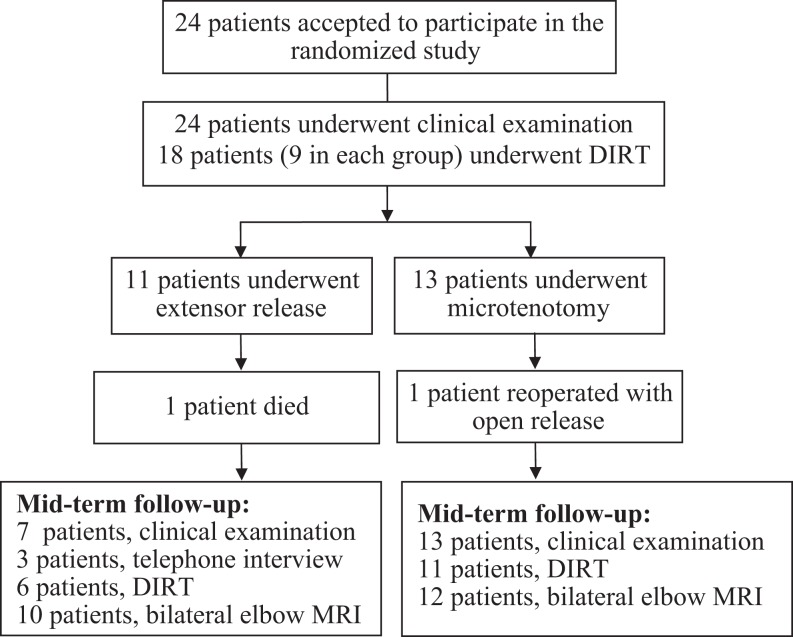
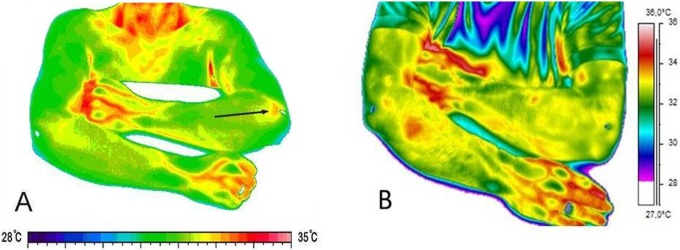
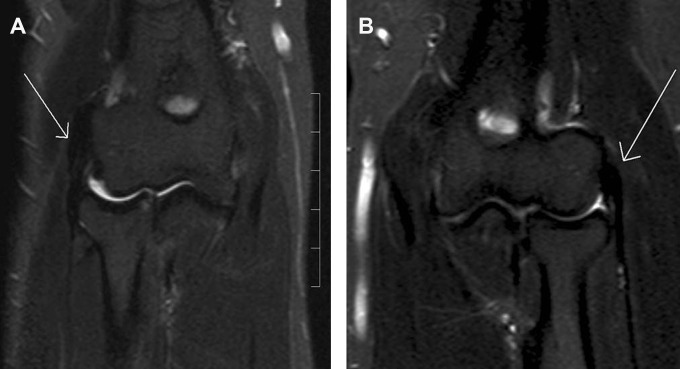
Twenty-four patients randomized to either open release or microtenotomy were assessed after 5 to 7 years. Clinical examination and dynamic infrared thermography (DIRT) of both elbows were performed preoperatively and at the medium-term follow-up. Magnetic resonance imaging (MRI) of both elbows was performed at the medium-term follow-up.
Significant pain reduction was found using a visual analog scale (VAS) at the medium-term follow-up in both groups compared with the preoperative assessment (P < .005). The Mayo Elbow Performance Score (MEPS) increased significantly in both groups (P < .01). The improvement in grip strength was not significant in either group. There was no significant difference between the groups in terms of VAS, strength, and the MEPS. On the DIRT examinations, there were significantly fewer hot spots at the medium-term follow-up than preoperatively (P = .0067, both study groups together). The MRI examinations revealed grade II changes in the operated elbow in 1 patient in each group at the medium-term follow-up, while all the other MRI examinations revealed a normal tendon.
In this prospective, randomized trial with a medium-term follow-up, the results were similar after surgical release and microtenotomy in patients with recalcitrant lateral epicondylitis. The hypothesis was thus verified.
顽固性外上髁炎(肘伸肌起点腱病)是一种常见的肘部疼痛原因,有许多治疗选择。本研究报告了切开松解术和射频微切开术后的中期结果。
微切开术将提供与切开松解术一样好的长期疼痛缓解。
前瞻性、随机试验。
24 例患者随机分为切开松解组或微切开组,5-7 年后进行评估。术前和中期随访时对双侧肘部进行临床检查和动态红外热成像(DIRT)检查。对双侧肘部进行磁共振成像(MRI)检查。
与术前评估相比,两组患者在中期随访时的视觉模拟评分(VAS)均显著降低(P <.005)。两组的 Mayo 肘部功能评分(MEPS)均显著升高(P <.01)。两组握力均无显著改善。两组间 VAS、肌力和 MEPS 无显著差异。在 DIRT 检查中,与术前相比,中期随访时的热点明显减少(P =.0067,两组研究对象均如此)。MRI 检查显示,两组各有 1 例患者在中期随访时手术侧肘部出现 II 级改变,而其余所有 MRI 检查均显示肌腱正常。
在这项前瞻性、随机试验中,中期随访结果显示,顽固性外上髁炎患者行切开松解术和微切开术的效果相似。因此,验证了假设。