• 文献检索
  • 文档翻译
  • 深度研究
  • 学术资讯
  • Suppr Zotero 插件Zotero 插件
  • 邀请有礼
  • 套餐&价格
  • 历史记录
应用&插件
Suppr Zotero 插件Zotero 插件浏览器插件Mac 客户端Windows 客户端微信小程序
定价
高级版会员购买积分包购买API积分包
服务
文献检索文档翻译深度研究API 文档MCP 服务
关于我们
关于 Suppr公司介绍联系我们用户协议隐私条款
关注我们

Suppr 超能文献

核心技术专利:CN118964589B侵权必究
粤ICP备2023148730 号-1Suppr @ 2026

文献检索

告别复杂PubMed语法,用中文像聊天一样搜索,搜遍4000万医学文献。AI智能推荐,让科研检索更轻松。

立即免费搜索

文件翻译

保留排版,准确专业,支持PDF/Word/PPT等文件格式,支持 12+语言互译。

免费翻译文档

深度研究

AI帮你快速写综述,25分钟生成高质量综述,智能提取关键信息,辅助科研写作。

立即免费体验

使用加速度计和全球定位系统对小学生身体活动进行定位

Localization of Physical Activity in Primary School Children Using Accelerometry and Global Positioning System.

作者信息

Bürgi Rahel, Tomatis Laura, Murer Kurt, de Bruin Eling D

机构信息

Department of Health Sciences and Technology, Institute of Human Movement Sciences and Sport, ETH Zurich, Zurich, Switzerland.

出版信息

PLoS One. 2015 Nov 4;10(11):e0142223. doi: 10.1371/journal.pone.0142223. eCollection 2015.

DOI:10.1371/journal.pone.0142223
PMID:26536595
原文链接:https://pmc.ncbi.nlm.nih.gov/articles/PMC4633135/
Abstract

BACKGROUND

Ecological approaches have highlighted the importance of the built environment as a factor affecting physical activity. However, knowledge on children's activity patterns is still incomplete. Particularly, data on the spatial context of physical activity is limited, which limits the potential to design location-based interventions effectively. Using global positioning system (GPS) and accelerometry, this study aimed to identify locations where children engage in moderate-vigorous physical activity (MVPA).

METHODS

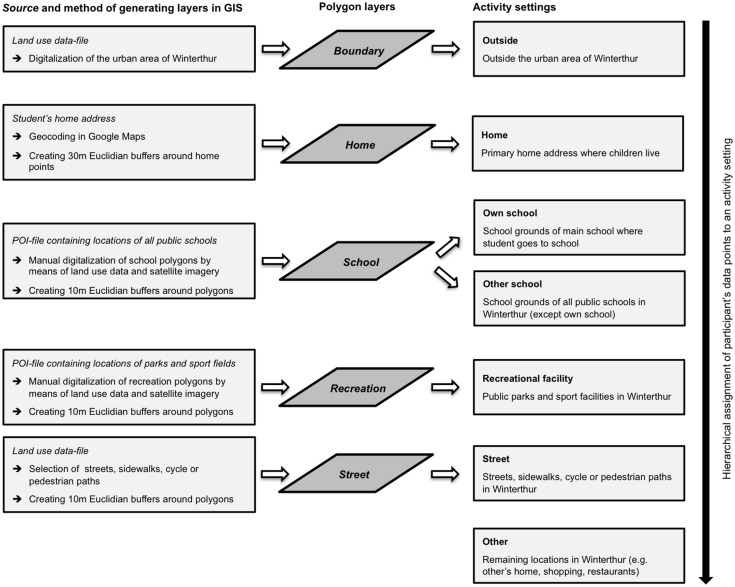
Participants included 119 children (11-14 years, 57% girls) from public schools in Winterthur, Switzerland. During a regular school week between February and April 2013, children wore an accelerometer and GPS sensor for seven consecutive days. Time-matched accelerometer and GPS data was mapped with a geographic information system and each data point was assigned to one of seven defined activity settings. Both the absolute amount of MVPA and proportion of time in MVPA were calculated for every setting. Multilevel analyses accounting for the hierarchical structure of the data were conducted to investigate any gender differences.

RESULTS

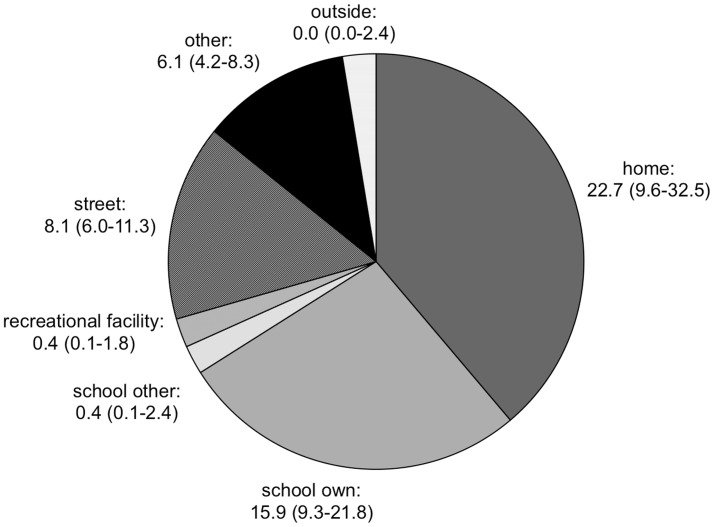
Children achieved most MVPA on streets (34.5%) and on school grounds (33.4%). The proportion children spent in MVPA was highest in recreational facilities (19.4%), at other schools (19.2%) and on streets (18.6%). Boys accumulated significantly more MVPA overall and on other school grounds (p < 0.05) and showed a significantly higher proportion of time in MVPA at own school and outside of Winterthur (p < 0.05).

CONCLUSIONS

The results indicate the importance of streets and school grounds as activity-promoting environments. The high use of streets may be an indicator for active transportation, which appears to contribute to an active lifestyle in both genders. In contrast, the school setting is more likely to encourage physical activity in boys. Recreational facilities seem to be conducive for MVPA among both genders, although infrequently visited during the week of measurement.

摘要

背景

生态学方法强调了建筑环境作为影响身体活动的一个因素的重要性。然而,关于儿童活动模式的知识仍然不完整。特别是,关于身体活动空间背景的数据有限,这限制了有效设计基于位置的干预措施的潜力。本研究使用全球定位系统(GPS)和加速度计,旨在确定儿童进行中等至剧烈身体活动(MVPA)的地点。

方法

参与者包括来自瑞士温特图尔公立学校的119名儿童(11 - 14岁,57%为女孩)。在2013年2月至4月的一个正常上学周期间,儿童连续七天佩戴加速度计和GPS传感器。将时间匹配的加速度计和GPS数据与地理信息系统进行映射,并将每个数据点分配到七个定义的活动环境之一。计算每个环境中MVPA的绝对量和MVPA时间的比例。进行考虑数据层次结构的多水平分析以调查任何性别差异。

结果

儿童在街道上(34.5%)和学校场地(33.4%)进行的MVPA最多。儿童在娱乐设施(19.4%)、其他学校(19.2%)和街道上(18.6%)花费在MVPA上的比例最高。男孩总体上和在其他学校场地积累的MVPA显著更多(p < 0.05),并且在自己学校和温特图尔以外地区在MVPA中花费的时间比例显著更高(p < 0.05)。

结论

结果表明街道和学校场地作为促进活动的环境的重要性。街道的高使用率可能是积极交通的一个指标,这似乎有助于男女形成积极的生活方式。相比之下,学校环境似乎更有可能鼓励男孩进行身体活动。娱乐设施似乎有利于男女双方进行MVPA,尽管在测量周期间很少被光顾。
https://cdn.ncbi.nlm.nih.gov/pmc/blobs/bd7a/4633135/727c1c07bc7c/pone.0142223.g002.jpg
https://cdn.ncbi.nlm.nih.gov/pmc/blobs/bd7a/4633135/720cbb1ada56/pone.0142223.g001.jpg
https://cdn.ncbi.nlm.nih.gov/pmc/blobs/bd7a/4633135/727c1c07bc7c/pone.0142223.g002.jpg
https://cdn.ncbi.nlm.nih.gov/pmc/blobs/bd7a/4633135/720cbb1ada56/pone.0142223.g001.jpg
https://cdn.ncbi.nlm.nih.gov/pmc/blobs/bd7a/4633135/727c1c07bc7c/pone.0142223.g002.jpg

相似文献

1
Localization of Physical Activity in Primary School Children Using Accelerometry and Global Positioning System.使用加速度计和全球定位系统对小学生身体活动进行定位
PLoS One. 2015 Nov 4;10(11):e0142223. doi: 10.1371/journal.pone.0142223. eCollection 2015.
2
Spatial physical activity patterns among primary school children living in neighbourhoods of varying socioeconomic status: a cross-sectional study using accelerometry and Global Positioning System.居住在不同社会经济地位社区的小学生的空间身体活动模式:一项使用加速度计和全球定位系统的横断面研究
BMC Public Health. 2016 Mar 22;16:282. doi: 10.1186/s12889-016-2954-8.
3
Using accelerometers and global positioning system devices to assess gender and age differences in children's school, transport, leisure and home based physical activity.使用加速度计和全球定位系统设备评估儿童在学校、交通、休闲和家庭中的身体活动的性别和年龄差异。
Int J Behav Nutr Phys Act. 2014 Jan 24;11:8. doi: 10.1186/1479-5868-11-8.
4
The physical environment and health-enhancing activity during the school commute: global positioning system, geographical information systems and accelerometry.上学通勤期间的物理环境与增进健康的活动:全球定位系统、地理信息系统和加速度计
Geospat Health. 2014 May;8(2):569-72. doi: 10.4081/gh.2014.46.
5
Schoolyard Characteristics, Physical Activity, and Sedentary Behavior: Combining GPS and Accelerometry.校园环境特征、身体活动与久坐行为:结合全球定位系统和加速度计的研究
J Sch Health. 2016 Dec;86(12):913-921. doi: 10.1111/josh.12459.
6
Neighborhood Places for Preschool Children's Physical Activity: A Mixed-Methods Study Using Global Positioning System, Geographic Information Systems, and Accelerometry Data.社区环境与学龄前儿童身体活动水平:基于 GPS、GIS 和加速度计数据的混合方法研究
J Phys Act Health. 2023 Jun 9;20(8):781-791. doi: 10.1123/jpah.2022-0462. Print 2023 Aug 1.
7
Demographic, physical activity, and route characteristics related to school transportation: an exploratory study.与学校交通相关的人口统计学、身体活动及路线特征:一项探索性研究。
Am J Health Promot. 2014 Jan-Feb;28(3 Suppl):S77-88. doi: 10.4278/ajhp.130430-QUAN-211.
8
Locations of Physical Activity as Assessed by GPS in Young Adolescents.通过全球定位系统评估的青少年身体活动地点
Pediatrics. 2016 Jan;137(1). doi: 10.1542/peds.2015-2430. Epub 2015 Dec 8.
9
Who children spend time with after school: associations with objectively recorded indoor and outdoor physical activity.儿童放学后与谁共度时间:与客观记录的室内和户外活动的关联。
Int J Behav Nutr Phys Act. 2014 Mar 30;11(1):45. doi: 10.1186/1479-5868-11-45.
10
Organizing "Play Streets" during school vacations can increase physical activity and decrease sedentary time in children.在学校假期组织“游戏街道”活动可以增加儿童的身体活动量,并减少他们久坐不动的时间。
Int J Behav Nutr Phys Act. 2015 Feb 13;12:14. doi: 10.1186/s12966-015-0171-y.

引用本文的文献

1
Satellite-Based and Street-View Green Space and Adiposity in US Children.基于卫星和街景的美国儿童绿色空间与肥胖问题
JAMA Netw Open. 2024 Dec 2;7(12):e2449113. doi: 10.1001/jamanetworkopen.2024.49113.
2
Assessing greenspace and cardiovascular health through deep-learning analysis of street-view imagery in a cohort of US children.通过对一组美国儿童的街景图像进行深度学习分析来评估绿地与心血管健康。
Environ Res. 2025 Jan 15;265:120459. doi: 10.1016/j.envres.2024.120459. Epub 2024 Nov 26.
3
The Potential for Bias across GPS-Accelerometer Combined Wear Criteria among Adolescents.

本文引用的文献

1
A framework for using GPS data in physical activity and sedentary behavior studies.一个在身体活动和久坐行为研究中使用GPS数据的框架。
Exerc Sport Sci Rev. 2015 Jan;43(1):48-56. doi: 10.1249/JES.0000000000000035.
2
Combining GPS, GIS, and accelerometry to explore the physical activity and environment relationship in children and young people - a review.结合全球定位系统、地理信息系统和加速度测量法探索儿童和青少年的身体活动与环境关系——综述
Int J Behav Nutr Phys Act. 2014 Sep 13;11:93. doi: 10.1186/s12966-014-0093-0.
3
Barriers for recess physical activity: a gender specific qualitative focus group exploration.
GPS 加速度计联合佩戴标准在青少年中的潜在偏差。
Int J Environ Res Public Health. 2022 May 13;19(10):5931. doi: 10.3390/ijerph19105931.
4
Assessing the Current Integration of Multiple Personalised Wearable Sensors for Environment and Health Monitoring.评估当前多种个人化可穿戴传感器在环境和健康监测中的综合应用。
Sensors (Basel). 2021 Nov 19;21(22):7693. doi: 10.3390/s21227693.
5
Systematic review of the correlates of outdoor play and time among children aged 3-12 years.系统评价 3-12 岁儿童户外活动和时间的相关因素。
Int J Behav Nutr Phys Act. 2021 Mar 18;18(1):41. doi: 10.1186/s12966-021-01097-9.
6
Locations of Physical Activity: Where Are Children, Adolescents, and Adults Physically Active? A Systematic Review.身体活动地点:儿童、青少年和成年人在哪里进行身体活动?系统评价。
Int J Environ Res Public Health. 2021 Jan 30;18(3):1240. doi: 10.3390/ijerph18031240.
7
Levels of Physical Activity during School Hours in Children and Adolescents: A Systematic Review.儿童和青少年在校期间的身体活动水平:系统评价。
Int J Environ Res Public Health. 2020 Jul 2;17(13):4773. doi: 10.3390/ijerph17134773.
8
Methodologies for assessing contextual exposure to the built environment in physical activity studies: A systematic review.评估身体活动研究中建筑环境背景暴露的方法学:系统评价。
Health Place. 2019 Nov;60:102226. doi: 10.1016/j.healthplace.2019.102226. Epub 2019 Nov 29.
9
Evidence synthesis - Where are children and adults physically active and sedentary? - a rapid review of location-based studies.证据综合 - 儿童和成人在哪里进行身体活动和久坐? - 基于位置的研究快速综述。
Health Promot Chronic Dis Prev Can. 2019 Mar;39(3):67-103. doi: 10.24095/hpcdp.39.3.01.
10
Applications of Space Technologies to Global Health: Scoping Review.空间技术在全球健康领域的应用:范围综述
J Med Internet Res. 2018 Jun 27;20(6):e230. doi: 10.2196/jmir.9458.
课间体育活动的障碍:基于性别的定性焦点小组探索
BMC Public Health. 2014 Jun 23;14:639. doi: 10.1186/1471-2458-14-639.
4
Dynamic Accuracy of GPS Receivers for Use in Health Research: A Novel Method to Assess GPS Accuracy in Real-World Settings.用于健康研究的 GPS 接收器的动态精度:一种在真实环境中评估 GPS 精度的新方法。
Front Public Health. 2014 Mar 10;2:21. doi: 10.3389/fpubh.2014.00021. eCollection 2014.
5
Using accelerometers and global positioning system devices to assess gender and age differences in children's school, transport, leisure and home based physical activity.使用加速度计和全球定位系统设备评估儿童在学校、交通、休闲和家庭中的身体活动的性别和年龄差异。
Int J Behav Nutr Phys Act. 2014 Jan 24;11:8. doi: 10.1186/1479-5868-11-8.
6
Reactivity to accelerometer measurement of children and adolescents.儿童和青少年对加速度计测量的反应性。
Med Sci Sports Exerc. 2014 Jun;46(6):1140-6. doi: 10.1249/MSS.0000000000000215.
7
Pediatric adiposity stabilized in Switzerland between 1999 and 2012.1999年至2012年间,瑞士儿童肥胖状况趋于稳定。
Eur J Nutr. 2014 Apr;53(3):865-75. doi: 10.1007/s00394-013-0590-y.
8
Schoolyard physical activity of 6-11 year old children assessed by GPS and accelerometry.基于 GPS 和加速度计评估 6-11 岁儿童的校园体力活动。
Int J Behav Nutr Phys Act. 2013 Aug 14;10:97. doi: 10.1186/1479-5868-10-97.
9
Correlates of physical activity: why are some people physically active and others not?身体活动的相关因素:为什么有些人积极参加身体活动,而有些人不这样做?
Lancet. 2012 Jul 21;380(9838):258-71. doi: 10.1016/S0140-6736(12)60735-1.
10
The global childhood obesity epidemic and the association between socio-economic status and childhood obesity.全球儿童肥胖症流行以及社会经济地位与儿童肥胖症之间的关联。
Int Rev Psychiatry. 2012 Jun;24(3):176-88. doi: 10.3109/09540261.2012.688195.