Woodlief Tracey L, Carnero Elvis A, Standley Robert A, Distefano Giovanna, Anthony Steve J, Dubis Gabe S, Jakicic John M, Houmard Joseph A, Coen Paul M, Goodpaster Bret H
Translational Research Institute for Metabolism and Diabetes, Florida Hospital, Orlando, Florida, USA.
Division of Endocrinology and Metabolism, Department of Medicine, University of Pittsburgh, Pittsburgh, Pennsylvania, USA.
Obesity (Silver Spring). 2015 Dec;23(12):2454-61. doi: 10.1002/oby.21332. Epub 2015 Nov 5.
Roux-en-Y gastric bypass (RYGB) surgery can cause profound weight loss and improve overall cardiometabolic risk factors. Exercise (EX) training following RYGB can provide additional improvements in insulin sensitivity (SI ) and cardiorespiratory fitness. However, it remains unknown whether a specific amount of EX post-RYGB is required to achieve additional benefits.
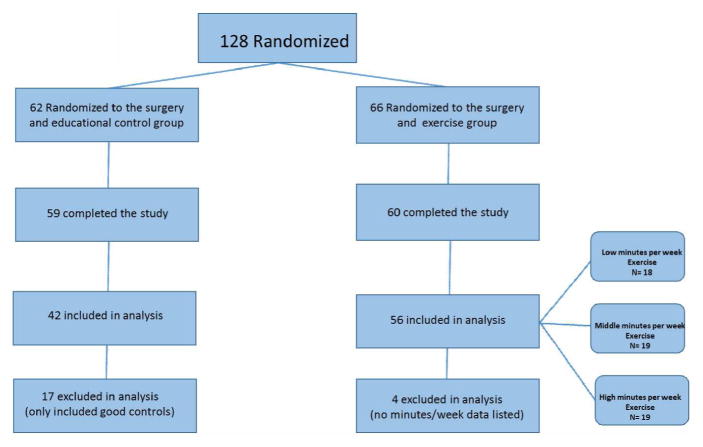
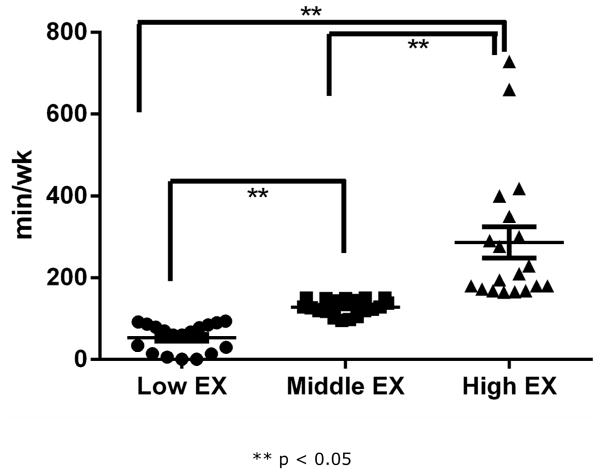
We performed a post hoc analysis of participants who were randomized into either a 6-month structured EX program or a health education control (CON). The EX group (n = 56) was divided into tertiles according to the amount of weekly exercise performed, compared with CON (n = 42): low-EX = 54 ± 8; middle-EX = 129 ± 4; and high-EX = 286 ± 40 min per week.
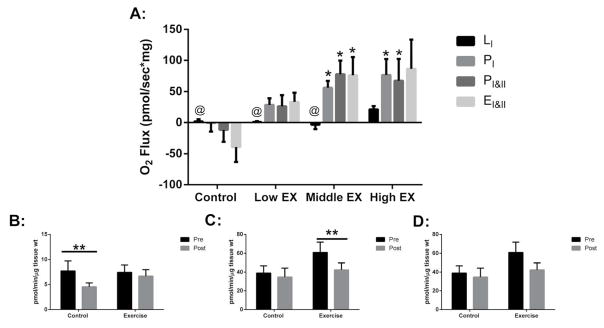
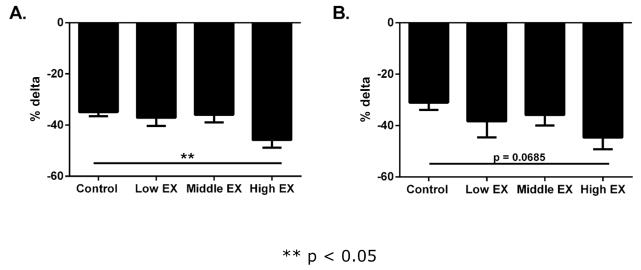
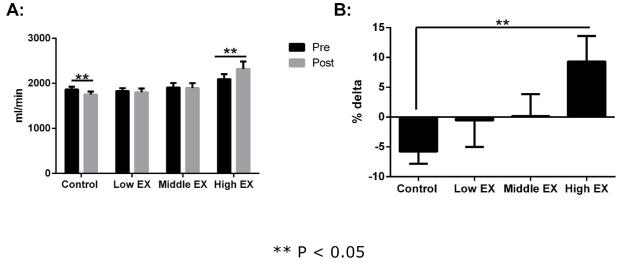
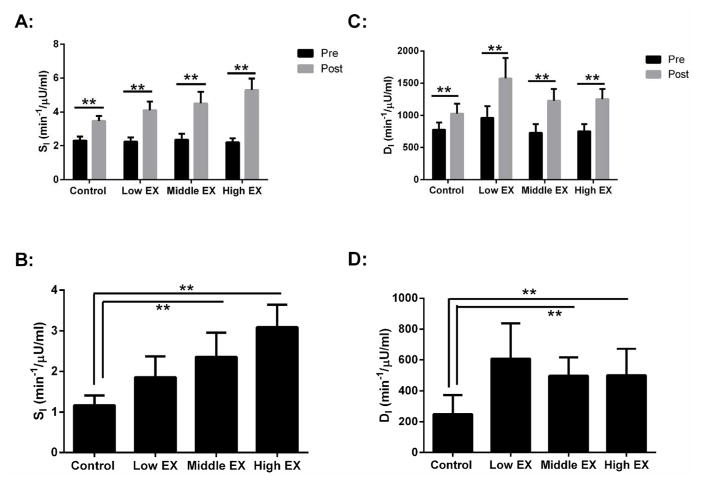
The high-EX lost a significantly greater amount of body weight, total fat mass, and abdominal deep subcutaneous abdominal fat compared with CON (P < 0.005). SI improved to a greater extent in both the middle-EX and high-EX compared with CON (P < 0.04). Physical fitness (VO2 max) significantly improved in the high-EX (9.3% ± 4.2%) compared with CON (-6.0 ± 2.4%) (P < 0.001). Skeletal muscle mitochondrial State 4 (P < 0.002) and 3 (P < 0.04) respiration was significantly higher in the high-EX compared with CON.
A modest volume of structured exercise provides additional improvements in insulin sensitivity following RYGB, but higher volumes of exercise are required to induce additional weight loss, changes in body composition, and improvements in cardiorespiratory fitness and skeletal muscle mitochondrial capacity.
Roux-en-Y胃旁路术(RYGB)可导致显著体重减轻并改善整体心脏代谢危险因素。RYGB术后进行运动(EX)训练可进一步改善胰岛素敏感性(SI)和心肺适能。然而,尚不清楚RYGB术后是否需要特定运动量才能获得额外益处。
我们对随机分为6个月结构化EX计划组或健康教育对照组(CON)的参与者进行了事后分析。EX组(n = 56)根据每周运动量分为三分位数,与CON组(n = 42)比较:低运动量组=54±8;中等运动量组=129±4;高运动量组=每周286±40分钟。
与CON组相比,高运动量组的体重、总脂肪量和腹部深层皮下脂肪量显著减少更多(P < 0.005)。与CON组相比,中等运动量组和高运动量组的SI改善程度更大(P < 0.04)。与CON组(-6.0±2.4%)相比,高运动量组的体能(最大摄氧量)显著改善(9.3%±4.2%)(P < 0.001)。与CON组相比,高运动量组的骨骼肌线粒体状态4(P < 0.002)和状态3(P < 0.04)呼吸显著更高。
适度的结构化运动可在RYGB术后进一步改善胰岛素敏感性,但需要更高的运动量才能诱导额外的体重减轻、身体成分变化以及心肺适能和骨骼肌线粒体能力的改善。