Banu Shahera, Guo Yuming, Hu Wenbiao, Dale Pat, Mackenzie John S, Mengersen Kerrie, Tong Shilu
School of Public Health and Social Work, Queensland University of Technology, Brisbane, QLD 4059, Australia.
School of Population Health, University of Queensland, Brisbane, QLD 4006, Australia.
Sci Rep. 2015 Nov 5;5:16105. doi: 10.1038/srep16105.
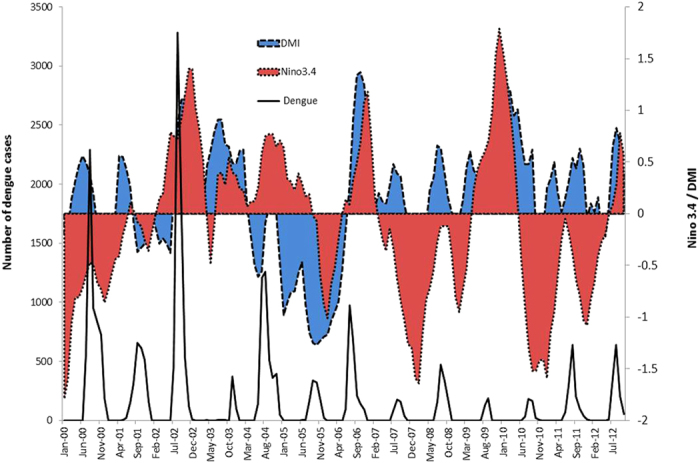
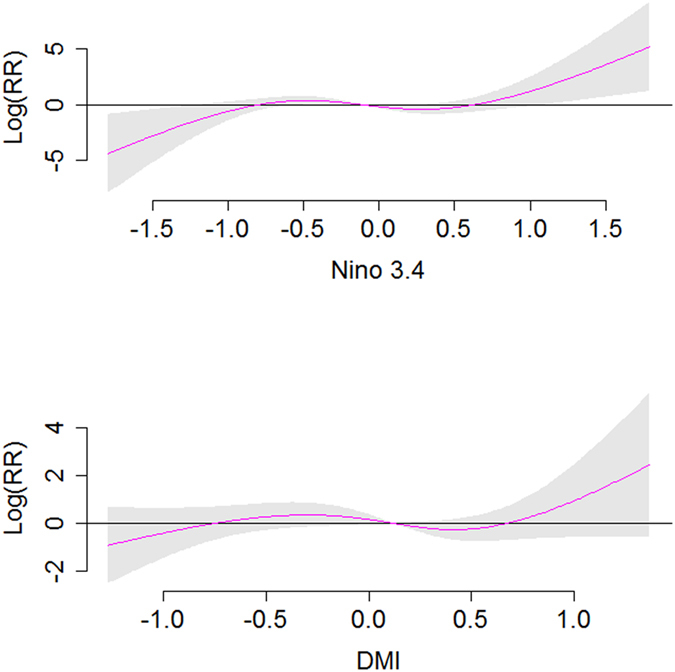
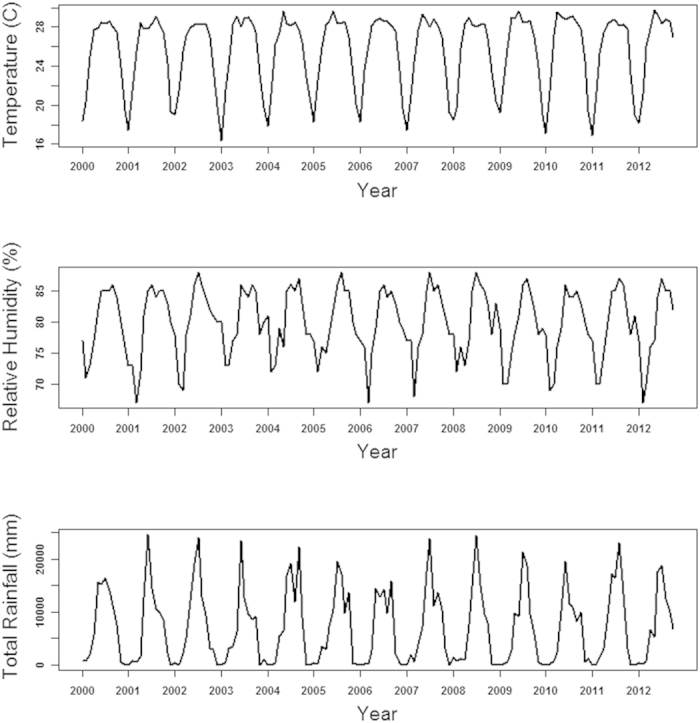
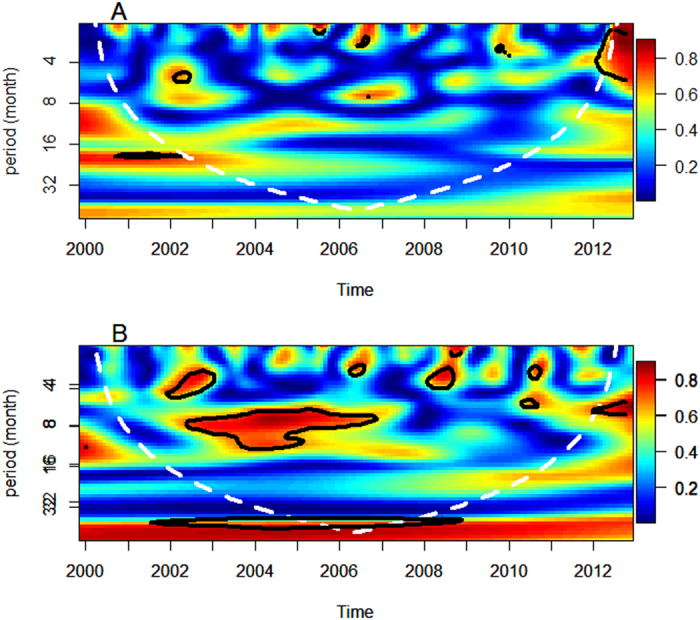
Dengue dynamics are driven by complex interactions between hosts, vectors and viruses that are influenced by environmental and climatic factors. Several studies examined the role of El Niño Southern Oscillation (ENSO) in dengue incidence. However, the role of Indian Ocean Dipole (IOD), a coupled ocean atmosphere phenomenon in the Indian Ocean, which controls the summer monsoon rainfall in the Indian region, remains unexplored. Here, we examined the effects of ENSO and IOD on dengue incidence in Bangladesh. According to the wavelet coherence analysis, there was a very weak association between ENSO, IOD and dengue incidence, but a highly significant coherence between dengue incidence and local climate variables (temperature and rainfall). However, a distributed lag nonlinear model (DLNM) revealed that the association between dengue incidence and ENSO or IOD were comparatively stronger after adjustment for local climate variables, seasonality and trend. The estimated effects were nonlinear for both ENSO and IOD with higher relative risks at higher ENSO and IOD. The weak association between ENSO, IOD and dengue incidence might be driven by the stronger effects of local climate variables such as temperature and rainfall. Further research is required to disentangle these effects.
登革热的动态变化是由宿主、病媒和病毒之间复杂的相互作用驱动的,而这些相互作用又受到环境和气候因素的影响。多项研究探讨了厄尔尼诺-南方涛动(ENSO)在登革热发病率中的作用。然而,印度洋偶极(IOD)这一控制印度地区夏季季风降雨的印度洋海洋-大气耦合现象的作用仍未得到探索。在此,我们研究了ENSO和IOD对孟加拉国登革热发病率的影响。根据小波相干分析,ENSO、IOD与登革热发病率之间的关联非常微弱,但登革热发病率与当地气候变量(温度和降雨)之间存在高度显著的相干性。然而,分布滞后非线性模型(DLNM)显示,在对当地气候变量、季节性和趋势进行调整后,登革热发病率与ENSO或IOD之间的关联相对更强。对于ENSO和IOD,估计效应均为非线性,在较高的ENSO和IOD水平下相对风险更高。ENSO、IOD与登革热发病率之间的微弱关联可能是由温度和降雨等当地气候变量的更强效应驱动的。需要进一步的研究来厘清这些影响。