Hogan Michael J, O'Hora Denis, Kiefer Markus, Kubesch Sabine, Kilmartin Liam, Collins Peter, Dimitrova Julia
School of Psychology, NUI Galway, Ireland.
Department of Psychiatry, University of Ulm Ulm, Germany.
Front Hum Neurosci. 2015 Oct 19;9:538. doi: 10.3389/fnhum.2015.00538. eCollection 2015.
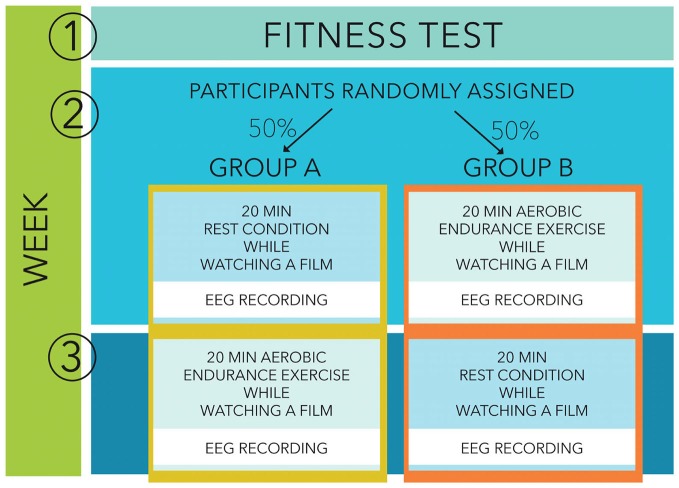
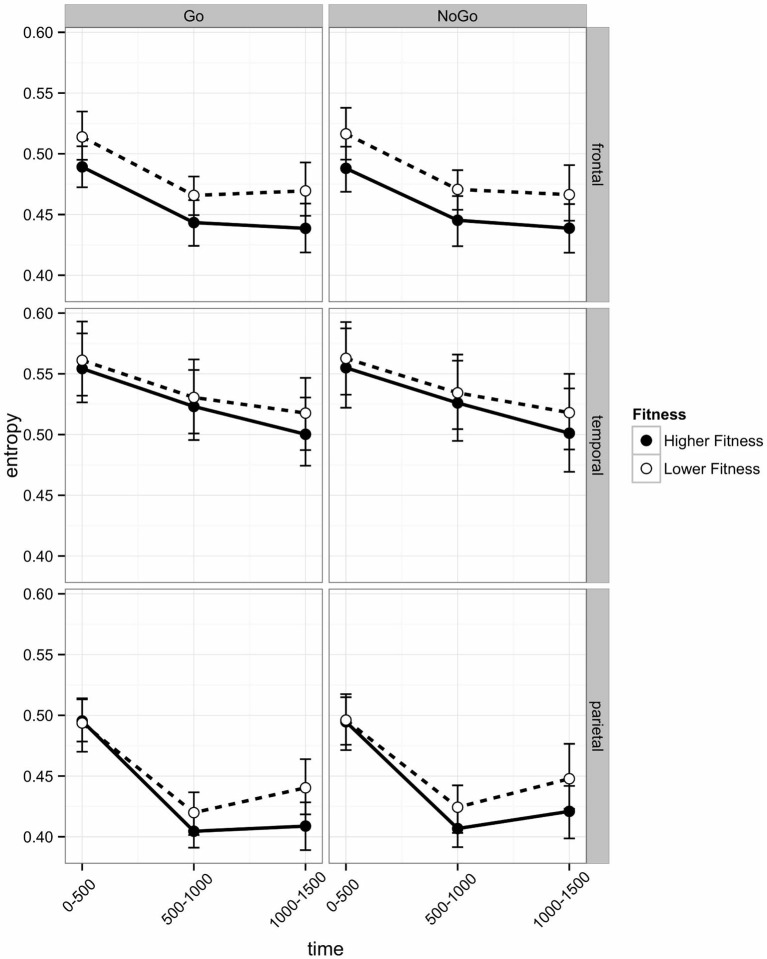
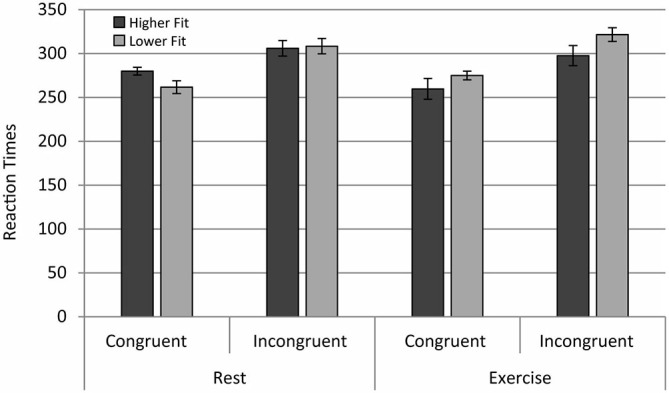
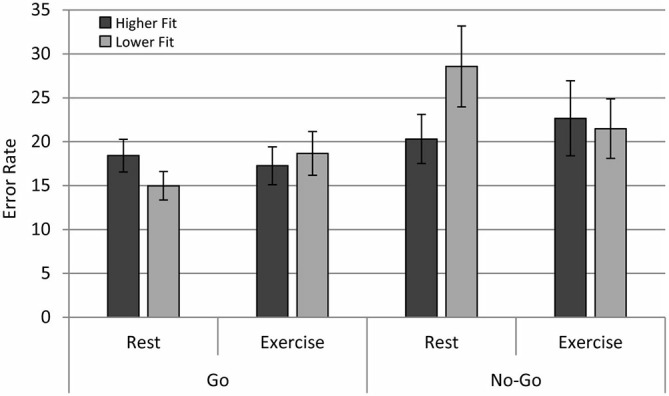
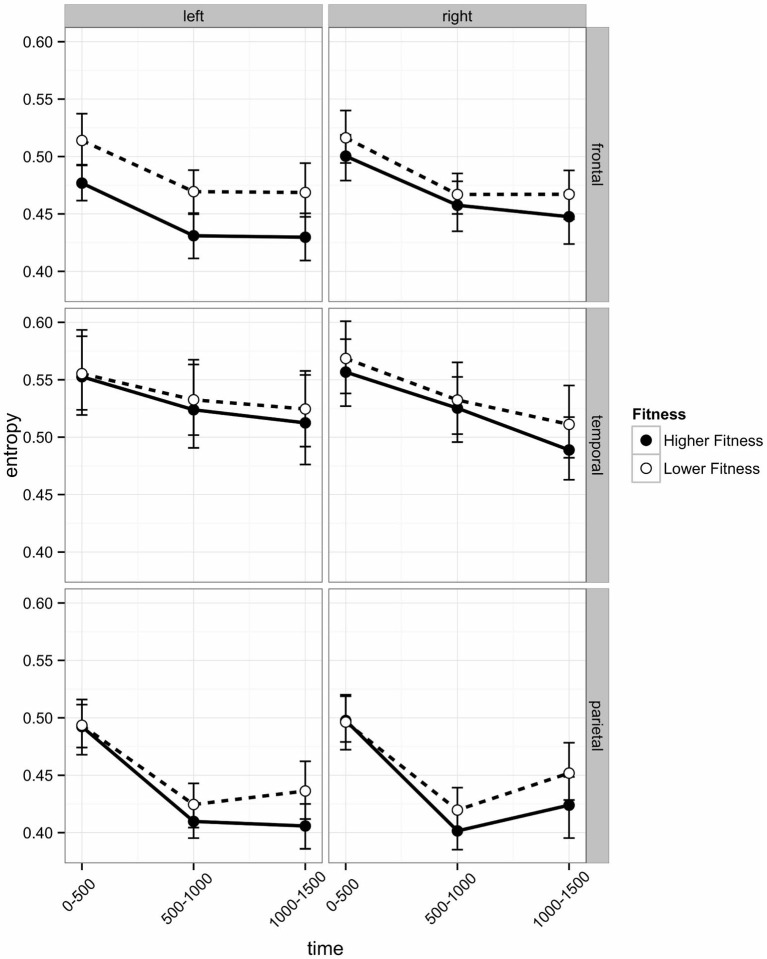
The current study examined the effects of cardiorespiratory fitness, identified with a continuous graded cycle ergometry, and aerobic exercise on cognitive functioning and entropy of the electroencephalogram (EEG) in 30 adolescents between the ages of 13 and 14 years. Higher and lower fit participants performed an executive function task after a bout of acute exercise and after rest while watching a film. EEG entropy, using the sample entropy measure, was repeatedly measured during the 1500 ms post-stimulus interval to evaluate changes in entropy over time. Analysis of the behavioral data for lower and higher fit groups revealed an interaction between fitness levels and acute physical exercise. Notably, lower fit, but not higher fit, participants had higher error rates (ER) for No Go relative to Go trials in the rest condition, whereas in the acute exercise condition there were no differences in ER between groups; higher fit participants also had significantly faster reaction times in the exercise condition in comparison with the rest condition. Analysis of EEG data revealed that higher fit participants demonstrated lower entropy post-stimulus than lower fit participants in the left frontal hemisphere, possibly indicating increased efficiency of early stage stimulus processing and more efficient allocation of cognitive resources to the task demands. The results suggest that EEG entropy is sensitive to stimulus processing demands and varies as a function of physical fitness levels, but not acute exercise. Physical fitness, in turn, may enhance cognition in adolescence by facilitating higher functionality of the attentional system in the context of lower levels of frontal EEG entropy.
本研究调查了通过连续递增式自行车测功法确定的心肺适能以及有氧运动对30名13至14岁青少年认知功能和脑电图(EEG)熵的影响。体能较高和较低的参与者在一次急性运动后以及休息时观看电影后执行了一项执行功能任务。在刺激后1500毫秒的时间间隔内,使用样本熵测量法反复测量EEG熵,以评估熵随时间的变化。对体能较低和较高组的行为数据进行分析后发现,体能水平与急性体育锻炼之间存在交互作用。值得注意的是,在休息状态下,体能较低而非较高的参与者在“否”试验相对于“是”试验中的错误率(ER)更高,而在急性运动状态下,两组之间的ER没有差异;与休息状态相比,体能较高的参与者在运动状态下的反应时间也明显更快。对EEG数据的分析表明,体能较高的参与者在刺激后左额叶半球的熵低于体能较低的参与者,这可能表明早期刺激处理效率提高,并且能够更有效地将认知资源分配到任务需求中。结果表明,EEG熵对刺激处理需求敏感,并且会随体能水平而变化,但不受急性运动的影响。反过来,体能可能通过在较低的额叶EEG熵水平下促进注意力系统的更高功能来增强青少年的认知能力。