Nebel Mary Beth, Eloyan Ani, Nettles Carrie A, Sweeney Kristie L, Ament Katarina, Ward Rebecca E, Choe Ann S, Barber Anita D, Pekar James J, Mostofsky Stewart H
Center for Neurodevelopmental and Imaging Research, Kennedy Krieger Institute, Baltimore, Maryland; Department of Neurology, Johns Hopkins University School of Medicine, Baltimore, Maryland.
Department of Biostatistics, School of Public Health, Brown University, Providence, Rhode Island.
Biol Psychiatry. 2016 Apr 15;79(8):633-41. doi: 10.1016/j.biopsych.2015.08.029. Epub 2015 Sep 3.
Imitation, which is impaired in children with autism spectrum disorder (ASD) and critically depends on the integration of visual input with motor output, likely impacts both motor and social skill acquisition in children with ASD; however, it is unclear what brain mechanisms contribute to this impairment. Children with ASD also exhibit what appears to be an ASD-specific bias against using visual feedback during motor learning. Does the temporal congruity of intrinsic activity, or functional connectivity, between motor and visual brain regions contribute to ASD-associated deficits in imitation, motor, and social skills?
We acquired resting-state functional magnetic resonance imaging scans from 100 8- to 12-year-old children (50 ASD). Group independent component analysis was used to estimate functional connectivity between visual and motor systems. Brain-behavior relationships were assessed by regressing functional connectivity measures with social deficit severity, imitation, and gesture performance scores.
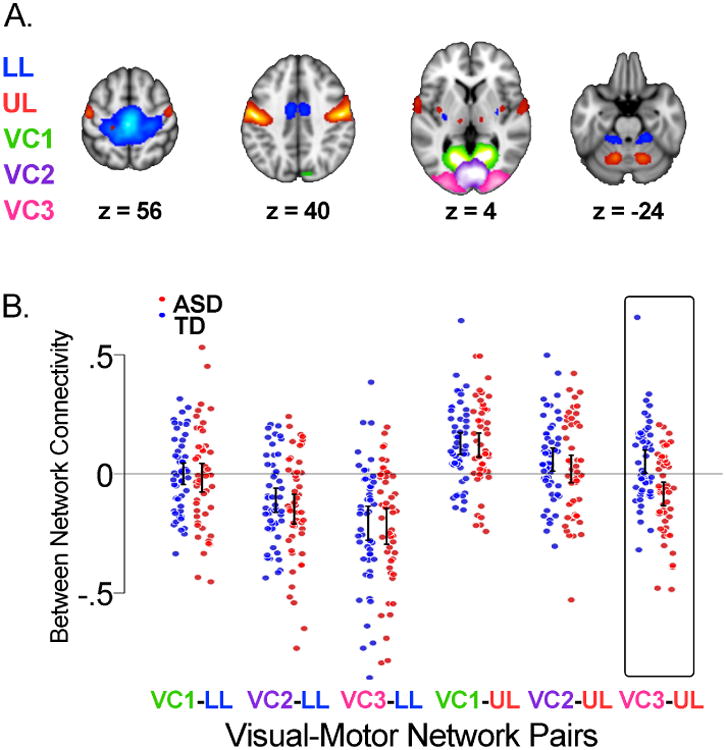
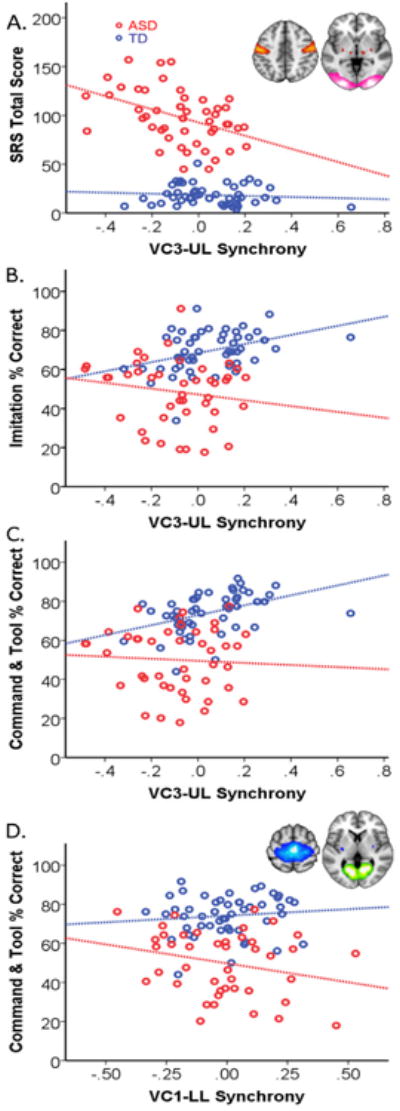
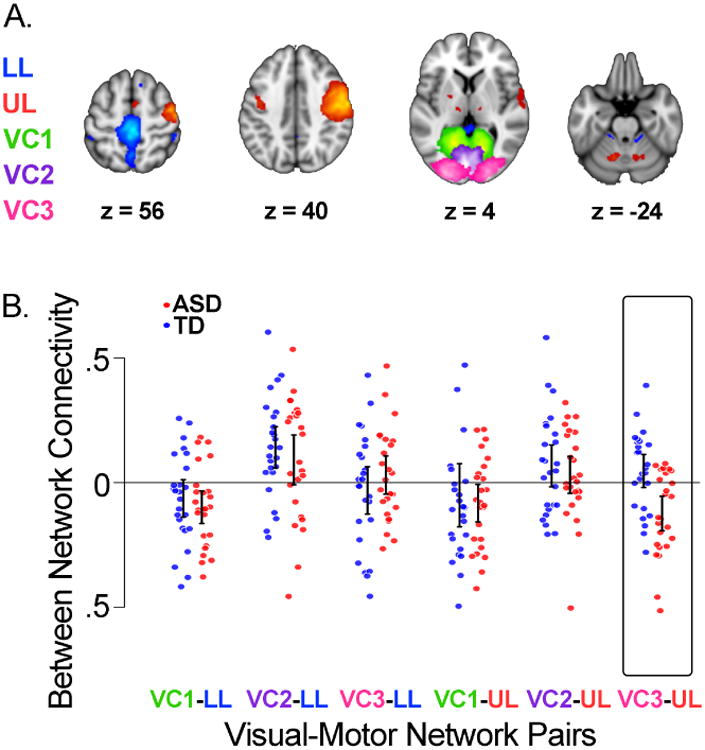
We observed increased intrinsic asynchrony between visual and motor systems in children with ASD and replicated this finding in an independent sample from the Autism Brain Imaging Data Exchange. Moreover, children with more out-of-sync intrinsic visual-motor activity displayed more severe autistic traits, while children with greater intrinsic visual-motor synchrony were better imitators.
Our twice replicated findings confirm that visual-motor functional connectivity is disrupted in ASD. Furthermore, the observed temporal incongruity between visual and motor systems, which may reflect diminished integration of visual consequences with motor output, was predictive of the severity of social deficits and may contribute to impaired social-communicative skill development in children with ASD.
模仿能力在自闭症谱系障碍(ASD)儿童中受损,且严重依赖视觉输入与运动输出的整合,这可能会影响ASD儿童运动和社交技能的习得;然而,尚不清楚哪些脑机制导致了这种损伤。ASD儿童在运动学习过程中还表现出一种似乎是ASD特有的对使用视觉反馈的偏见。运动和视觉脑区之间内在活动的时间一致性或功能连接性是否会导致ASD相关的模仿、运动和社交技能缺陷?
我们对100名8至12岁儿童(50名ASD儿童)进行了静息态功能磁共振成像扫描。采用组独立成分分析来估计视觉和运动系统之间的功能连接性。通过将功能连接性测量值与社会缺陷严重程度、模仿和手势表现得分进行回归分析,评估脑-行为关系。
我们观察到ASD儿童视觉和运动系统之间的内在异步性增加,并在来自自闭症脑成像数据交换的独立样本中重复了这一发现。此外,内在视觉-运动活动不同步程度越高的儿童,自闭症特征越严重,而内在视觉-运动同步性越高的儿童模仿能力越好。
我们两次重复的研究结果证实,ASD患者的视觉-运动功能连接性受到破坏。此外,观察到的视觉和运动系统之间的时间不一致性,可能反映了视觉结果与运动输出的整合减少,这预示着社会缺陷的严重程度,并可能导致ASD儿童社会交往技能发展受损。